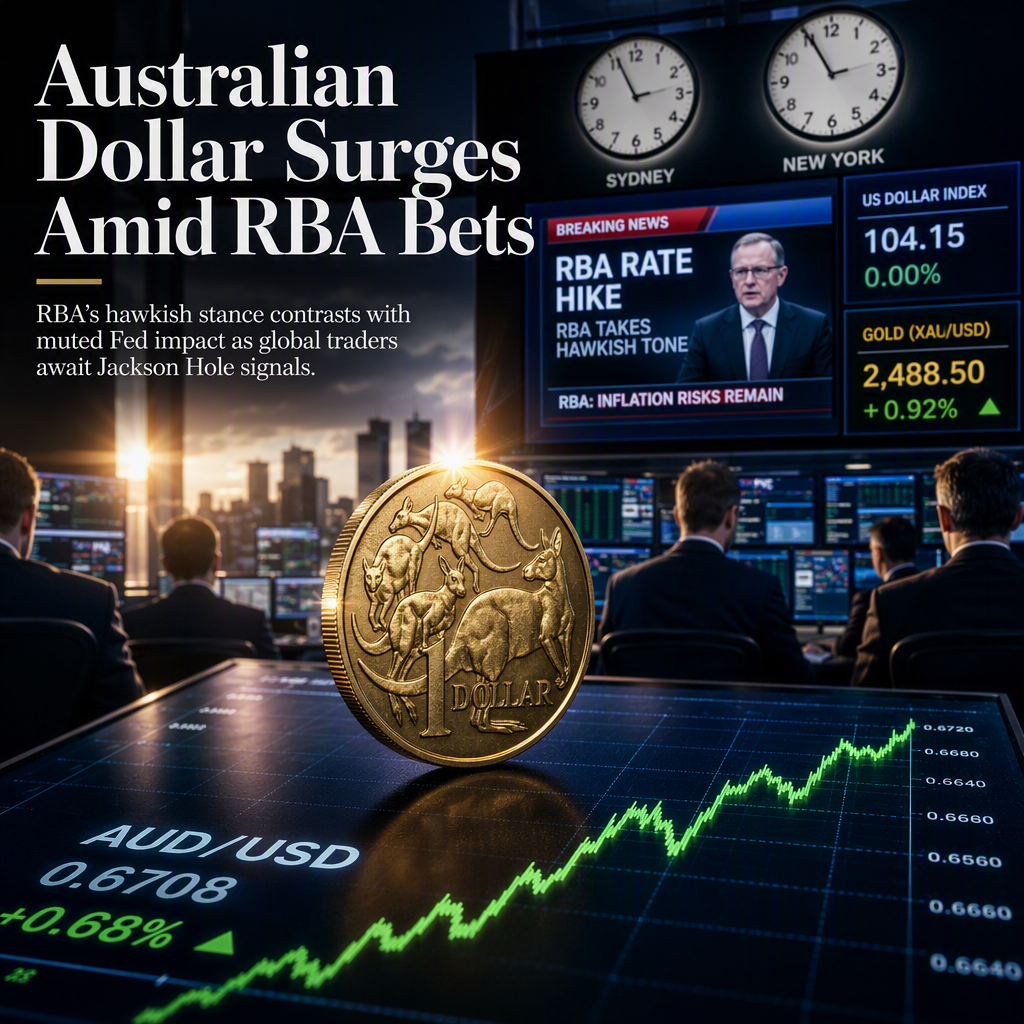
The Australian Dollar (AUD) outperformed major peers on Thursday, buoyed by a hawkish outlook for the Reserve Bank of Australia (RBA) following stronger-than-expected inflation data released on Wednesday [1]. This data reinforced expectations that the RBA could raise interest rates as soon as September, with three of Australia’s four major banks now forecasting another hike this year: NAB expects a 25-basis-point increase in September, while Commonwealth Bank and ANZ anticipate a move in November; Westpac expects rates to remain unchanged [1]. The RBA had left the cash rate at 4.35% at its August meeting after three increases earlier in the year, warning that inflation is likely to stay elevated, particularly due to higher oil prices amid Middle East tensions [1].
Meanwhile, the US Dollar Index (DXY) remained steady, trading just above 99.00 and showing little reaction to hawkish speeches from Federal Reserve officials at the Jackson Hole Symposium [3][4]. Cleveland Fed President Beth Hammack stated that policy restrictiveness is still needed, expecting slow progress on inflation, which she projects will end the year around 3% and may ease to 2.5% next year [2]. Other Fed officials echoed concerns about persistent inflation, but the market reaction was muted, with the DXY at 99.14 and money markets pricing a 68% chance the Fed will hold rates unchanged at the September 16 meeting, though a 72% chance of a hike in December remains [4].
Despite hawkish Fed commentary, US Treasury yields fell and gold prices edged higher, with XAU/USD up 0.25% to $4,610 [4]. The US jobless claims report showed a decrease from 207K to 203K, below forecasts, indicating a strong labor market, while the US trade deficit widened from $102.1 billion to $118.8 billion in July [4]. The US Dollar was strongest against the British Pound on the day, but lost ground to the Australian Dollar, which gained 0.37% against the USD [5].
Looking ahead, traders are focused on Fed Chair Kevin Warsh’s upcoming speech at Jackson Hole, which could provide further clues on the Fed’s interest rate outlook and serve as the next catalyst for AUD/USD [1][4]. Additionally, market participants are watching for the preliminary Nonfarm Payrolls benchmark revision and University of Michigan Consumer Sentiment data on Friday [1][4]. Diverging policy expectations between the RBA and Fed are likely to keep the Australian Dollar supported in the near term [1].
CONCLUSION
The Australian Dollar's rally is underpinned by rising expectations of further RBA rate hikes, contrasting with a US Dollar that remains subdued despite hawkish Fed rhetoric. Market participants are awaiting key speeches and data releases for further direction, with policy divergence likely to support the AUD in the short term.