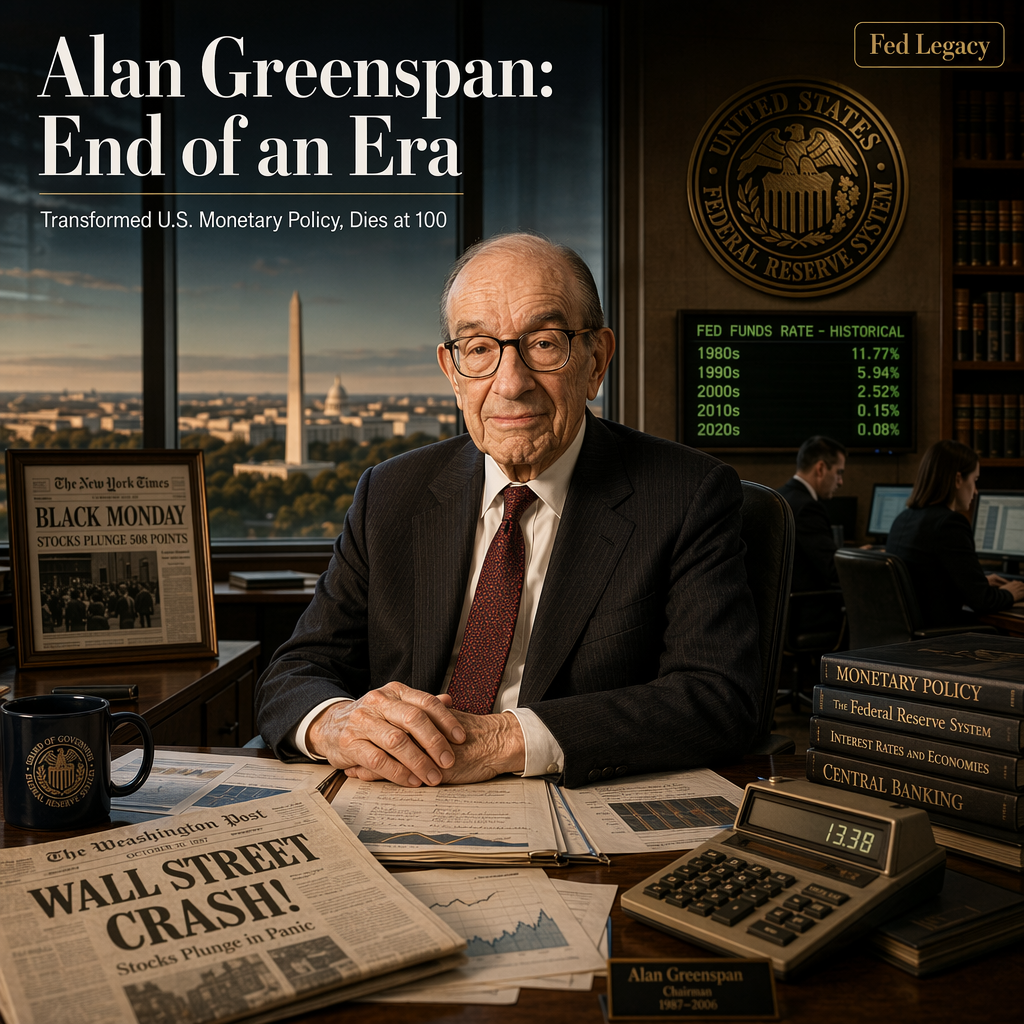
Alan Greenspan, who served as U.S. Federal Reserve chairman from August 1987 to January 2006, died at age 100 on Monday due to complications from Parkinson’s Disease, according to NBC News and his wife Andrea Mitchell [1][2]. Greenspan's tenure was marked by significant influence over the U.S. economy, including overseeing the second-longest economic expansion in U.S. history, with uninterrupted growth from March 1991 to March 2001 [1]. He was praised for his response to the Black Monday stock market crash in October 1987, acting quickly to expand bank reserves and lower the Fed funds rate, which stabilized financial markets [1][2].
Greenspan fundamentally changed the Fed’s approach to monetary policy, moving away from Volcker’s monetarism and control of the M2 money supply to a system of data dependence and Fed funds targeting [2]. He was known for using unconventional data sources, such as rail car loadings and commodity price indices, to inform his decisions [2]. Under his leadership, the Fed became a reliable provider of emergency liquidity, a practice dubbed the "Greenspan put," which was evident during market crises in 1987, 1998, and 2000 [2].
Greenspan's era was also marked by his prescient judgment that a productivity surge in the mid-1990s would keep inflation contained, a view still referenced by policymakers like Jerome Powell [1]. However, his reputation suffered after the housing price bubble burst during his final years in office, leading to the 2007-2009 financial crisis. Critics argued that his policies fueled asset price bubbles, though some, like former Fed official Stephen Oliner, suggested both the praise and criticism he received were not fully deserved [1].
Greenspan nearly doubled the Fed’s Washington DC staff to over 3,000 and participated actively in international banking standards, including the Basel accords [2]. He cautioned Wall Street in 1996 with the phrase "irrational exuberance," but investors remained optimistic until the dot-com crash in 2000 [2]. His philosophy on asset bubbles evolved, and by 1999 he told Congress that it was the job of policymakers to mitigate fallout and ease transitions to new expansions [2].
CONCLUSION
Alan Greenspan's passing marks the end of an era for the Federal Reserve, with his legacy defined by both economic expansion and controversy over asset bubbles. His innovative approach to monetary policy and crisis management shaped modern central banking, but the aftermath of his tenure continues to influence debates on financial regulation and economic stability. The market impact is medium, reflecting both respect for his achievements and ongoing scrutiny of his policies.