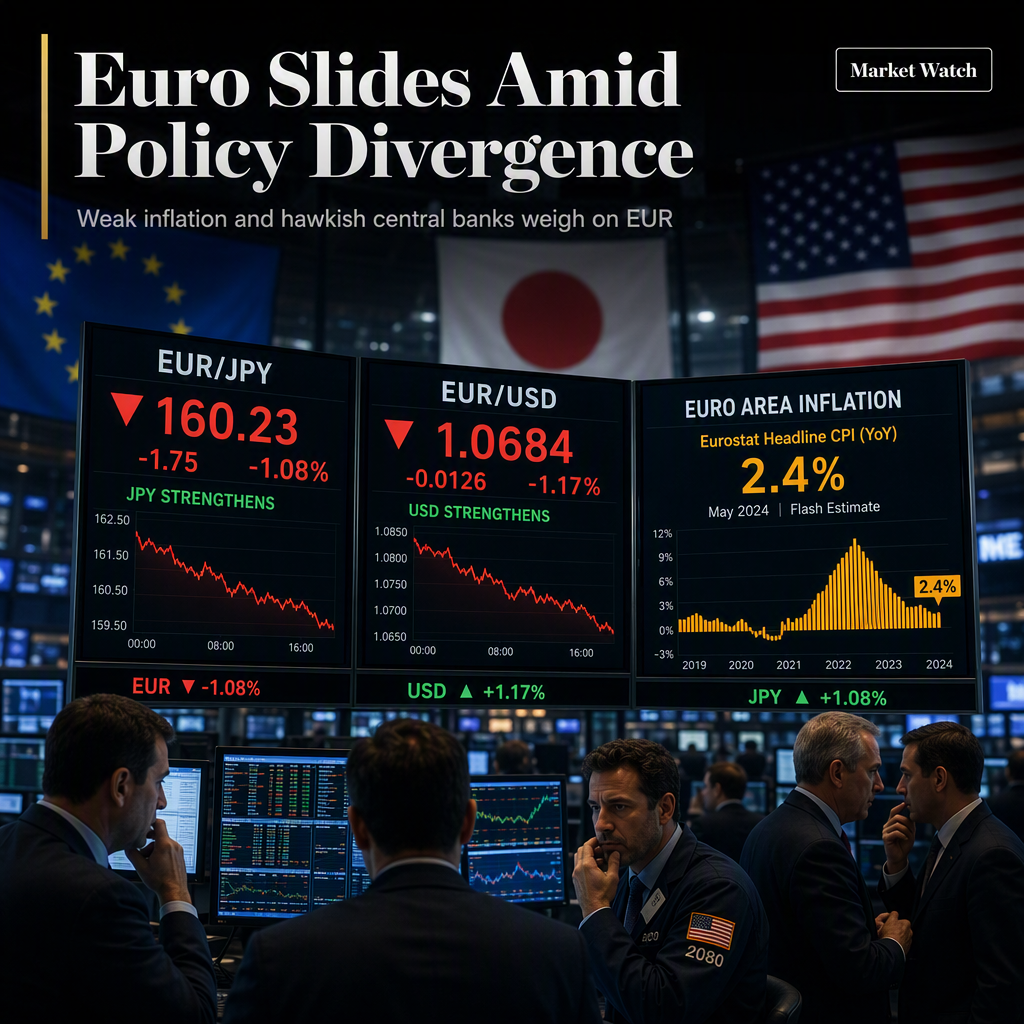
The Euro (EUR) experienced notable declines against both the Japanese Yen (JPY) and the US Dollar (USD) on Thursday, driven by central bank policy expectations and revised inflation data. EUR/JPY fell 0.25%, trading around 178.70 and breaking a three-day winning streak, as investors anticipated a potential 25 basis point rate hike from the Bank of Japan (BoJ) at Friday's meeting. This prospect strengthened the Yen, with Japanese officials maintaining a cautious tone ahead of the decision. Economy Minister Minoru Kiuchi emphasized the government's aim to balance economic strength with fiscal sustainability, while Finance Minister Satsuki Katayama underscored the importance of managing debt issuance and maintaining market confidence, expecting the BoJ to conduct monetary policy appropriately to achieve its 2% inflation target in a stable manner [1].
Meanwhile, the Euro languished at one-and-a-half-month lows against the US Dollar, trading flat at 1.1475 after depreciating more than 1% during the week. This followed the Federal Reserve's (Fed) quarter-point rate hike—the first in three years—which met market expectations but was accompanied by a surprisingly hawkish tone from Chairman Kevin Warsh. Warsh stated that "inflation remains elevated" and "the economy appears to be strengthening," signaling further rate hikes may be forthcoming. These comments boosted the USD against its main peers and restored confidence in the Fed's independence [2].
On the inflation front, Eurostat revised down August's Harmonized Index of Consumer Prices (HICP) to a 3.2% year-over-year increase from the previous 3.3% estimate, with monthly inflation confirmed at 0.4%. Core HICP was confirmed at 0.2% monthly growth and 2.4% year-over-year, maintaining pressure on the European Central Bank (ECB) to continue tightening interest rates [1][2]. The latest inflation data provided little support to the Euro, highlighting stable underlying price pressures and reinforcing the monetary policy divergence between Europe and Japan [1].
Analysts at ING see downside risks for the Euro, citing the hawkish Fed and higher oil prices. Their model now shows a short-term fair value for EUR/USD at 1.150, 1% lower than a week ago, and warn that further moves in front-end rates, oil, or global equities could push fair value lower. ING also notes that there is little, especially eurozone-born, outside of a correction in energy prices, likely to reverse the Euro's downward trend at this stage [2].
CONCLUSION
The Euro's decline against both the Yen and Dollar reflects diverging central bank policies and subdued inflation data, with market sentiment skewed negative. Expectations of further tightening by the BoJ and Fed, combined with limited support from Eurozone inflation figures, suggest continued downside risk for the Euro in the near term. Analysts caution that external factors such as oil prices and global equities could further impact the Euro's fair value.