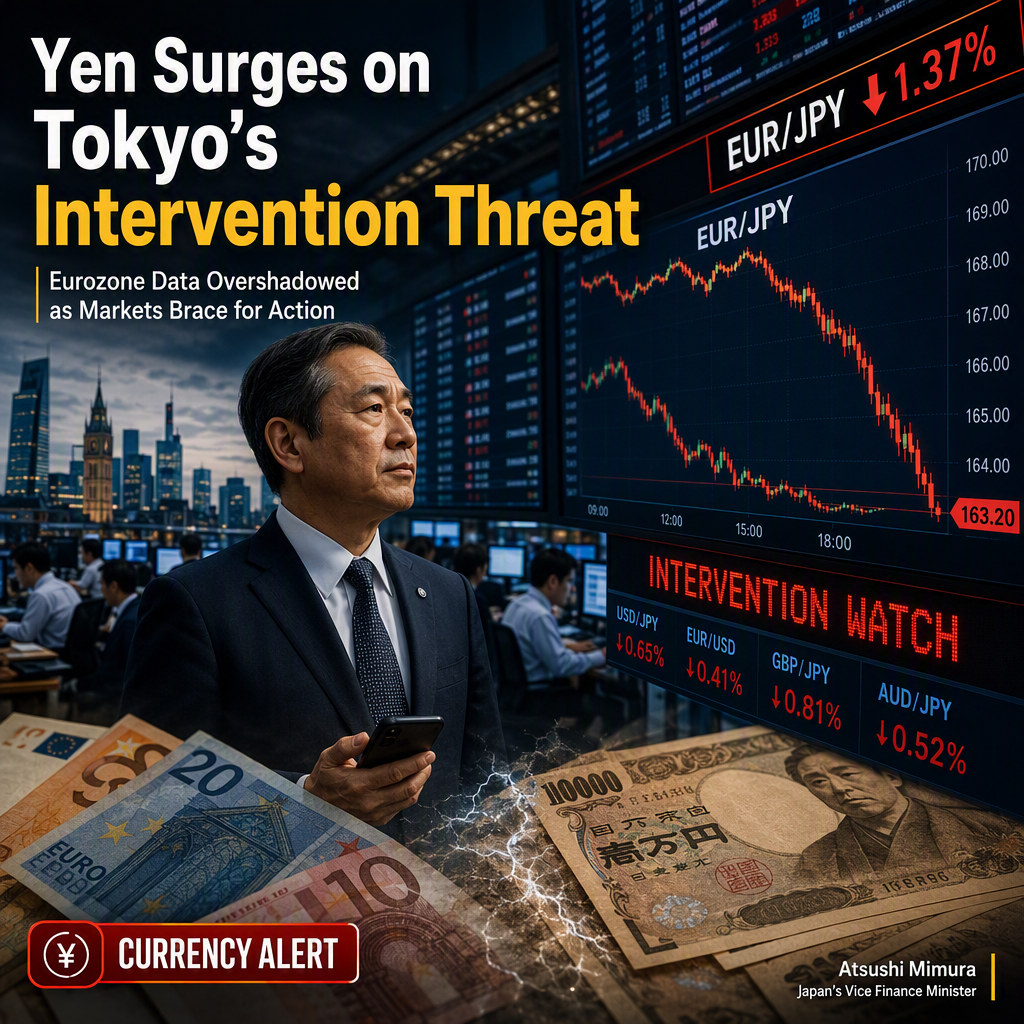
On Thursday, the Japanese Yen (JPY) strengthened sharply against the Euro (EUR), with EUR/JPY falling to around 181.40, marking a 1.37% decline on the day [1]. This move was driven by renewed warnings from Japanese authorities regarding potential intervention in the foreign exchange market. Atsushi Mimura, Japan’s top currency diplomat, reiterated that authorities remain ready to act in the forex market, stating, 'We continue to stand ready on forex,' but declined to comment on whether recent rate checks had been conducted—a practice that can precede intervention. Mimura also expressed dissatisfaction with current market conditions, keeping the threat of intervention alive and supporting the Yen, though no confirmation of concrete action was provided [1].
On the European side, economic data offered limited support to the Euro. The Eurozone HCOB Services Purchasing Managers Index (PMI) was revised down to 51.7 in August from the preliminary estimate of 51.8, while the Composite PMI was lowered to 52.0 from 52.1. Both indicators remain above the 50 threshold, signaling expansion, but divergences among major economies persist. Germany’s Services PMI was revised higher to 49.7 from 48.5 but stayed below the expansion threshold, while France’s index was revised down to 48.0 from 48.4. In contrast, Italy and Spain reported stronger readings of 55.2 and 57.8, respectively [1].
The Eurozone Producer Price Index (PPI) indicated accelerating factory-gate price pressures, with producer prices rising 1.6% month-on-month in July after contracting 0.3% in June, surpassing expectations for a 1.2% increase. On an annual basis, PPI rose 5.8%, up from 4.6% previously [1]. Despite these persistent upstream price pressures and mixed activity indicators, the sharp appreciation of the Yen and intervention warnings from Tokyo dominated EUR/JPY trading, relegating European economic data to the background [1].
In terms of daily performance, the Euro was the strongest against the US Dollar, up 0.11%, but weakened against the Yen, down 1.38% [1].
CONCLUSION
The Japanese Yen's surge against the Euro was primarily driven by intervention threats from Japanese authorities, overshadowing mixed Eurozone economic data. Market sentiment remains cautious, with the possibility of further action from Tokyo keeping traders alert. The immediate impact is high, as intervention rhetoric continues to influence currency movements.