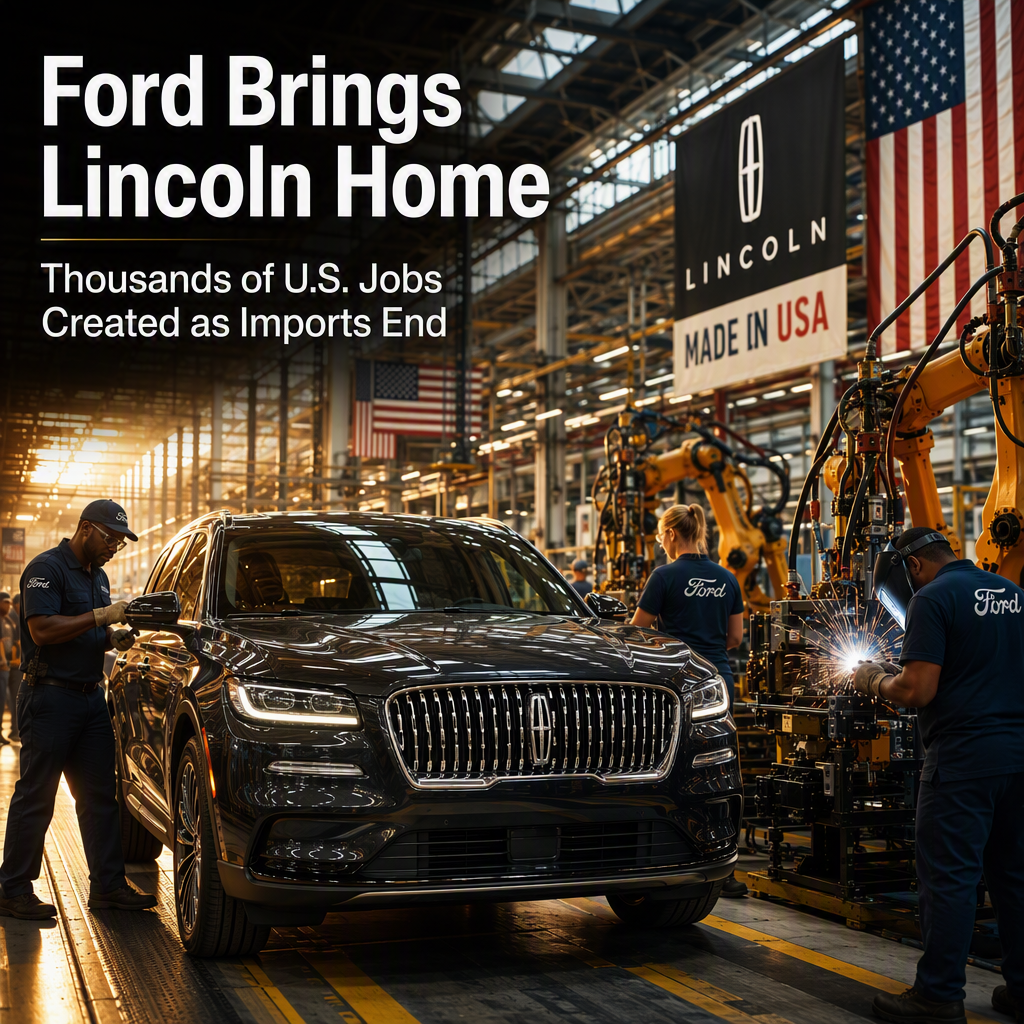
Ford is set to significantly expand its U.S. manufacturing operations by increasing domestic production of Lincoln vehicles, a move that will phase out imports from China for American customers beginning in 2030 [1]. Commerce Secretary Howard Lutnick highlighted this initiative as part of the Trump administration's broader push to bolster domestic manufacturing, citing Ford as a key example of companies responding to auto tariffs by bringing production back to the United States [1].
The company expects this expansion to generate 'thousands of direct and indirect U.S. jobs,' though it has not disclosed specific investment amounts or identified which plants will receive the new production lines [1]. Currently, Lincoln’s U.S. lineup includes the China-built Nautilus, but Ford has not confirmed whether Nautilus production will shift to the U.S. or which other China-imported vehicles will be affected by the plan [1].
Ford already maintains a substantial U.S. manufacturing presence, having assembled more than 2 million vehicles domestically in 2025 and employing approximately 56,300 hourly manufacturing workers in the country [1]. Lutnick emphasized that tariffs are a driving force behind this reshoring of jobs, stating, 'Thousands of jobs, thousands and thousands of jobs coming back to America because of these tariffs on automotives' [1].
Looking ahead, Lutnick stressed the importance of preparing the workforce for increasingly automated and high-tech manufacturing roles, noting the administration's commitment to building advanced manufacturing capacity within the United States [1].
CONCLUSION
Ford's decision to expand U.S. Lincoln production and end China imports is expected to create thousands of jobs and strengthen the company's domestic manufacturing base. The move underscores the impact of tariffs and policy incentives on reshoring industrial activity, with significant implications for the U.S. automotive sector and workforce development.