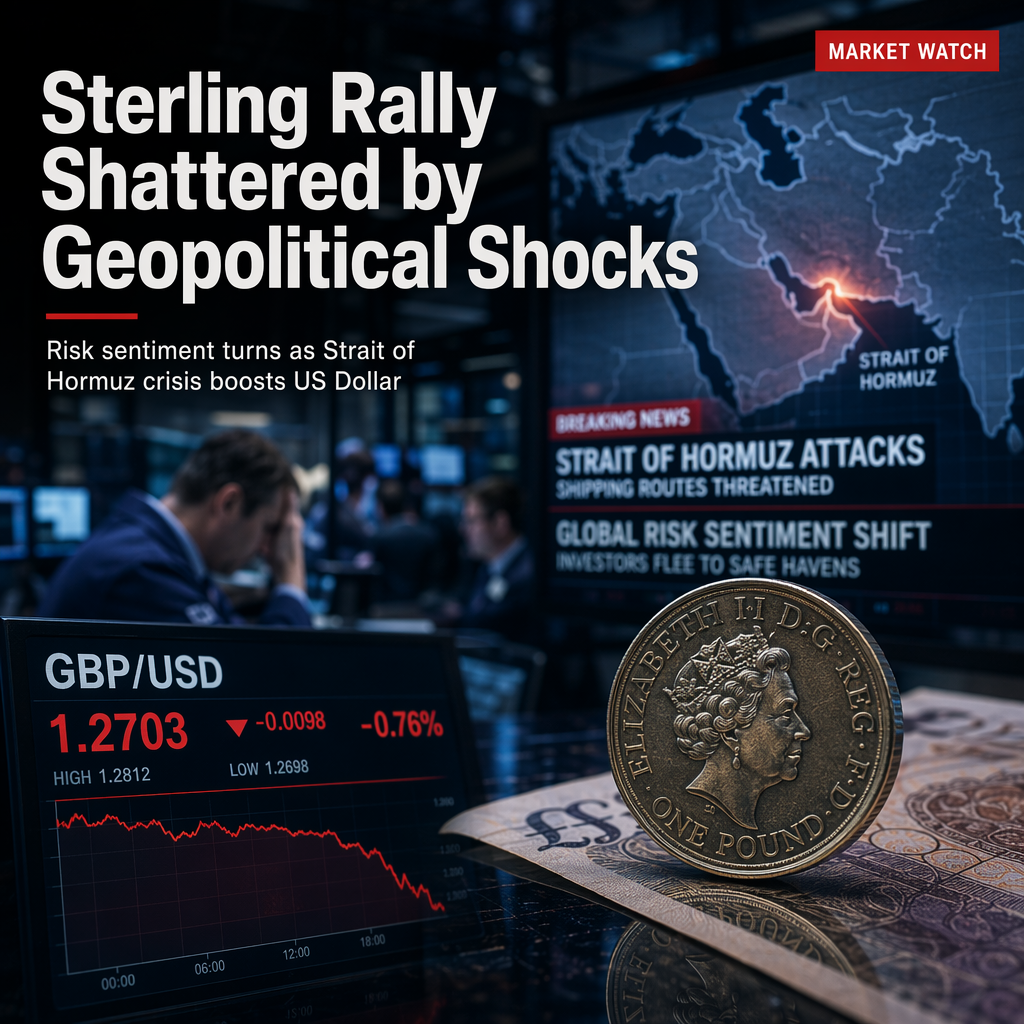
The British Pound's nine-session rally against the US Dollar came to an abrupt end on Tuesday, following a significant geopolitical development in the Strait of Hormuz. Cable opened near 1.3392, briefly surpassed the 1.3400 level in early European trading, but ultimately retreated to settle around 1.3356, marking a 0.27% decline and falling below a key daily moving-average cluster that had been acting as resistance for weeks [1].
The preceding nine-day streak was driven not by domestic UK factors but by weakness in US economic data. Specifically, June nonfarm payrolls came in at 57,000, well below the consensus estimate of 115,000, and previous months' figures were revised downward. Additionally, the ADP four-week average employment change slipped to 21,000 from 24,250, reinforcing the trend of softening US labor market data [1]. Despite this, market expectations for a Federal Reserve rate hike at the July 28-29 meeting have increased to roughly one-in-four, up from one-in-eight a month ago, while rate cuts are not currently priced in [1].
The turning point for Sterling was a series of attacks in the Strait of Hormuz, where Iranian missiles struck two commercial vessels and a third ship was attacked on Tuesday morning. A Qatari liquefied natural gas carrier caught fire after being hit, marking the most serious incident in the waterway since the Versailles agreement. Tehran's insistence on enforcing its own shipping routes and charging passage fees, which is opposed by Washington and Gulf states, was interpreted as the motive behind the attacks. The US President responded with a statement that his administration would either finalize a deal or take military action, maintaining elevated geopolitical risk premiums throughout the New York session [1].
As a result, risk appetite shifted sharply, with investors rotating into the US Dollar and away from assets tied to global trade. This defensive move was further exacerbated by an Asian technology sell-off. The Bank of England's Financial Stability Report, released at 09:30 GMT, noted increased stability risks for 2026, stretched artificial intelligence valuations, and heightened vulnerabilities in private credit, but had little immediate impact on Sterling's performance amid the broader risk-off environment [1].
Although the Bank of England maintains a hawkish stance, having held the Bank Rate at 3.75% in June on a seven-to-two vote, this domestic policy outlook was overshadowed by the geopolitical developments and global risk aversion [1].
CONCLUSION
The British Pound's recent gains were undone by escalating geopolitical tensions in the Strait of Hormuz, which triggered a flight to safety and boosted the US Dollar. Despite a hawkish Bank of England and weak US labor data, Sterling remains vulnerable to external shocks and shifts in global risk sentiment.