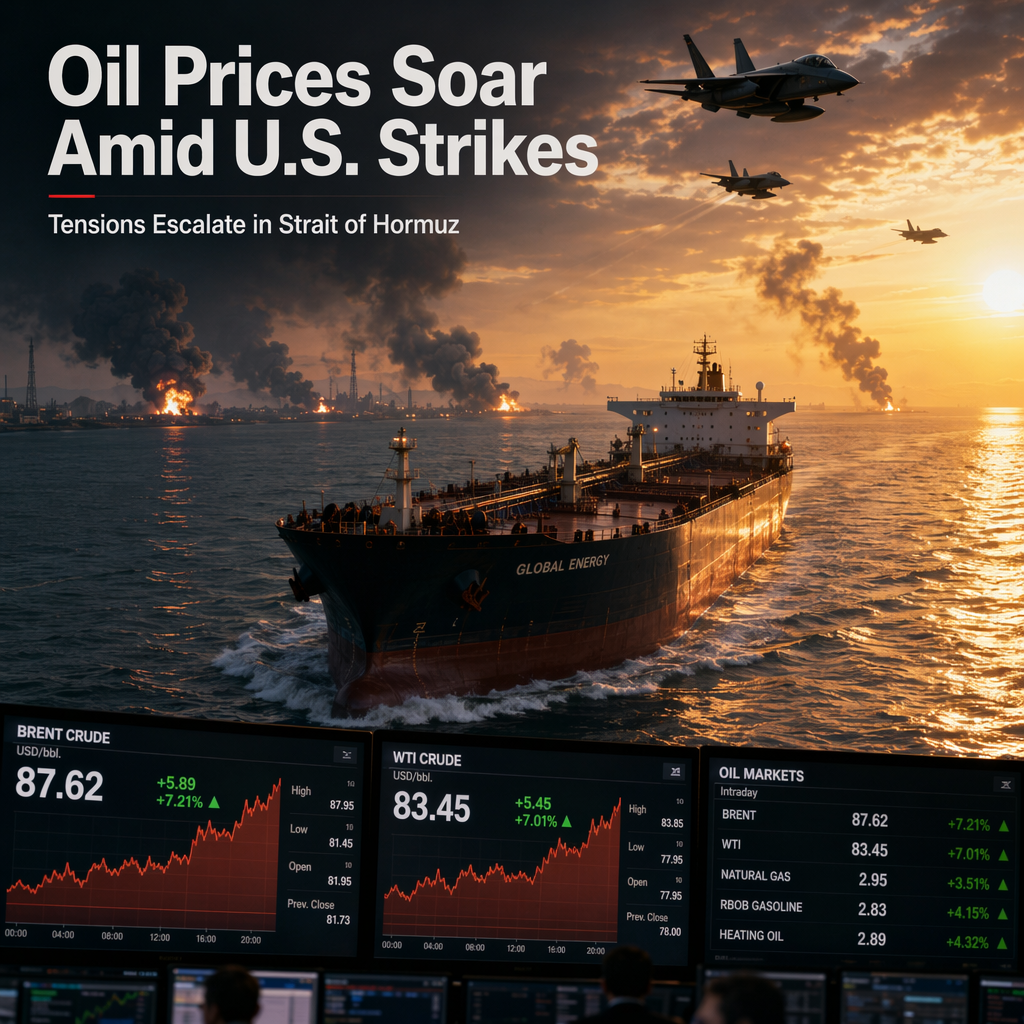
Oil prices surged following the United States' launch of fresh military strikes against Iran in retaliation for attacks on commercial vessels in the Strait of Hormuz, a critical shipping route for global oil and gas supplies [1]. The U.S. military described the action as a 'series of powerful strikes' after three commercial vessels transiting the strait were attacked on Tuesday, raising the threat assessment for ships in the area to 'severe' and warning of likely further hostile action by Iran [1].
West Texas Intermediate (WTI) futures for August delivery climbed 2.87% to $72.46 per barrel, while Brent crude futures for September delivery rose 2.75% to $76.18 per barrel in response to the escalating conflict [1]. The latest exchange threatens a fragile ceasefire reached last month, which had reopened the Strait of Hormuz after months of blockade and disruption caused by the outbreak of war between the U.S. and Iran in late February [1].
In addition to the military response, the U.S. Treasury Department withdrew a waiver that had previously allowed Iran to sell its oil, signaling a tightening of economic pressure [1]. A U.S. official emphasized that Iran would only benefit if it exhibited 'good behavior,' and described Iran's recent actions as 'wholly unacceptable' and subject to consequences [1].
High-level diplomatic efforts are ongoing, with U.S. Vice President JD Vance arriving in Switzerland for talks with the Iranian delegation to clarify terms for ending the conflict [1]. Analysts note that Iran's leverage may increase as the U.S. approaches its November midterm elections, with the potential for Mideast conflict-induced inflation to raise political stakes for the Trump administration [1].
CONCLUSION
The U.S. strikes on Iran and the subsequent escalation in the Strait of Hormuz have driven oil prices sharply higher and raised the risk of further market volatility. With the ceasefire now under threat and diplomatic negotiations ongoing, the situation remains highly fluid, with significant implications for global energy markets and U.S. domestic politics.