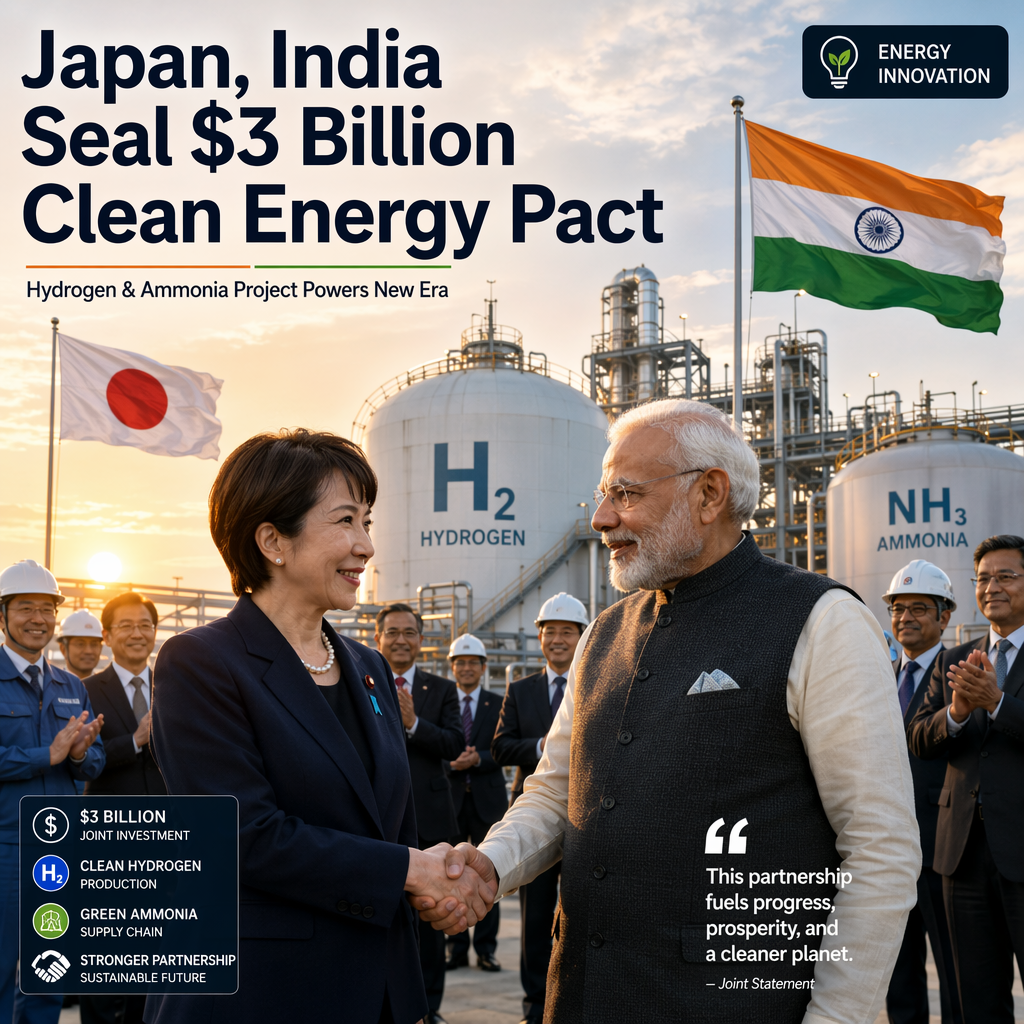
Japanese Prime Minister Sanae Takaichi is scheduled to visit India this week to meet with Indian Prime Minister Narendra Modi, where both leaders are expected to agree on supporting a major hydrogen and ammonia production project. The initiative, involving Japan's IHI and India's ACME Group, is valued at $3 billion and aims to boost the production and use of hydrogen and ammonia in both countries [1].
Japan is set to subsidize ammonia production in India as part of this agreement, marking a significant step in the two nations' efforts to deepen energy ties and accelerate the transition to cleaner fuels [1]. The project is positioned as a key move toward decarbonizing heavy industry and power generation, sectors that are critical for both economies [1].
While the article does not provide a detailed financial breakdown or specific market analysis, the scale of the $3 billion investment underscores the importance of the initiative and signals growing cooperation between Japan and India in the development of next-generation fuels such as hydrogen and ammonia [1].
No forward-looking statements or analyst opinions are included in the article [1].
CONCLUSION
The agreement between Japan and India to support a $3 billion hydrogen and ammonia production project marks a significant advancement in bilateral energy cooperation. This initiative is expected to play a crucial role in the decarbonization of heavy industry and power generation in both countries.