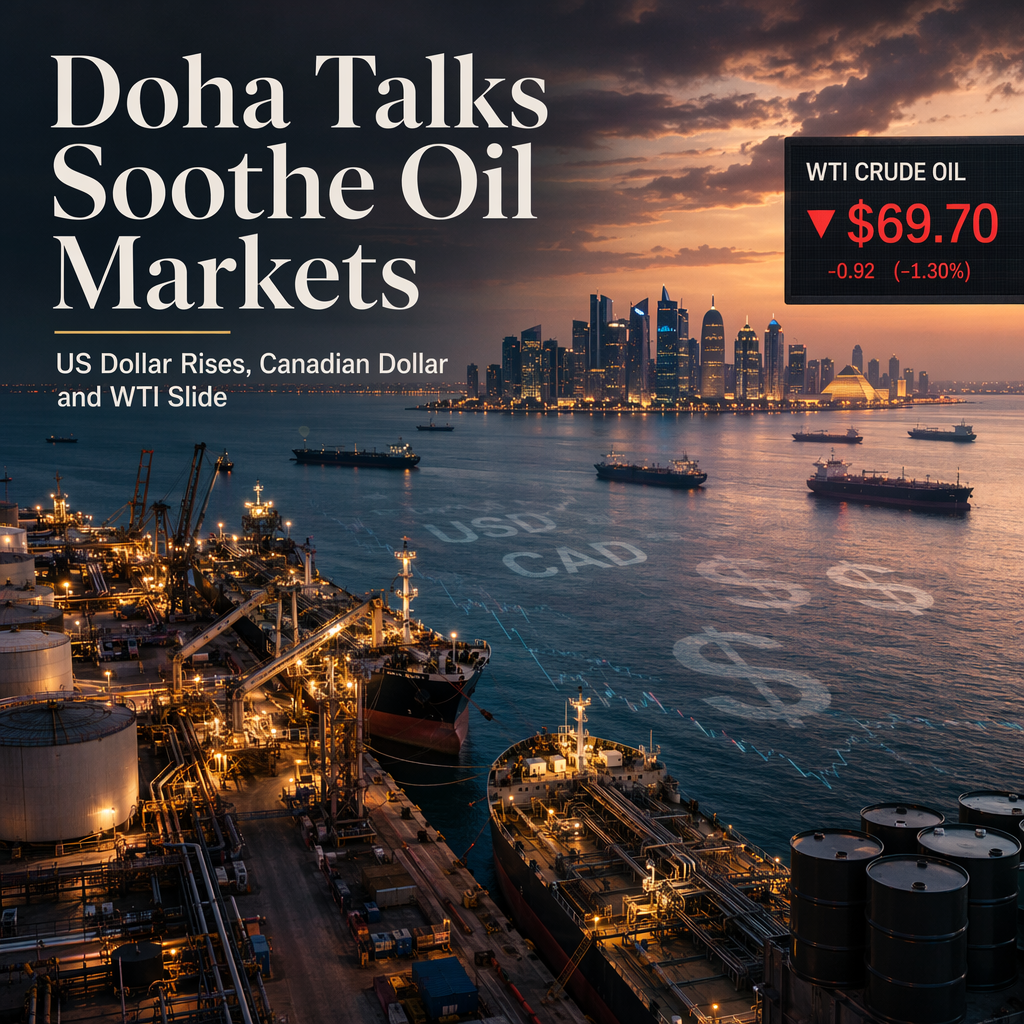
The US Dollar strengthened against the Canadian Dollar, with USD/CAD trading around 1.4220 during Asian hours on Wednesday, as geopolitical uncertainty surrounding US-Iran Doha talks fueled safe-haven demand for the Greenback [1]. US negotiators Jared Kushner and Steve Witkoff arrived in Qatar to meet with mediators regarding an initial peace deal with Iran, but Tehran refused direct talks, maintaining uncertainty over a lasting resolution [1]. This ongoing uncertainty has kept geopolitical risk premiums elevated in the market [1].
The Federal Reserve's June meeting contributed to the US Dollar's strength, as the central bank held its benchmark interest rate steady at 3.50% to 3.75% and removed language suggesting future rate cuts. The CME FedWatch tool indicates a nearly 63% probability of a rate hike by September [1]. Meanwhile, the Canadian Dollar faced additional pressure from declining oil prices, as crude oil markets reacted to the potential for peace talks in Doha and the easing of tensions in the Strait of Hormuz following recent military clashes [1].
West Texas Intermediate (WTI) oil prices remained subdued for a second day, trading near $69.70 per barrel during Asian hours on Wednesday [2]. The halt in military exchanges between the US and Iran allowed oil tanker traffic and shipments to recover, alleviating fears of prolonged supply disruptions [2]. This led analysts to lower their 2026 oil price forecasts for the first time since the conflict began, ending a five-month streak of forecast increases [2]. According to a Reuters poll, the reopening of the Strait of Hormuz has significantly reduced supply concerns, but analysts now warn of a potential supply glut as global exports rebound faster than expected [2]. Iran reported shipping over 40 million barrels of oil since the US lifted its naval blockade, while Russian exports have surged to record highs, resulting in a buildup of barrels at sea [2].
Some downward pressure on oil prices was offset by shrinking US domestic supplies. The American Petroleum Institute reported a 6.1 million barrel decline in US crude inventories for the week ended June 26, with gasoline stocks also falling [2]. Markets are awaiting official data from the US Energy Information Administration for confirmation [2].
CONCLUSION
Geopolitical developments in the US-Iran Doha talks have eased oil supply concerns, leading to lower oil prices and a weaker Canadian Dollar, while boosting the US Dollar on safe-haven demand. Analysts have lowered their oil price forecasts for the first time in months, though concerns of a supply glut persist. The market remains attentive to further inventory data and the outcome of ongoing diplomatic efforts.