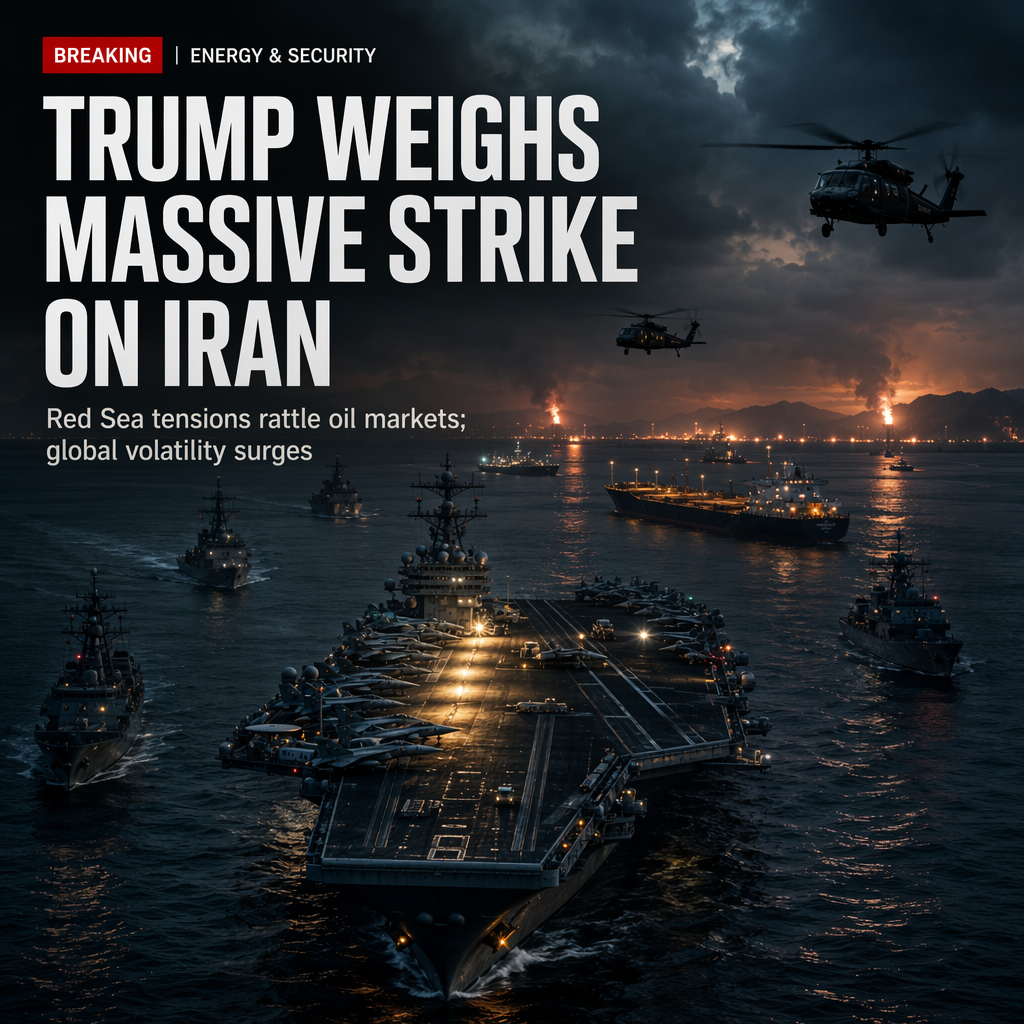
U.S. President Donald Trump announced he is considering a 'massive attack' on Iran, stating the proposed strikes would be larger than any previous actions in the ongoing conflict. Trump did not provide a specific timeline for his decision but emphasized that Iran has not 'received enough pain yet' and that the U.S. is 'all set' for such an operation. He also indicated that Israel could join the operation quickly if requested, though he warned of potential Iranian retaliation against Israel if it participated. Trump reiterated that Iran 'wants to negotiate,' but he believes Tehran is not yet ready to make a deal with the U.S. [1]
Over the past two weeks, U.S. forces have conducted strikes on Iranian positions, with Central Command completing a 13th consecutive night of attacks. Trump further warned that the U.S. would hold Iran responsible for any additional attacks by Yemen's Tehran-backed Houthis, following the group's claim of striking two Saudi Arabian oil tankers in the Red Sea. He stated that any repeat attacks would result in 'major military punishment' for both Iran and the Houthis. The Houthis have declared a maritime embargo against Saudi Arabia, threatening to cut off the kingdom's oil exports through the Red Sea and Bab el-Mandeb strait. [1]
Iran's Revolutionary Guard announced it had attacked U.S. military facilities at an American base in Jordan, according to Iranian state media. U.S. Secretary of State Marco Rubio described Trump's approach as 'a head for an eye,' warning that Iran would 'pay a very heavy price' for its actions. [1]
Oil prices responded to the escalating tensions, falling by around 1% on Friday morning but remaining on track for a weekly rise of 10%. Brent crude futures stayed above $99 per barrel, while U.S. West Texas Intermediate (WTI) crude traded at $91.08 a barrel. The threats to Saudi oil exports and ongoing military actions have injected significant volatility into oil markets, with traders closely monitoring the potential for further escalation and broader regional conflict. [1]
In Europe, the U.K. reaffirmed its readiness to defend itself after Iran labeled it an 'accomplice' to the U.S. due to the use of British military bases by American forces. The U.K. has extended permission for the U.S. to use its bases for defensive operations, a policy unchanged by recent leadership. [1]
CONCLUSION
President Trump's consideration of a large-scale attack on Iran, combined with ongoing regional hostilities and threats to oil infrastructure, has heightened market volatility and pushed oil prices higher. The situation remains fluid, with traders and policymakers closely watching for further escalation and its potential impact on global energy supplies.