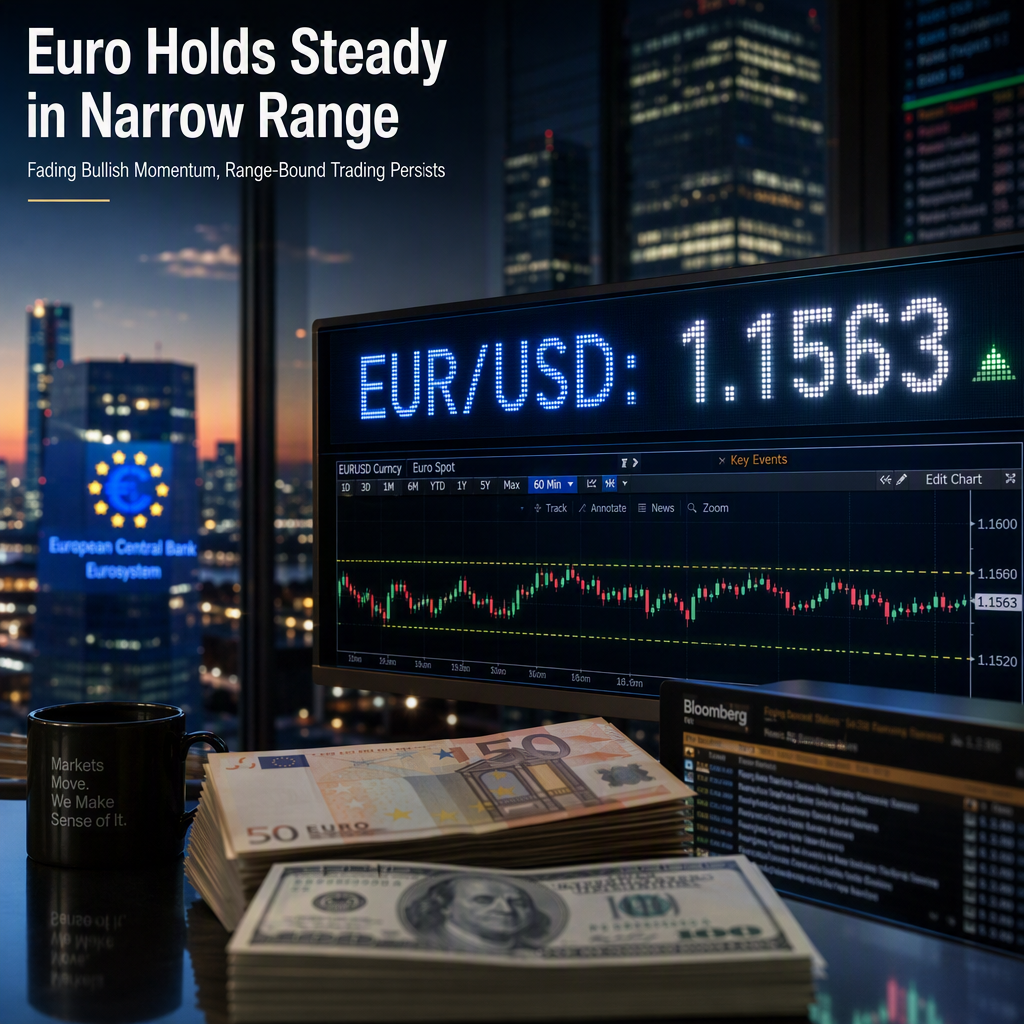
The Euro (EUR) has maintained a steady position, extending its tight consolidation in the mid-1.15s against the US Dollar (USD) following the Dollar’s broad, Fed-driven decline in late July [1]. According to Scotiabank strategists Shaun Osborne and Eric Theoret, the EUR/USD pair is trading close to a fair value estimate of 1.1563, which is based on the 2-year Germany–US yield spreads [1]. The strategists note that while fundamentally-driven movements (such as those based on yield spreads) have moderated, sentiment-driven correlations, particularly risk reversals, are strengthening [1].
From a technical perspective, the EUR’s bullish momentum is described as fading, with the Relative Strength Index (RSI) drifting into the upper 50s, indicating a deceleration in the recovery that began in late July [1]. Despite this, the EUR/USD maintains a marginal bullish trend, characterized by a sequence of higher highs and higher lows [1]. Resistance levels have been observed around 1.1580, with further resistance near 1.1600 and the 200-day moving average at 1.1630, while support is expected at the 50-day moving average at 1.1468 [1]. The strategists anticipate a near-term trading range between 1.1500 and 1.1580 [1].
The current environment is marked by a quiet economic data and European Central Bank (ECB) calendar, which is expected to contribute to continued range-bound trading for the EUR/USD pair [1]. No significant market-moving events or surprises are highlighted, and the overall tone suggests limited volatility in the near term [1].
CONCLUSION
The Euro is consolidating in a narrow range against the US Dollar, with technical indicators pointing to fading bullish momentum but no immediate risk of a sharp move. Market participants can expect continued range-bound trading in the absence of major data releases or ECB events.