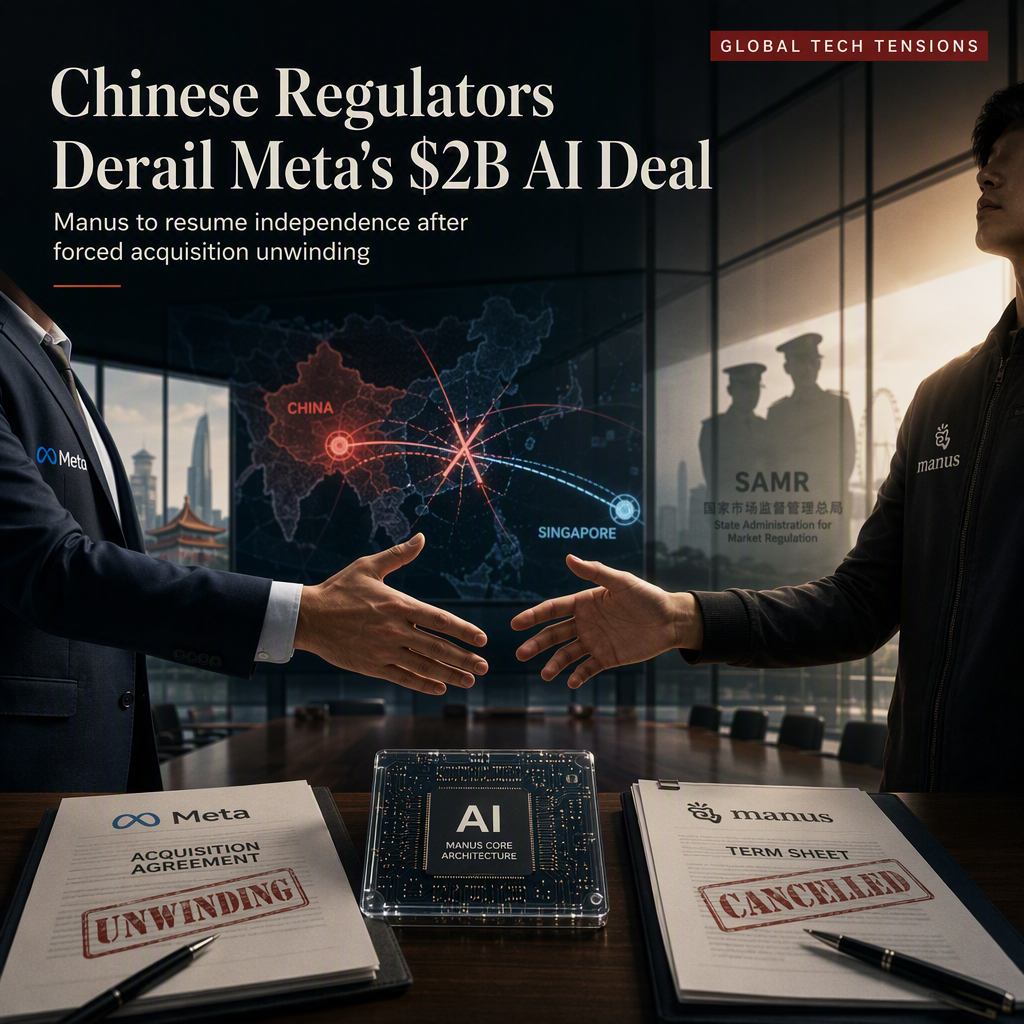
Manus announced that it will soon return to operating as an independent company after Chinese regulators ordered Meta to unwind its $2 billion acquisition of the AI startup. The acquisition, initially announced by Meta in December of the previous year, was part of Meta's broader strategy to strengthen its AI capabilities and compete with industry leaders such as Google, Anthropic, and OpenAI [1]. Manus, which develops general purpose AI agents and was founded in China in 2022 before relocating to Singapore, became the subject of regulatory scrutiny from both Beijing and Washington shortly after the deal was made public [1].
In April, China's National Development and Reform Commission instructed Meta and Manus to withdraw from the transaction, citing concerns over foreign investment regulations. This directive initiated a complex unwinding process, further complicated by Beijing's recent tightening of technology export controls on cross-border deals amid escalating competition between the U.S. and China for AI talent, hardware, and data [1].
As part of the separation process, Manus informed users that they would need to back up data generated on or after December 29, 2025, the date the Meta deal was announced. Manus stated, 'This is part of our separation from Meta; we must take this step to comply with regulatory requirements in specific parts of the world' [1].
Meta had intended to integrate Manus' technology into its consumer and enterprise products and had recently released its first coding agent as part of its ongoing efforts to monetize AI technology [1]. The forced unwinding of the deal represents a significant setback for Meta's AI expansion plans and highlights the increasing regulatory barriers facing cross-border technology acquisitions between the U.S. and China [1].
CONCLUSION
The forced unwinding of Meta's $2 billion acquisition of Manus by Chinese regulators marks a significant disruption in Meta's AI expansion strategy. This development underscores the growing regulatory challenges and geopolitical tensions impacting cross-border technology deals, particularly in the AI sector.