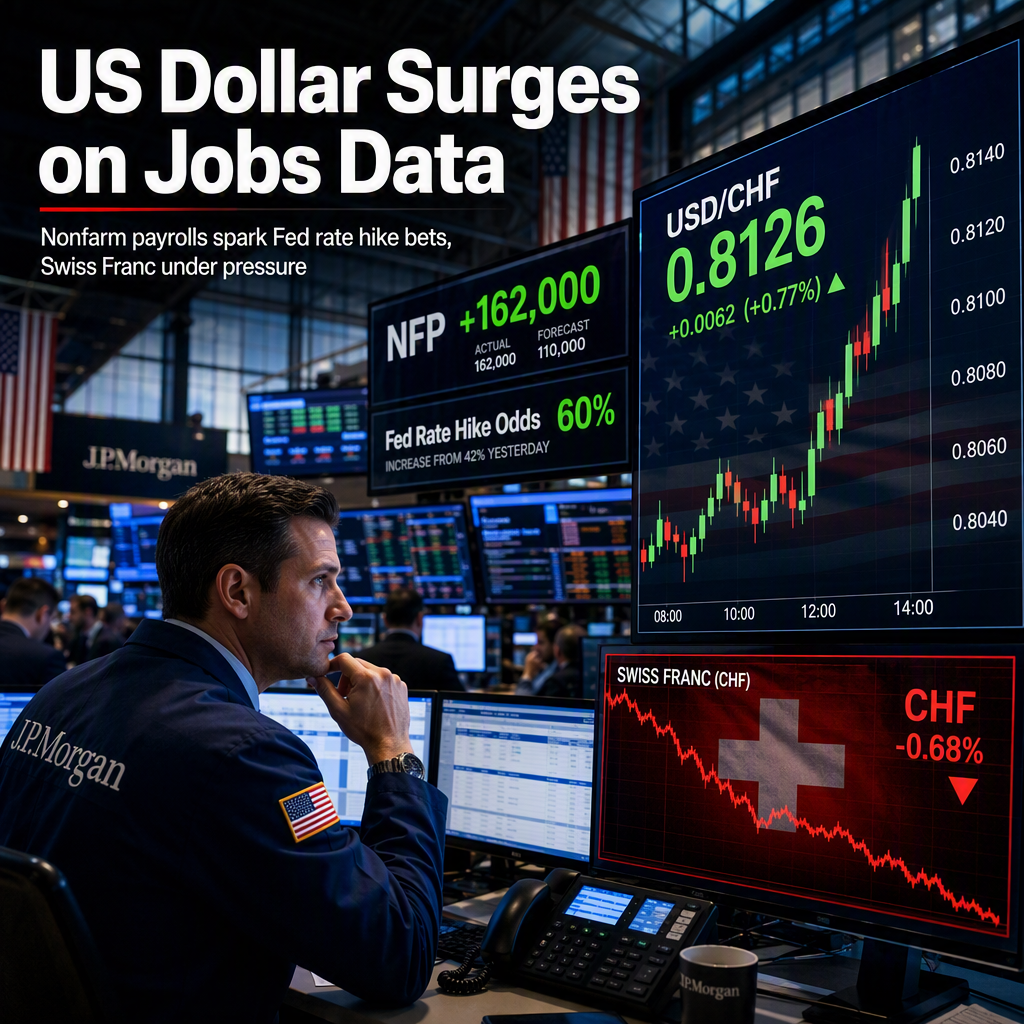
The US Dollar strengthened against the Swiss Franc on Friday following the release of stronger-than-expected US Nonfarm Payrolls (NFP) data, which triggered fresh volatility in currency markets. The USD/CHF currency pair surged to 0.8126 immediately after the data release before retreating slightly to trade around 0.8102, marking a gain of nearly 0.34% on the day [1].
US NFP increased by 162,000 in August, significantly surpassing expectations for a 56,000 rise. Additionally, July's payrolls were revised sharply higher to a gain of 21,000 from a previously reported 23,000 decline, and June's figure was revised to 31,000 from 20,000. The US unemployment rate remained steady at 4.1%, in line with forecasts [1]. The US Dollar Index (DXY) climbed as high as 99.39 after the data before settling around 99.15, reflecting initial optimism that later moderated [1].
Market expectations for a Federal Reserve rate hike at the September 15-16 meeting increased, with the CME FedWatch Tool indicating a 60% probability of a 25-basis-point hike, up from about 50% prior to the NFP release [1]. US President Donald Trump praised the jobs data in a Truth Social post, reiterating his call for lower interest rates and urging the Fed to act, stating, “LOWER THE RATE OR I’LL STOP TRADING WITH COUNTRIES WITH WHICH WE HAVE A DEFICIT” and emphasizing the need for the Fed Board to “get smart” [1].
Despite the robust jobs report, the US Dollar's inability to maintain its initial gains highlights ongoing uncertainty regarding the Fed's policy direction, especially as recent data suggest moderating inflation. Upcoming August Consumer Price Index (CPI) and Producer Price Index (PPI) reports are expected to play a crucial role in shaping the Fed's decision at its next meeting [1].
On the Swiss side, inflation remains subdued, with August inflation rising 0.4% month-on-month after a 0.1% decline in July, and the annual rate accelerating to 0.8% from 0.4%. This allows the Swiss National Bank (SNB) to keep its policy rate at 0%. According to BBH, the SNB has ample room to maintain rates at 0.00% for some time, given inflation is well within its price stability mandate of less than 2% per annum, which may limit the Swiss Franc's upside in the coming quarters [1].
CONCLUSION
Stronger-than-expected US jobs data boosted the US Dollar and raised market expectations for a Federal Reserve rate hike in September, pressuring the Swiss Franc. However, uncertainty remains over the Fed's next move, with upcoming inflation data likely to be decisive. The Swiss National Bank's accommodative stance is expected to persist as inflation remains subdued.