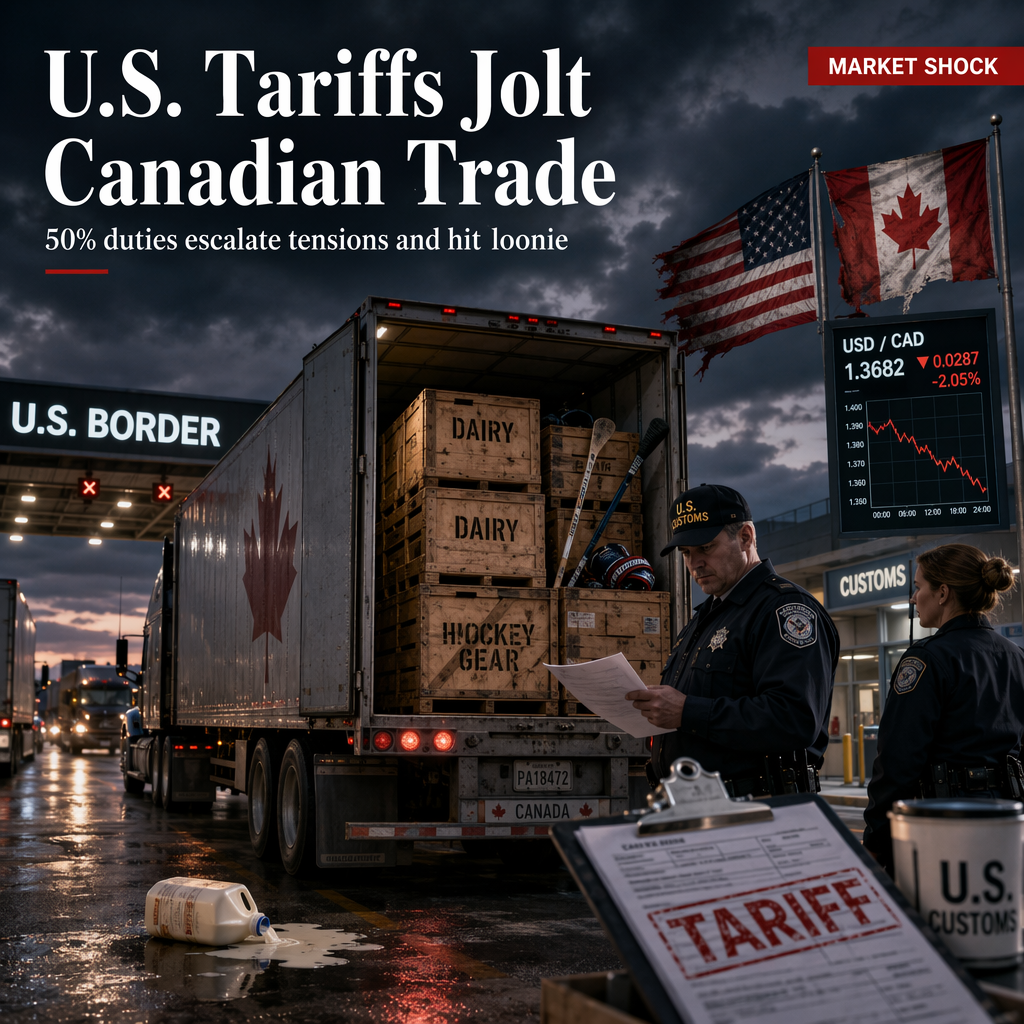
The United States has announced the imposition of new 50% tariffs on selected Canadian goods, escalating trade tensions between the two countries. According to BNY’s Geoff Yu, these tariffs represent a direct trade shock, with Washington citing unfair treatment of U.S. exports and explicitly ruling out exemptions under the United States-Mexico-Canada Agreement (USMCA) [1]. The tariffs, which are set to take effect in 30 days, will target products such as milk and cream, hockey equipment, and alcohol. Major Canadian resource exports, including energy, potash, fish, and critical minerals, as well as goods already covered by separate auto and steel duties, are excluded from the new measures [1].
The U.S. justified the move under Section 338 of the 1930 Tariff Act, linking the decision to what it described as unfair Canadian treatment of U.S. alcohol, cars, and dairy products. U.S. officials have stated that there will be no USMCA exemptions for these tariffs, and Canada has responded by noting it has faced similar threats in the past [1].
The announcement has added further strain to already fragile trade negotiations, especially after the U.S. declined to renew the USMCA. The Canadian government is working to defend market access and limit domestic damage, with Mark Carney signaling that talks could intensify as Ottawa seeks to protect its most important export relationship [1].
Market reaction was immediate, with the Canadian dollar slipping on the news. Asset allocators are now increasingly pricing in tariff risk as a persistent factor in Canada, rather than viewing it as a short-term political threat [1].
CONCLUSION
The U.S. decision to impose 50% tariffs on select Canadian goods has heightened trade tensions and pressured the Canadian dollar. With no USMCA exemptions and ongoing trade negotiations strained, market participants are bracing for prolonged tariff risks in Canada.