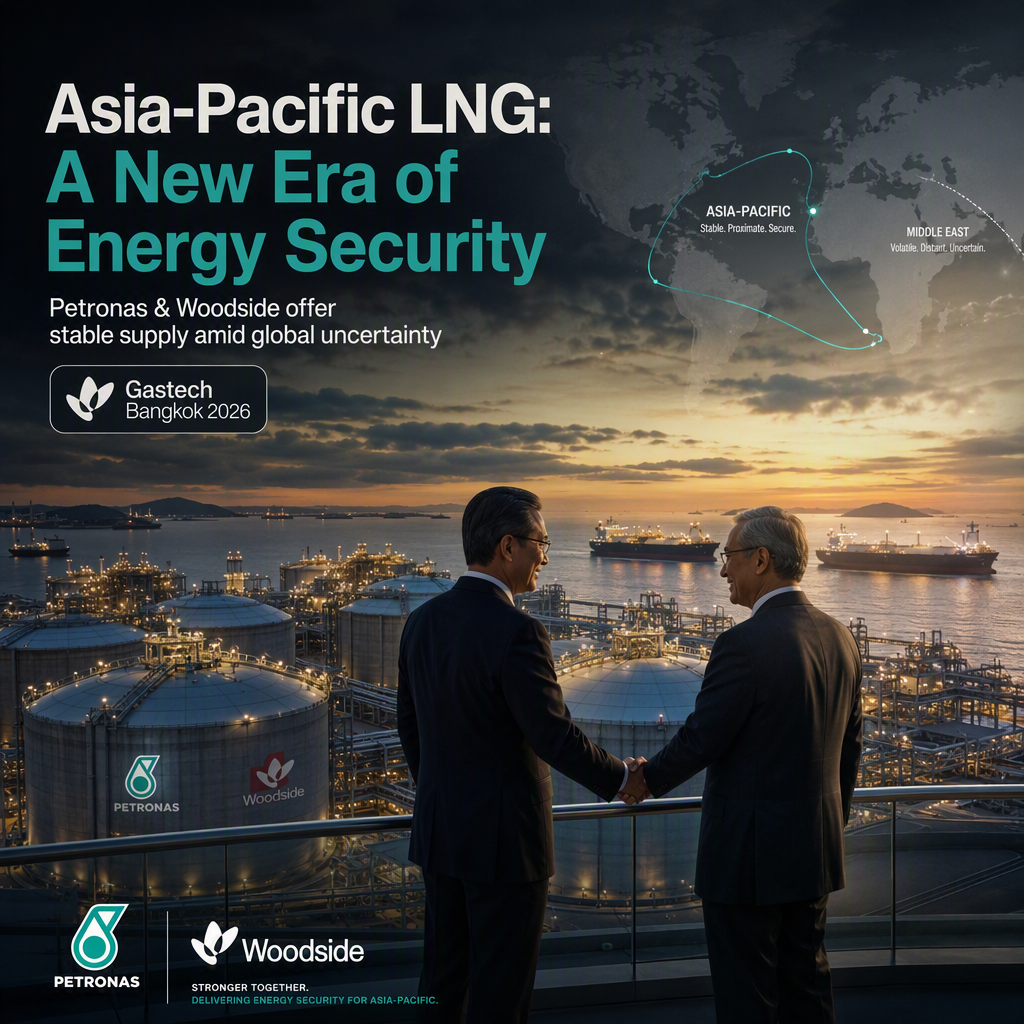
Malaysia's state-owned energy group Petronas is advancing liquefied natural gas (LNG) projects in the Asia-Pacific region, aiming to provide buyers with alternatives to the unstable Middle Eastern supply, which has been affected by ongoing geopolitical tensions and disruptions [1]. Petronas plans to increase its LNG output by 38% by 2035, with expansion coming from both new and existing projects, emphasizing sustainability and long-term contracts [1]. At Gastech Bangkok 2026, Petronas executives underscored their commitment to being a reliable partner for Asian buyers, offering security of supply and competitive pricing [1].
Australian energy company Woodside is also positioning its Asia-Pacific LNG resources as an attractive option for buyers seeking to hedge against volatility in the Middle East [1]. Both companies highlighted the importance of regional LNG supply chains and investment in infrastructure to meet the growing demand in Asia [1].
Industry analysts noted that the Asia-Pacific region's expanding LNG capacity could shift market dynamics, potentially reducing Asia's dependence on the Middle East. Price stability, supply security, and flexible contract terms are expected to become key differentiators as competition intensifies among global LNG suppliers [1].
CONCLUSION
Petronas and Woodside are actively promoting Asia-Pacific LNG as a stable and competitive alternative to Middle Eastern supply, responding to buyer concerns over geopolitical risks. The planned expansion and focus on infrastructure and contract flexibility could reshape regional energy markets, offering greater security and price stability for Asian buyers.