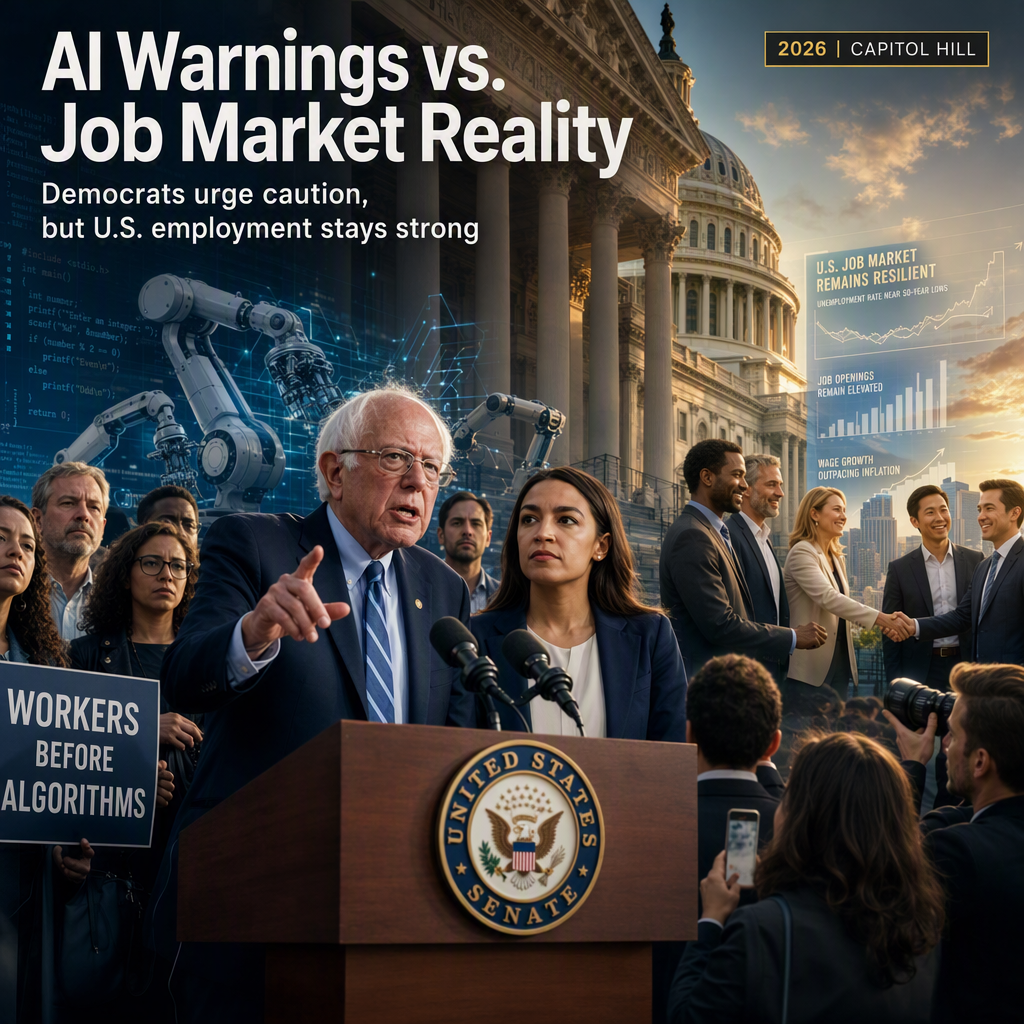
Democratic lawmakers, including Sen. Bernie Sanders and Rep. Alexandria Ocasio-Cortez, have raised alarms about the potential for artificial intelligence (AI) to cause mass unemployment in the United States. In response, they have proposed policies such as an employment program funded by taxing AI, and introduced the Artificial Intelligence Data Center Moratorium Act at a press conference on March 25, 2026, in Washington, D.C. [1]
Despite these warnings, labor market data from the Bureau of Labor Statistics indicates that since the introduction of AI chatbots in late 2022, the U.S. has continued to add jobs, with total non-farm payroll employment increasing each year and unemployment remaining below 4.5%. This trend suggests that the anticipated wave of AI-driven job losses has not materialized, and the labor market has remained robust. [1]
Economist Richard Stern of Advancing American Freedom highlighted that innovation historically eliminates some jobs but also creates opportunities for new types of work and products. He cited the example of the Jacquard loom in the 1820s, which automated certain tasks but ultimately led to new forms of employment. Stern argued that the current debate reflects a deeper ideological divide between free-market approaches and central planning. [1]
Additionally, some companies have reportedly adjusted their expectations regarding AI's impact on the workforce. According to The Wall Street Journal, several firms resumed hiring after realizing that AI was not replacing junior workers as initially projected. This adjustment further underscores the resilience and adaptability of the labor market in the face of technological change. [1]
CONCLUSION
While Democratic leaders continue to advocate for government intervention to address potential AI-driven unemployment, current labor market data shows ongoing job growth and low unemployment rates. The market has so far defied projections of widespread job losses, suggesting that AI's impact on employment may be less severe than feared.