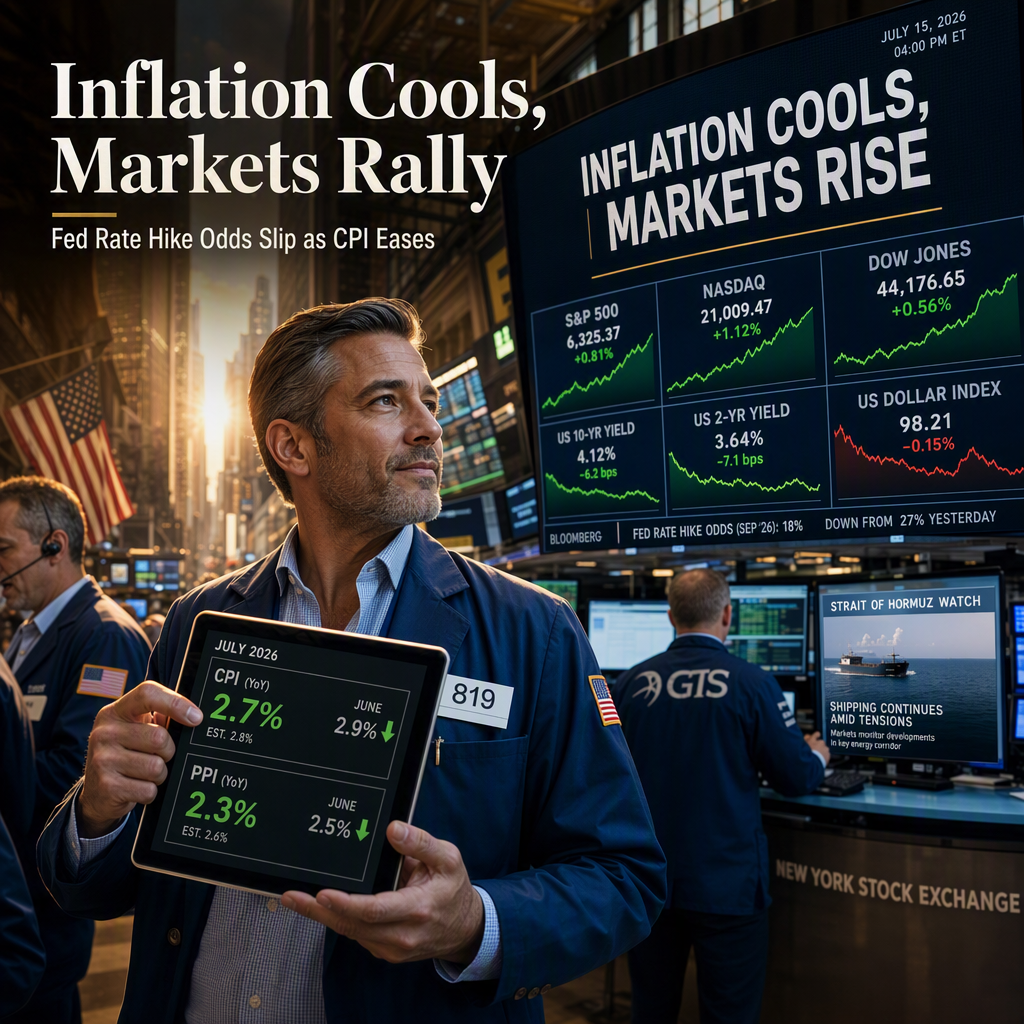
The July 2026 US Consumer Price Index (CPI) report showed inflation easing, with headline CPI rising 0.1% month-over-month and the annual rate slipping to 3.4% from 3.5% in June, matching Wall Street forecasts and reversing June’s 0.4% decline [1][2][3][5]. Core CPI, which excludes food and energy, increased 0.2% for the month, bringing the annual core rate down to 2.5%, its slowest pace since March 2021 [1][2][3][5]. Energy prices fell 1.5% for a second consecutive month, though they remain 14.7% higher year-over-year, while grocery prices dropped 0.1%, the first monthly decline since March [3]. Shelter costs rose 0.1% and accounted for about two-thirds of the overall monthly increase [3].
The Producer Price Index (PPI) for July was unchanged from June, with the annual rate easing to 4.7% from 5.5% [4][5][7]. Core PPI rose 0.2% month-over-month, down from 0.4% previously, and the annual core rate slowed to 4.2% from 4.7% [4][5][7]. These disinflationary signals, combined with softer labor market data—such as initial jobless claims rising to 209,000 and continuing claims declining to 1.777 million—have reduced pressure on the Federal Reserve to maintain a restrictive monetary policy stance [4][5][7].
Market reaction was positive: the S&P 500 rose by 0.2% to close near 7,747, approaching its record high of 7,757.64, and spiked as high as 7,772 after the CPI release [2][7]. The Nasdaq Composite and Russell 2000 also hit new all-time highs in early trading [7]. US Treasury yields fell sharply, with the 10-year yield dropping to 4.61% and the 30-year yield to around 5.18%, their lowest levels since last week [7]. The US Dollar Index (DXY) initially dipped but then reversed to close higher against every major currency except the Australian dollar, before retreating below the 100 mark later in the day [1][2][4][5][6].
Fed rate hike expectations have shifted notably. According to the CME FedWatch Tool, the probability of a September rate hike dropped to 32%, down from 55% a week ago [5]. Futures markets price roughly a 55% chance the Fed holds rates steady at its September 15-16 meeting [3]. Several analysts and Fed officials commented on the data: Cleveland Fed President Beth Hammack called the inflation reports “welcome news” but was not confident the progress would continue, while PNC Financial’s Kurt Rankin and Wells Fargo’s Gary Schlossberg described the PPI data as “friendly” and indicative of moderating inflation pressures [5][7]. Citigroup economist Veronica Clark projected that core PCE, the Fed’s preferred inflation measure, would likely rise by only around 0.2% in July, easing to 3.2% year-over-year [7].
Despite the positive inflation data, some risks remain. Elevated energy prices and ongoing geopolitical tensions, particularly the standoff over the Strait of Hormuz, continue to support a premium in oil and the US dollar [1][2][4][6]. Rabobank’s Jane Foley noted that while reduced Fed rate hike speculation opens downside risks for the dollar, safe haven flows linked to energy and geopolitical uncertainty could offset this [6].
CONCLUSION
July’s US inflation and producer price data came in softer than expected, easing market fears of further Fed rate hikes and fueling a rally in equities and bonds. While the probability of a September rate hike has dropped, persistent energy price risks and geopolitical tensions could still influence future policy and market direction. Overall, the data signal a tentative step toward moderating inflation, but markets remain alert to potential shocks.