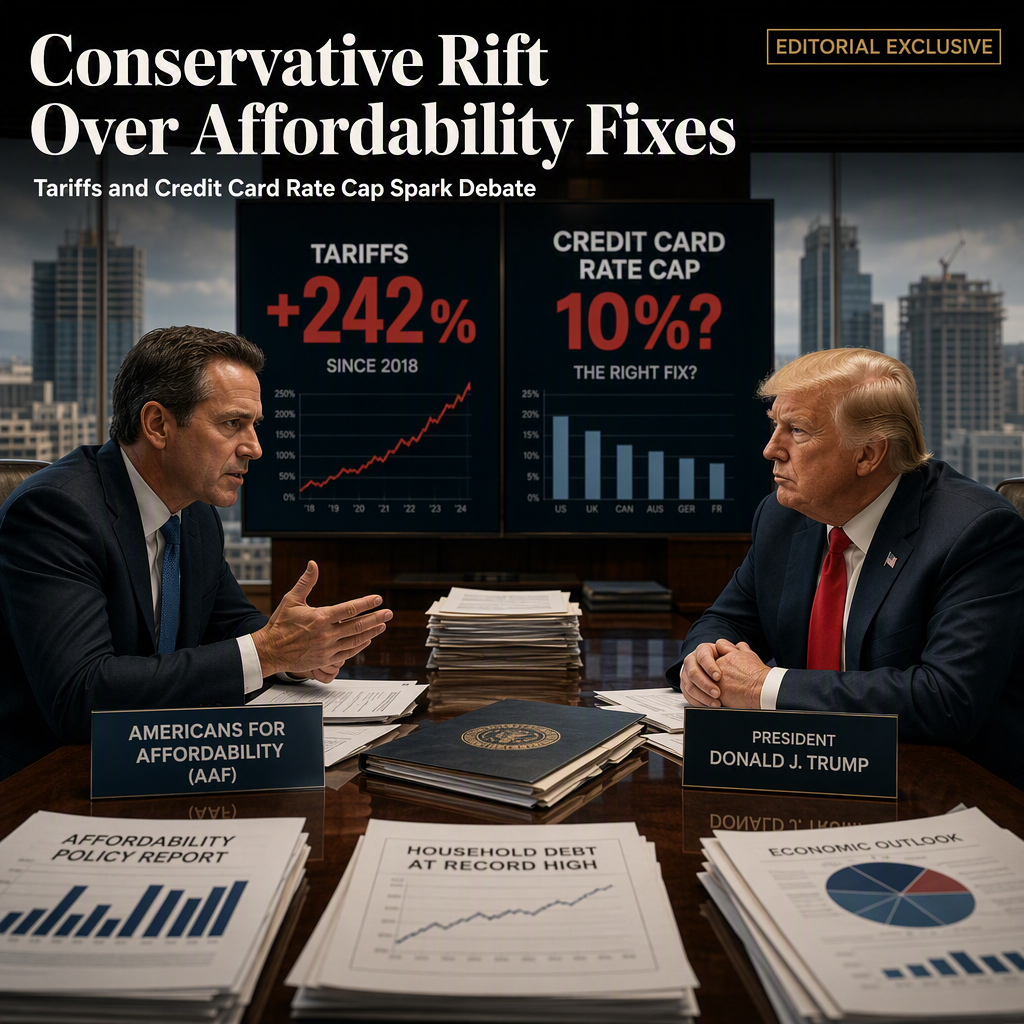
A new report from Advancing American Freedom (AAF), a conservative group founded by former Vice President Mike Pence, has outlined 10 proposals aimed at addressing the affordability crisis facing Americans, with a particular focus on reducing costs in housing, energy, and business sectors [1]. The report, titled '10 Ways to Improve Affordability Now Across 10 Levels of the Economy,' argues that government policies are largely to blame for the current unaffordability crisis, which it calls the 'No. 1 issue facing the American people' [1].
While the AAF blueprint echoes parts of former President Donald Trump’s second-term agenda, it notably diverges on two major issues: tariffs and credit card interest rates [1]. The report criticizes Trump’s sweeping tariffs, stating they have increased costs for American consumers, strained U.S. alliances, and resulted in nearly 900,000 fewer jobs than expected. It calls for shifting more tariff authority back to Congress. Treasury data cited in the report shows that tariff duties in January totaled $30.4 billion, a 242% increase from $8.9 billion a year earlier, highlighting the significant financial impact of these policies [1].
The AAF report also opposes Trump’s proposed 10% cap on credit card interest rates, warning that such a cap could make lending unprofitable for roughly 60% of Americans [1]. On housing, the report points to government regulations as a major driver of costs, with the National Association of Home Builders estimating that regulations account for about 26% of the price of a new single-family home. The report recommends limiting local zoning restrictions, streamlining project approvals, and tying approximately $50 billion in annual federal housing aid to zoning reform [1].
Industry leaders cited in the report note that states prioritizing homebuilding have been better able to accommodate population growth and economic expansion. The broader debate, according to AAF’s Richard Stern, centers on whether Americans can still build a better future for their families amid rising costs, particularly in housing and energy [1].
CONCLUSION
The AAF report signals a significant conservative pushback against key elements of Trump’s affordability plan, particularly on tariffs and credit card interest rates. With affordability emerging as a central issue ahead of the midterms, the debate highlights deep divisions within the conservative movement on how best to address rising costs for American families.