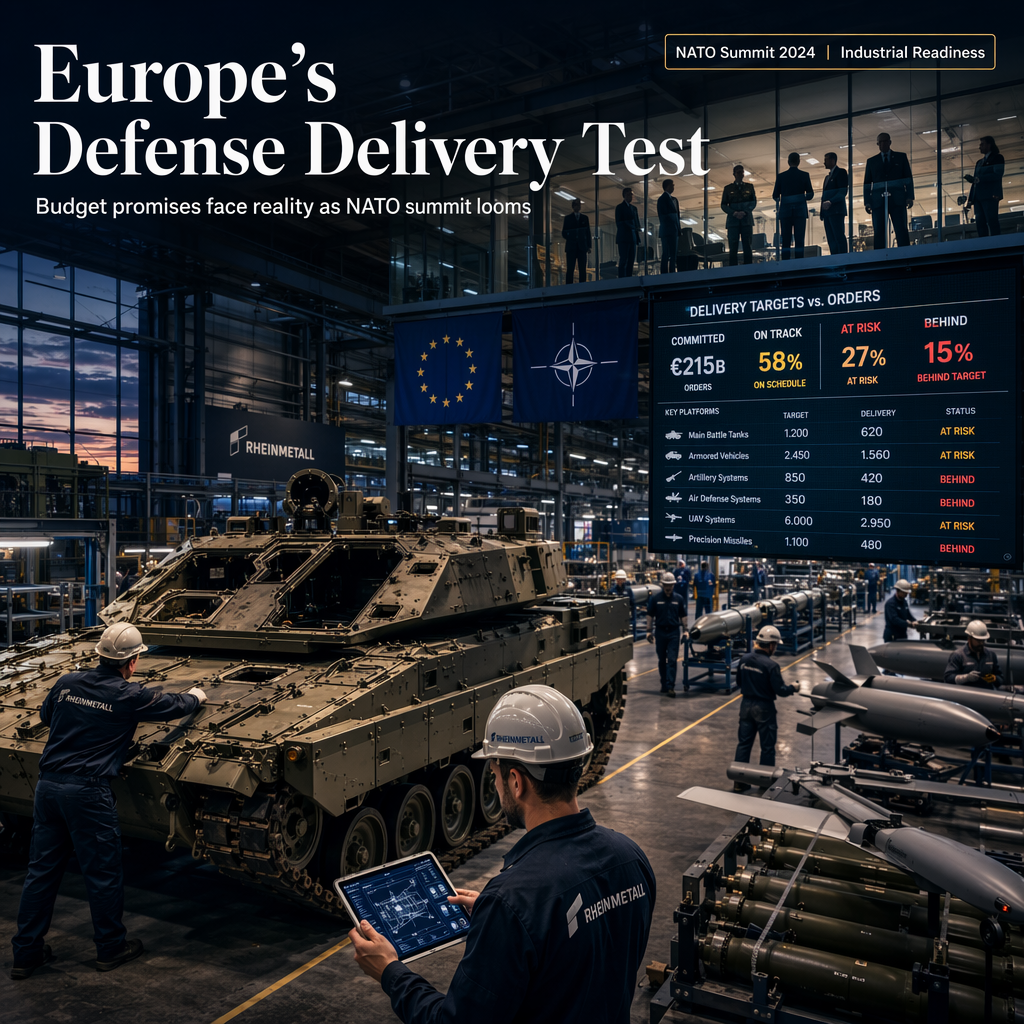
Europe’s defense industry is entering a critical phase as the focus shifts from record-high spending pledges to the actual delivery of weapons and military capabilities, raising questions among investors about whether current defense stock valuations are justified by production capacity [1]. This transition comes ahead of the NATO Summit in Ankara, Turkey, where leaders will review progress since last year and outline a roadmap to achieve new spending goals, aiming to turn allied commitments into tangible results [1].
Despite a dramatic rise in military budgets and emergency spending for Ukraine, the path from increased funding to delivered weapons has been hampered by procurement delays, fragmented national programs, labor shortages, and strained supply chains, casting doubt on how quickly Europe can rebuild its industrial base after decades of underinvestment [1]. The urgency has been heightened by U.S. War Secretary Pete Hegseth’s recent announcement of a review of American forces in Europe, warning that allies not meeting spending commitments could face consequences—a review expected to last up to six months [1].
European defense companies such as Rheinmetall, BAE Systems, Leonardo, Thales, and Saab have seen surging order books since Russia’s 2022 invasion of Ukraine, as governments ramp up military spending [1]. According to McKinsey, European NATO core defense spending has doubled since 2019 and could reach approximately 800 billion euros ($912 billion) by the end of the decade, aligning with NATO’s new benchmark of 3.5% of GDP spent on defense [1]. Venture funding is also increasing for European defense technology, including drones and autonomous systems [1].
Hugues Lavandier, a senior partner at McKinsey, noted that the evolving U.S. geopolitical stance has been a “real moment of truth” for Europe, accelerating the recognition that the era of the peace dividend is over and that governments must reinvest in defense capabilities [1].
CONCLUSION
Europe’s defense sector is under intense scrutiny as the focus shifts from budget increases to actual delivery of military capabilities, with significant pressure from both NATO and the U.S. to meet commitments. While defense companies have benefited from surging orders, execution risks and supply chain challenges remain key concerns for investors. The outcome of the upcoming NATO Summit and the U.S. force review will be pivotal for the sector’s trajectory.