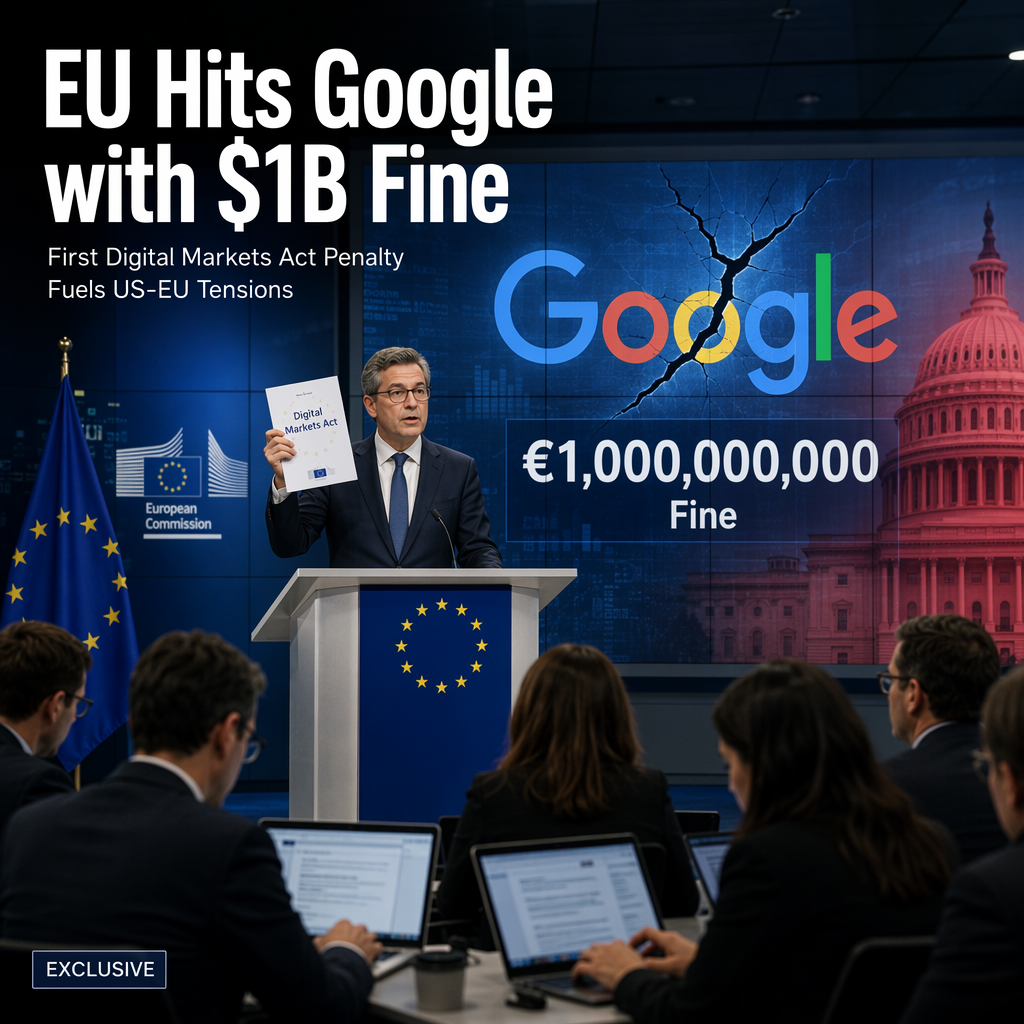
European regulators have fined Google 890 million euros ($1 billion), alleging that the company gives preferential treatment to its own services, such as shopping and hotels, over those of third parties in search results. This fine is the first imposed on Google under the European Union’s Digital Markets Act (DMA), which aims to scrutinize the operating practices of Big Tech in Europe and enforce fair competition. The EU commission also found Google in breach of anti-steering measures, stating that Google failed to allow app developers distributing via Google Play to inform customers of alternative, potentially cheaper offers and to direct customers to those offers even if they are on external websites outside the Google Play Store. The regulator ordered Google to treat third-party services in search results in a fair manner [1].
The Trump administration has strongly criticized the EU's action, warning that the $1 billion fine threatens the US-European trade relationship. U.S. Trade Representative Jamieson Greer noted that the latest fine pushes the total fines paid by Google to more than 2% of the EU's total budget, which he claims is more than some member states contribute. Greer argued that the EU continues to target the most competitive U.S. companies and that such moves undermine reasonable, constructive dialogue with Europe over trade differences, posing a real risk to the continuation of transatlantic stability [1].
In response, EU Commissioner for Democracy and Rule of Law Michael McGrath stated that the EU's legislation and regulation apply to all companies, regardless of their country of origin, and are enforced in a balanced and even-handed manner. McGrath denied any targeting of companies based on nationality. Kent Walker, President of Global Affairs at Google and Alphabet, criticized the DMA's implementation, claiming it forces Google to strip away real-time Search features and dismantle safety protections on Google Play, resulting in product degradation that harms European businesses and consumers. Walker argued that regulation should improve products, not make them worse [1].
The fine and the regulatory action have heightened tensions between the U.S. and the EU, with both sides defending their positions. The market implications are significant, as the fine represents a substantial financial penalty for Google and signals increased regulatory scrutiny for U.S. tech companies operating in Europe [1].
CONCLUSION
The EU's $1 billion fine against Google under the Digital Markets Act marks a major escalation in regulatory action against Big Tech and has triggered strong criticism from the U.S. government. The dispute underscores growing transatlantic tensions over technology regulation and trade, with potential implications for future U.S.-EU relations and the operating environment for American tech firms in Europe.