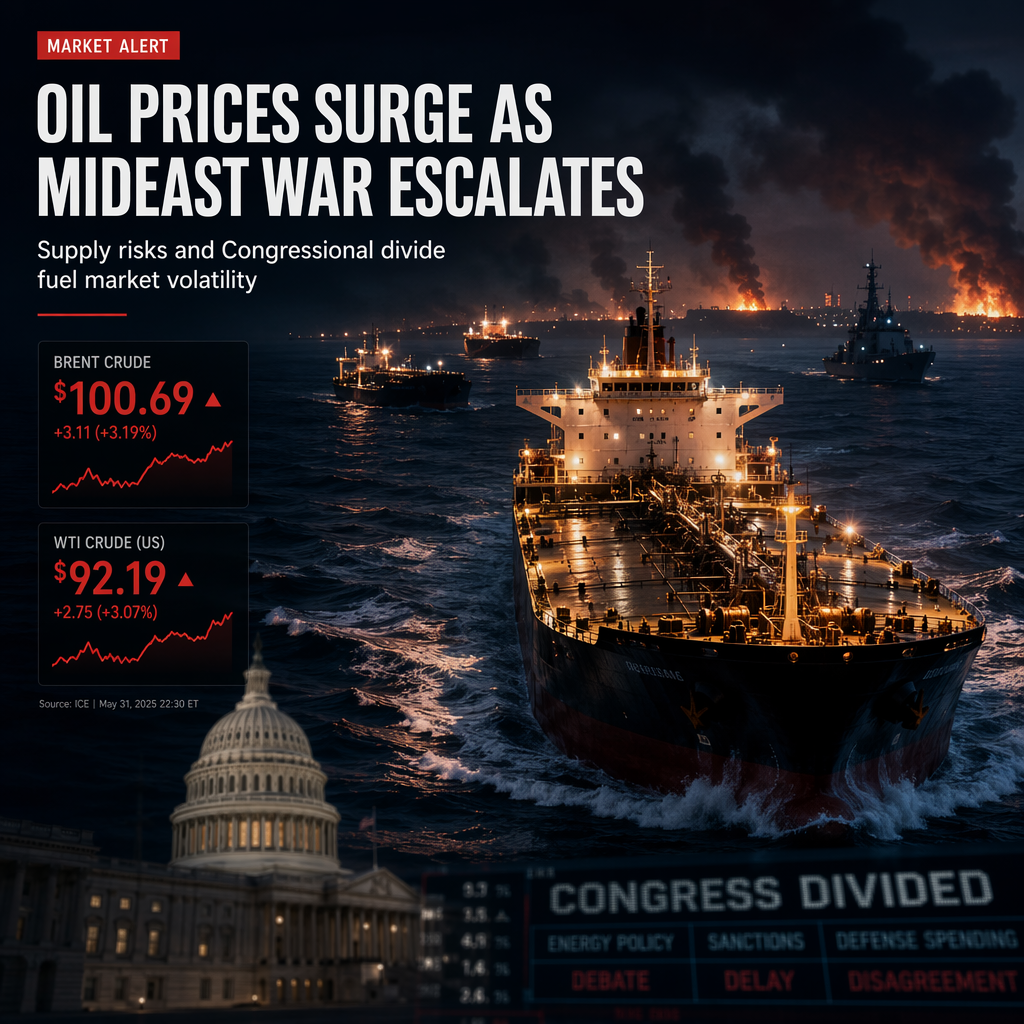
Oil prices surged to their highest levels in nearly two months following an escalation in the Iran war, which has raised concerns about significant disruptions to global energy supplies [1]. Brent crude oil, a key global benchmark, closed up 7% at $100.69 per barrel, after reaching an intraday high of $102 per barrel—the highest since late May [1]. U.S. crude oil also saw a substantial increase, closing up 6.2% at $92.19 per barrel, marking its highest close since June 4 [1].
The price spike was triggered by reports that Tehran-backed Houthi rebels attacked two Saudi oil tankers in the Red Sea and announced a naval blockade on Saudi Arabia [1]. This development is notable as it marks the first time since the Iran war began that attacks on shipping have extended beyond the Strait of Hormuz, opening a new front in the ongoing conflict [1].
On the political front, the U.S. House of Representatives approved a nonbinding proposal to end the Iran war, with four Republicans joining all Democrats in support [1]. However, the Senate rejected a joint resolution that would have had the force of law, though it would still be subject to a presidential veto [1]. One Republican, Sen. Susan Collins, joined all Democrats except Sen. John Fetterman in voting to advance the measure, while four Republicans did not vote [1]. The votes were driven by Democrats seeking to hold Republicans accountable for the unpopular war ahead of the midterm elections and to reassert Congress' constitutional role in declaring war [1].
Several Senate Republicans, including Sen. Thom Tillis and Sen. John Curtis, have stated that the war should not continue for more than 60 days without congressional approval, in compliance with federal law [1]. Despite this, both voted against the resolution, with Tillis arguing that the 60-day clock began in July, not February, when the initial strikes occurred [1]. Tillis emphasized the importance of Congress authorizing the war once the 60-day period expires, stating, "The clock is ticking. We got to get serious about that" [1].
CONCLUSION
Oil prices have surged sharply due to escalating conflict in the Middle East and new threats to global energy supplies. Congressional divisions over the authorization and continuation of the Iran war add further uncertainty to the market outlook. The situation remains volatile, with both political and supply risks driving market sentiment.