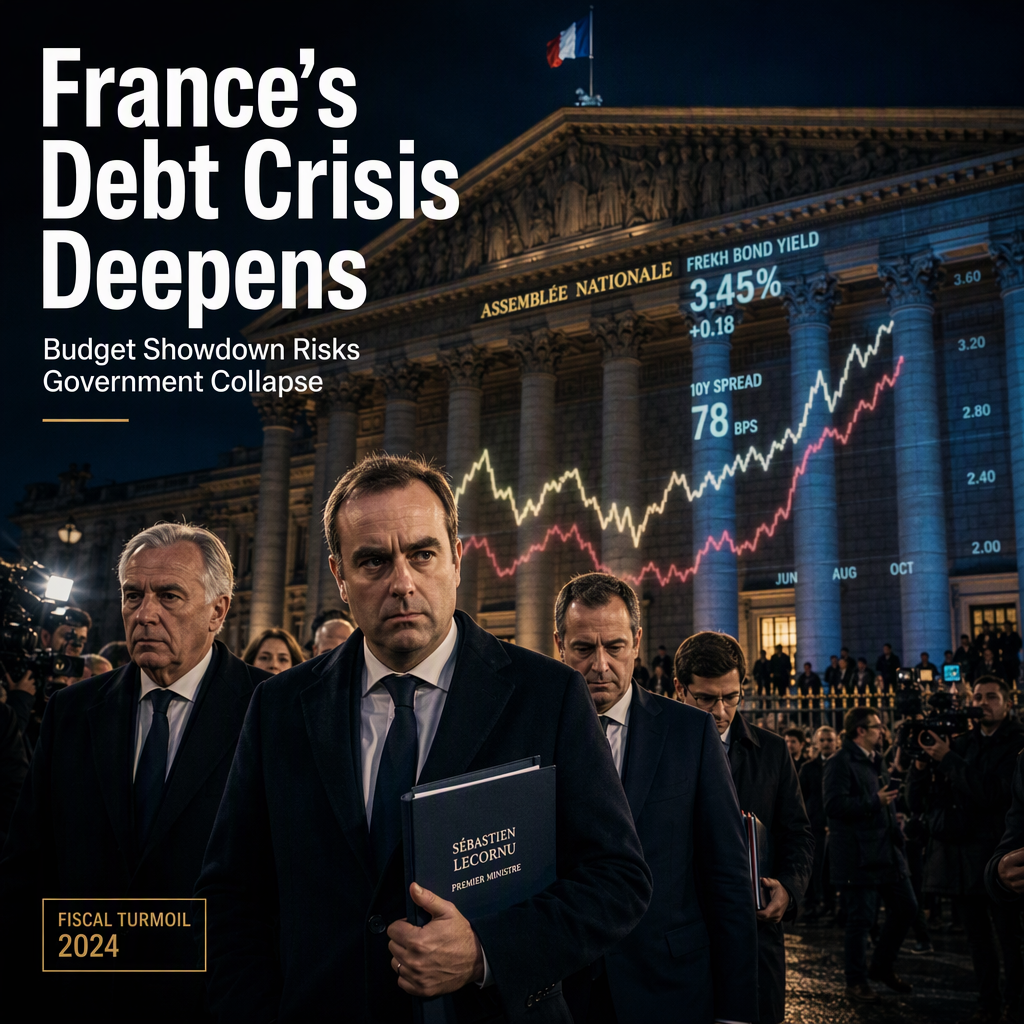
French lawmakers are under pressure to agree on a new budget by early October aimed at reducing the country's significant national deficit, amid fears that the ongoing budget negotiations could destabilize the current government yet again [1]. France is experiencing a sharp rise in its risk premium, with the yield on its 10-year government bonds (OATs) surpassing 4.5% for the first time since 2008 and recently trading at 4.53% [1]. This yield is now more than one percentage point higher than that of German 10-year bonds, marking a divergence not seen since the euro zone sovereign debt crisis in 2012 [1]. Investors are demanding higher compensation for lending to France than to Italy or Greece, and France now faces some of the highest government borrowing costs among G7 economies [1].
Prime Minister Sébastien Lecornu's minority government is set to submit a draft 2027 budget proposal to parliament in early October, targeting €54 billion ($61.8 billion) in spending cuts to address the country's growing debt and one of the euro area's largest budget deficits [1]. The French finance ministry projects national debt will reach a record 119.3% of GDP in 2026 and 121.7% in 2027 [1]. Political divisions in the National Assembly, intensified since the July 2024 snap election, have led to repeated government oustings through no-confidence votes in December 2024 and September 2025 [1]. Lecornu previously passed the 2026 budget by bypassing parliament using a constitutional clause [1].
Analysts warn that the tough measures in the draft 2027 budget, such as a partial freeze on pensions, are likely to face strong opposition from various parliamentary factions [1]. Mujtaba Rahman of Eurasia Group noted that while there is a general desire to avoid a political crisis before the upcoming presidential election, the risk of government collapse remains high if the budget is not approved [1]. Some economists argue that France's fiscal path is unsustainable, especially after Fitch downgraded the country's credit rating last year [1].
The ongoing budget battle and rising debt costs have heightened market concerns about France's fiscal stability and political outlook, with the potential for further volatility if the government fails to secure parliamentary support for its proposed spending cuts [1].
CONCLUSION
France's escalating debt costs and contentious budget negotiations have created significant political and market uncertainty. With record-high debt projections and a fragile government facing opposition to austerity measures, investors remain wary of further instability in the lead-up to the presidential election.