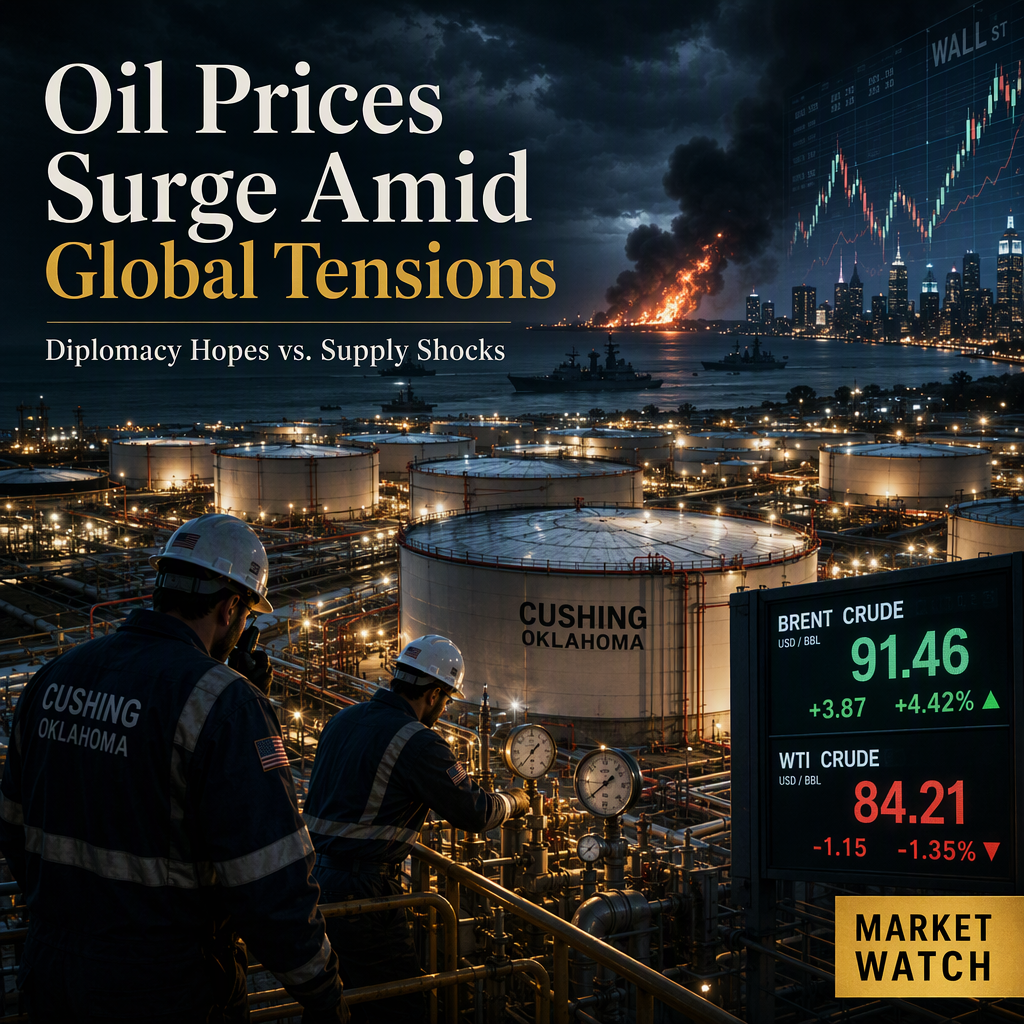
Oil markets experienced heightened volatility as geopolitical tensions between the US and Iran escalated, with fresh attacks reported in the Strait of Hormuz tightening physical oil markets and driving record premiums at Cushing, Oklahoma, the largest US storage hub [1]. Brent crude surged 3.9% to around USD103, reflecting strong demand for immediate supply and concerns over disruptions, despite Saudi Arabia's partial restart of a key pipeline offering only limited relief [1]. Meanwhile, President Trump indicated support for a potential ban on US diesel exports, citing ongoing conflicts in Iran and Ukraine as factors behind record diesel prices, though the administration's stance remained uncertain during the session [1]. Five-year US Treasury yields also spiked, briefly surpassing 5% for the first time in nearly two decades, with their correlation to Brent prices reaching the highest level since 1989 [1].
In contrast, West Texas Intermediate (WTI) crude fell below $91.50, trading around $91.40 during early Asian hours, as hopes for diplomatic progress between the US and Iran emerged [2]. Iran stated it remained open to diplomacy to resolve conflicts, reviewing Washington's response to its peace proposals, which include lifting a US naval blockade and reopening the Strait of Hormuz [2]. Market participants began unwinding part of the geopolitical risk premium as Gulf supply recovered and diplomatic prospects improved, though analysts cautioned that the physical market remains far from normalized and highly sensitive to headlines [2].
US crude oil inventories unexpectedly rose by 2.969 million barrels for the week ending September 18, according to the Energy Information Administration (EIA), contrasting with a previous decline of 640,000 barrels and market expectations for a 700,000-barrel draw [2]. This inventory build contributed to the downward pressure on WTI prices [2].
Analysts at TD Securities described the energy market as finely balanced, with risks in both directions: increased refiner runs could ease product market tightness but re-tighten crude, while a crude rally could falter if increased flows are not matched by refiner uptake, potentially pushing product prices higher until demand destruction occurs [2]. They also noted that elevated flows through the Strait of Hormuz may signal a loss of Iranian leverage, possibly making Iran more open to a deal, but also increasing the risk of escalation as Iran seeks to reassert control [2].
Technical analysis indicates that WTI maintains a near-term bullish bias, with prices above the 100-day moving average and lower Bollinger Band, though momentum has turned neutral, suggesting consolidation rather than a decisive reversal [2].
CONCLUSION
Oil markets remain highly sensitive to geopolitical developments, with physical supply tightness and diplomatic signals from Iran driving sharp price swings. While Brent surged on renewed conflict and supply concerns, WTI retreated on hopes for diplomacy and a surprise US inventory build. The market outlook remains uncertain, with analysts highlighting both upside and downside risks amid ongoing volatility.