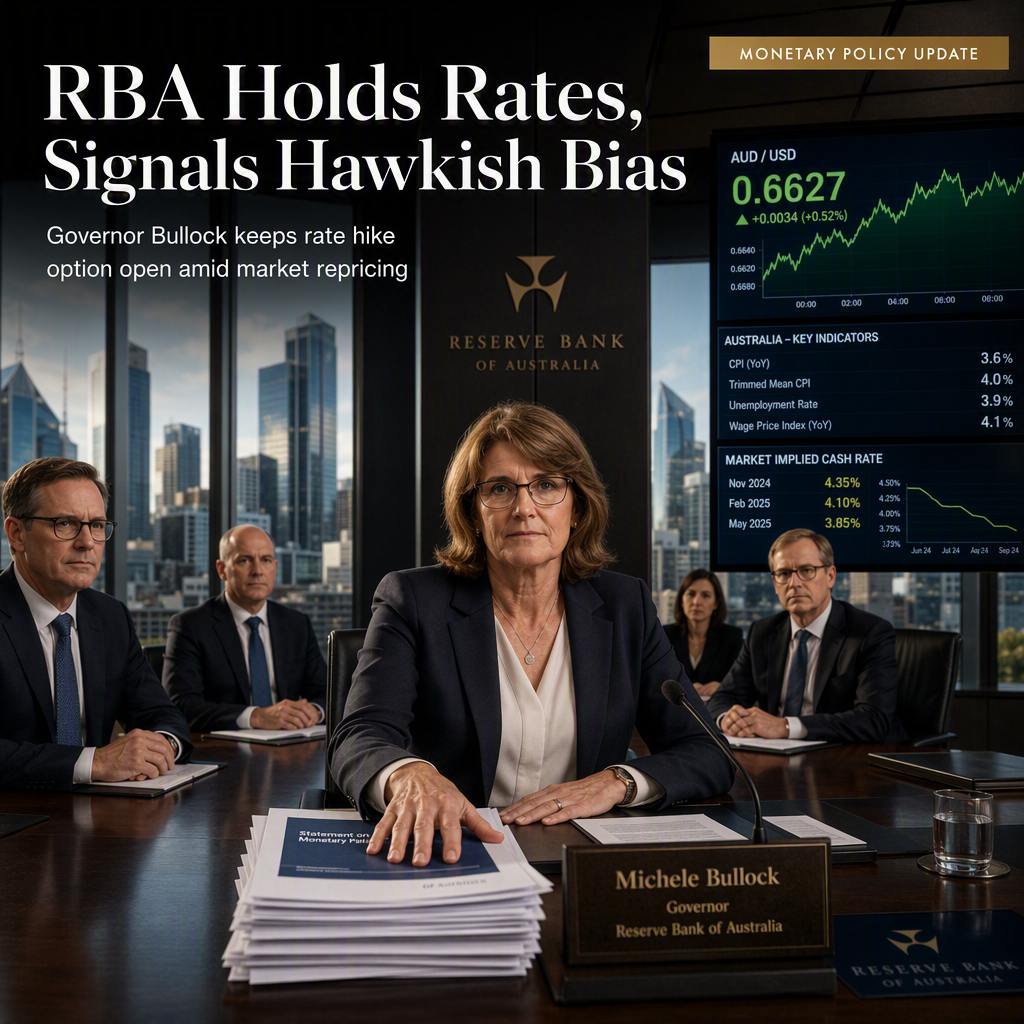
The Reserve Bank of Australia (RBA) decided to keep its Official Cash Rate (OCR) unchanged at 4.35% for the second consecutive meeting, as widely anticipated by the market [2]. The decision was accompanied by a statement that included downward revisions to the RBA's growth and inflation forecasts, which traders interpreted as dovish, leading to a brief slip in the Australian Dollar (AUD) [1][2]. Despite this, the AUD attracted bids against major peers but remained marginally lower at around 0.7050 against the US Dollar during the European session on Tuesday [2].
RBA Governor Michele Bullock emphasized in her press conference that another rate hike is 'quite possible,' stating, 'We will raise rates again if needed,' and highlighting that the economy remains above capacity [1][2]. Policymakers debated whether to hold or hike at the meeting, and the RBA kept the door open for a potential fourth rate hike this year, citing persistent upside risks to inflation [1][2]. However, market experts, including TD Securities, interpreted the statement and revised forecasts as less hawkish than expected, suggesting that a rate hike is not the central forecast and that the bar for further tightening has been raised [2].
Analysts at Ernst & Young (EY) echoed the RBA's caution, noting that the decision should not be seen as an 'all-clear' on inflation and that there remains a material risk of further policy tightening if inflation proves more persistent than expected [2]. In contrast, Commerzbank analysts observed that the RBA's communication and updated projections, including an upward revision to the expected unemployment rate, point to a softer near-term outlook and do not read as particularly hawkish [2].
Rabobank's Australia strategist continues to expect one more rate increase in November, expressing skepticism that the three rate hikes since the start of the year will be sufficient to dampen domestic demand [1]. The overall market reaction has been muted, with the AUD showing only marginal movement and rate hike expectations being repriced lower by market participants [1][2].
No direct references to the RBA decision were made in the US-focused articles, which instead discussed Federal Reserve policy and US Dollar volatility [3][4].
CONCLUSION
The RBA's decision to hold rates steady was interpreted as dovish by markets, but Governor Bullock maintained a hawkish bias, keeping the possibility of further hikes alive. While some analysts see a material risk of additional tightening, others view the RBA's stance as less hawkish, leading to a repricing of rate hike expectations. The market impact has been moderate, with the AUD showing limited movement and future policy moves remaining data-dependent.