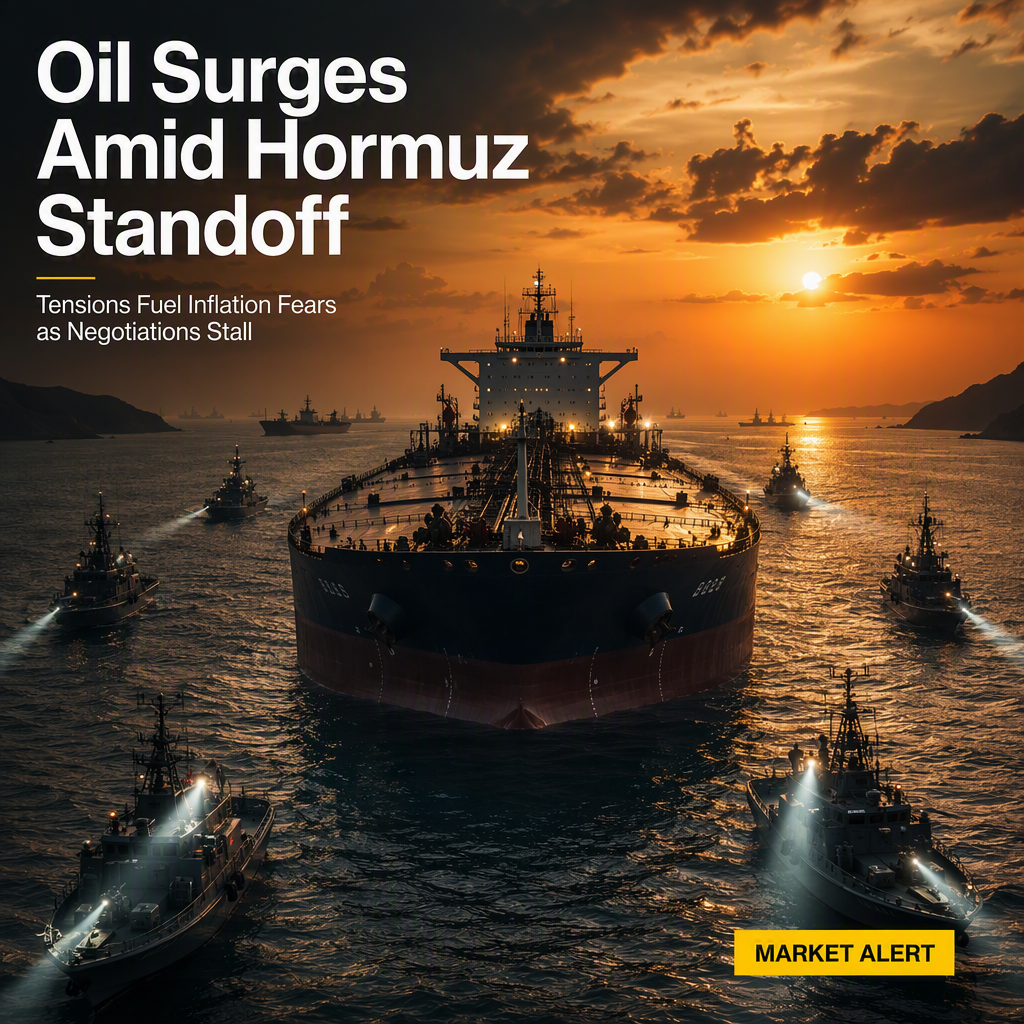
Oil prices surged for a second consecutive day on Tuesday, driven by escalating tensions and a lack of progress in negotiations to reopen the Strait of Hormuz. West Texas Intermediate (WTI) crude traded at $83.50 during the European session, marking a nearly 10% increase from last week’s closing prices, while U.S. WTI futures rose 2.7% to $84.36 a barrel at 4:30 a.m. ET, their highest level this month [1][3]. International benchmark Brent crude also rallied, breaking above $85 and closing near $88, with a 4.99% gain to $87.72 per barrel and a 2.53% increase to $89.94 per barrel reported [2][3]. The ongoing closure of the Strait of Hormuz, with only six vessels crossing on Monday compared to a pre-war average of 130 to 160, has severely restricted oil flows and contributed to the price spike [1].
The deadlock between the U.S. and Iran has intensified, with both sides now demanding reparations for war damages, further delaying any potential peace agreement or reopening of the vital shipping corridor [1][3]. Tehran has restructured its military leadership, appointing Mohsen Rezaee as Secretary of the Supreme National Security Council, a move seen as signaling skepticism toward negotiations with the U.S. [1]. Meanwhile, President Donald Trump asserted that the U.S. has "100%" control of the Strait, though contradictory statements from both governments have left traders uncertain about the prospects for a deal [3].
The market reaction has been pronounced, with Deutsche Bank strategists highlighting that Brent's rally and the closure of Hormuz have revived inflation concerns and speculation about more hawkish Federal Reserve and European Central Bank rate paths [2]. The 6-month Brent future rose 4.44% to $80.24 per barrel, and the 1-year Euro inflation swap climbed 12.6 basis points to 2.39% [2]. U.S. crude oil stockpiles have also fallen to their lowest level in more than four decades, adding further upward pressure on prices [3]. The Trump administration responded by extending a suspension of a shipping law, though the waiver was narrowed to vessels hauling certain energy resources [3].
Analysts from ING noted that the oil market remains "very headline-driven," with prices whipsawing on shifting news. They cautioned that optimism for a deal is fading and that "risks remain skewed to the upside for oil prices" given the current rhetoric and unresolved issues [3].
CONCLUSION
The deepening standoff over the Strait of Hormuz has driven oil prices to multi-month highs, stoked inflation fears, and heightened expectations of more aggressive central bank policies. With negotiations stalled and both sides demanding reparations, the market remains volatile and risks to oil prices are tilted upward. Traders and analysts are bracing for continued uncertainty as geopolitical tensions persist.