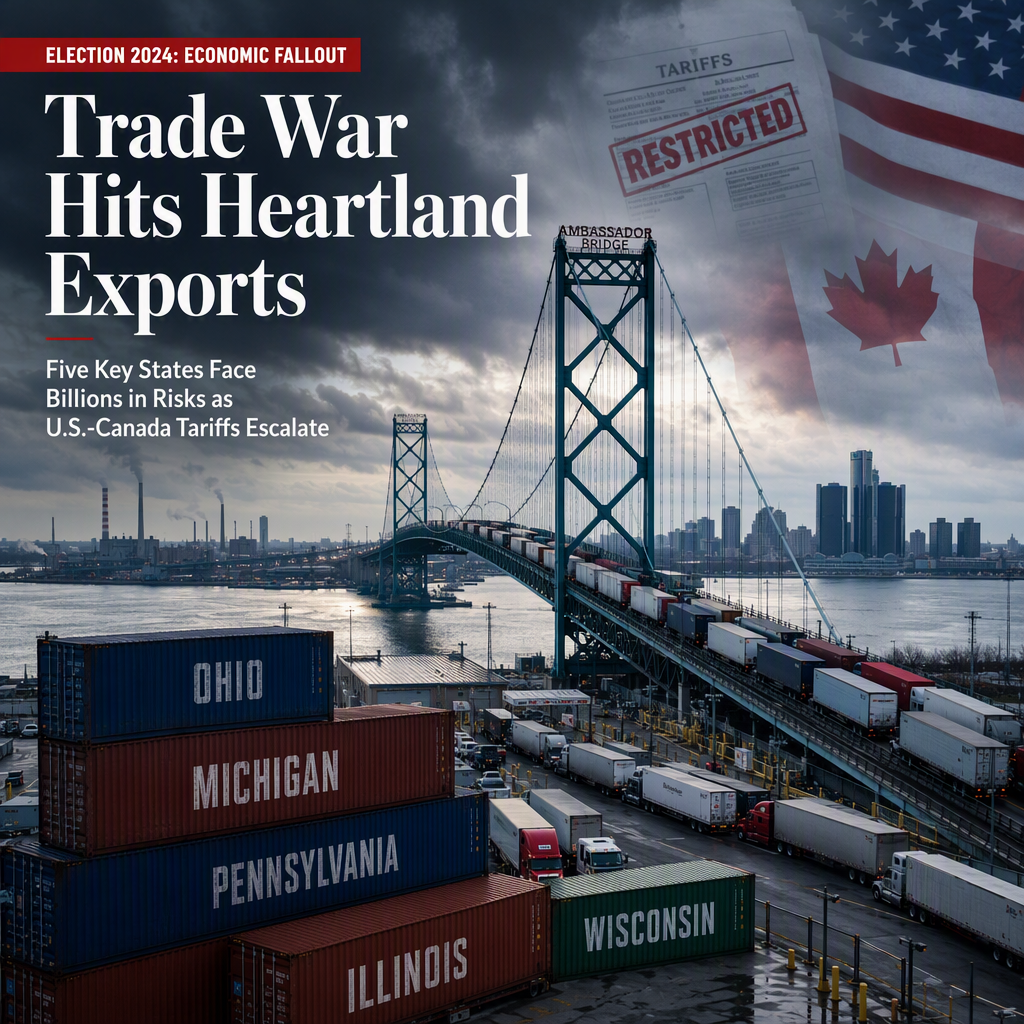
President Donald Trump has intensified his trade war with Canada, exposing billions of dollars in U.S. exports to retaliatory tariffs from the northern neighbor, according to expert analysis [1]. The tariffs target a wide range of American goods, with the most significant impact expected in five battleground states: Ohio, Illinois, Michigan, Pennsylvania, and Wisconsin [1]. David Clement, policy director at the Consumer Choice Center, highlighted that these states are particularly vulnerable due to their substantial trade with Canada and the specific goods affected by the tariffs [1].
Ohio stands out as the most exposed, with an estimated $2.3 billion in exports to Canada at risk, primarily in machinery, transportation products, minerals, and metals [1]. In Michigan, the auto industry is especially susceptible, as supply chains with Ontario are highly integrated. Clement noted that a single component on a U.S.-assembled vehicle can cross the border up to eight times before completion, and tariffs on automotive parts disrupt this intricate supply chain, potentially increasing costs for consumers [1].
Pennsylvania also faces considerable risk, with about 25% of its exports—just under $1.8 billion—going to Canada, mainly in machinery and equipment [1]. The escalation of tariffs has already led to rising costs for U.S. businesses and consumers, with affordability remaining a key concern for voters ahead of the November elections [1].
While President Trump continues to defend tariffs as a means to boost domestic manufacturing and secure more favorable trade agreements, the immediate effect has been higher prices for American families and businesses [1]. Clement suggested that even a potential shift in congressional control after the elections may not bring an end to the tariffs, indicating ongoing uncertainty for affected industries and states [1].
CONCLUSION
The escalation of the Trump-Canada trade war places billions in U.S. exports from key states at risk, with immediate cost increases for businesses and consumers. Despite political uncertainty, tariffs are expected to remain a central issue, impacting both the economy and the upcoming elections.