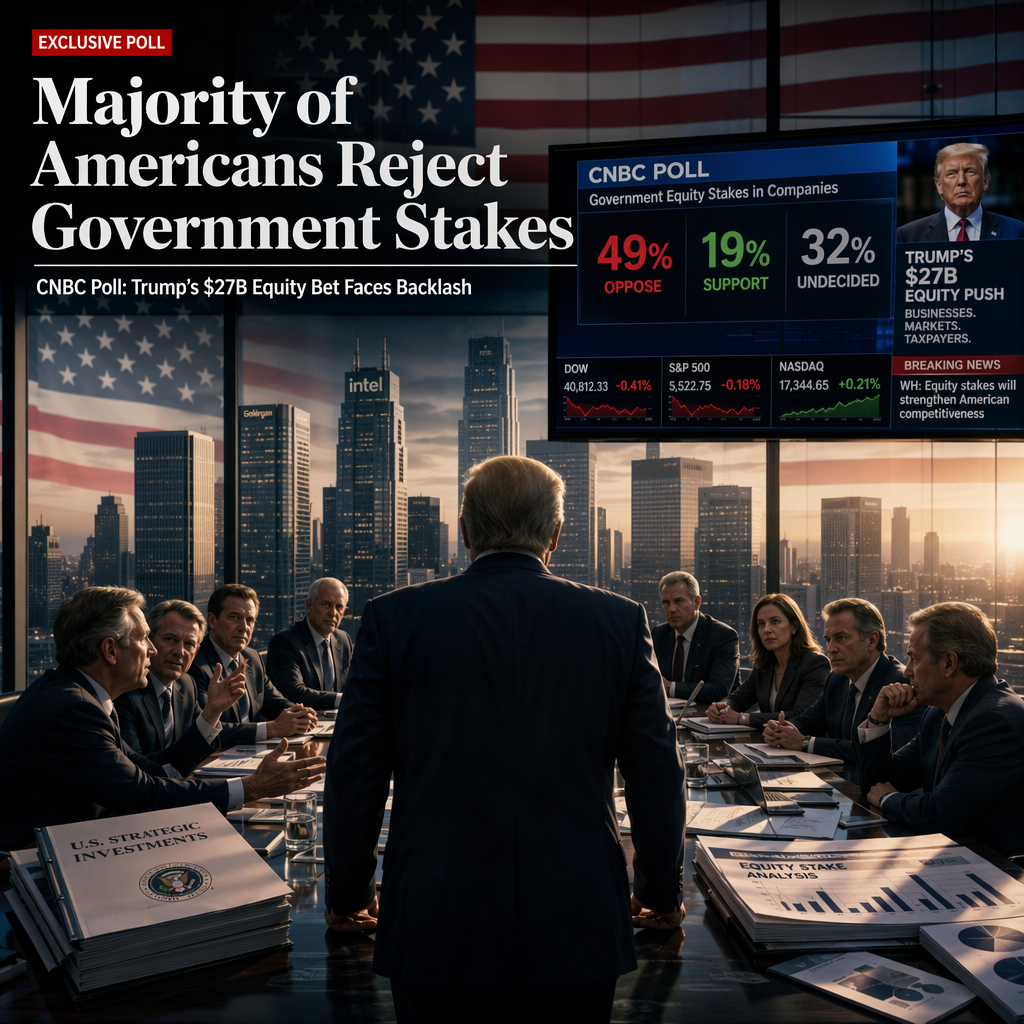
The Trump administration has advanced a significant policy of acquiring equity stakes in U.S.-based companies, negotiating 30 deals totaling nearly $27 billion, according to the Council on Foreign Relations [1]. This initiative includes discussions with OpenAI regarding a potential government stake if the company goes public [1]. However, a CNBC All-America Economic Survey conducted July 8-12, 2026, found that 49% of U.S. voters believe it is inappropriate for the federal government to take ownership stakes in domestic companies, compared to only 19% who support the idea, and 32% who remain undecided [1].
A notable example of this policy is the U.S. government's 10% ownership stake in chipmaker Intel (INTC), which originated from an $8.9 billion grant provided under Biden-era legislation. The Trump administration converted this grant into equity, arguing that taxpayers should benefit from any potential upside. As of Thursday's market close, the value of the government's stake in Intel had surged 372% to $42 billion [1].
The policy has sparked debate among lawmakers. Commerce Secretary Howard Lutnick discussed the Intel stake with Senate Republicans, with Sen. John Hoeven expressing caution about the approach, and Sen. Jon Husted advocating for limits on the duration of government ownership. Husted is sponsoring legislation to restrict such investments to a maximum of eight years, emphasizing that government stakes should not be permanent, even if justified by national security or taxpayer interests [1].
Beyond Intel, the government has also taken stakes in companies like MP Materials to secure access to critical resources such as rare earths, which are essential for national defense technologies. This move comes as China consolidates its control over global rare-earth mining, raising concerns about U.S. supply chain security [1].
Critics have voiced concerns about the broader implications of government involvement in private companies, though specific criticisms were not detailed in the article [1].
CONCLUSION
The Trump administration's push for government equity stakes in U.S. companies has generated significant public skepticism and political debate, despite notable financial gains such as the Intel investment. The policy's future may hinge on legislative efforts to limit the scope and duration of government ownership, as well as ongoing concerns about national security and market intervention.