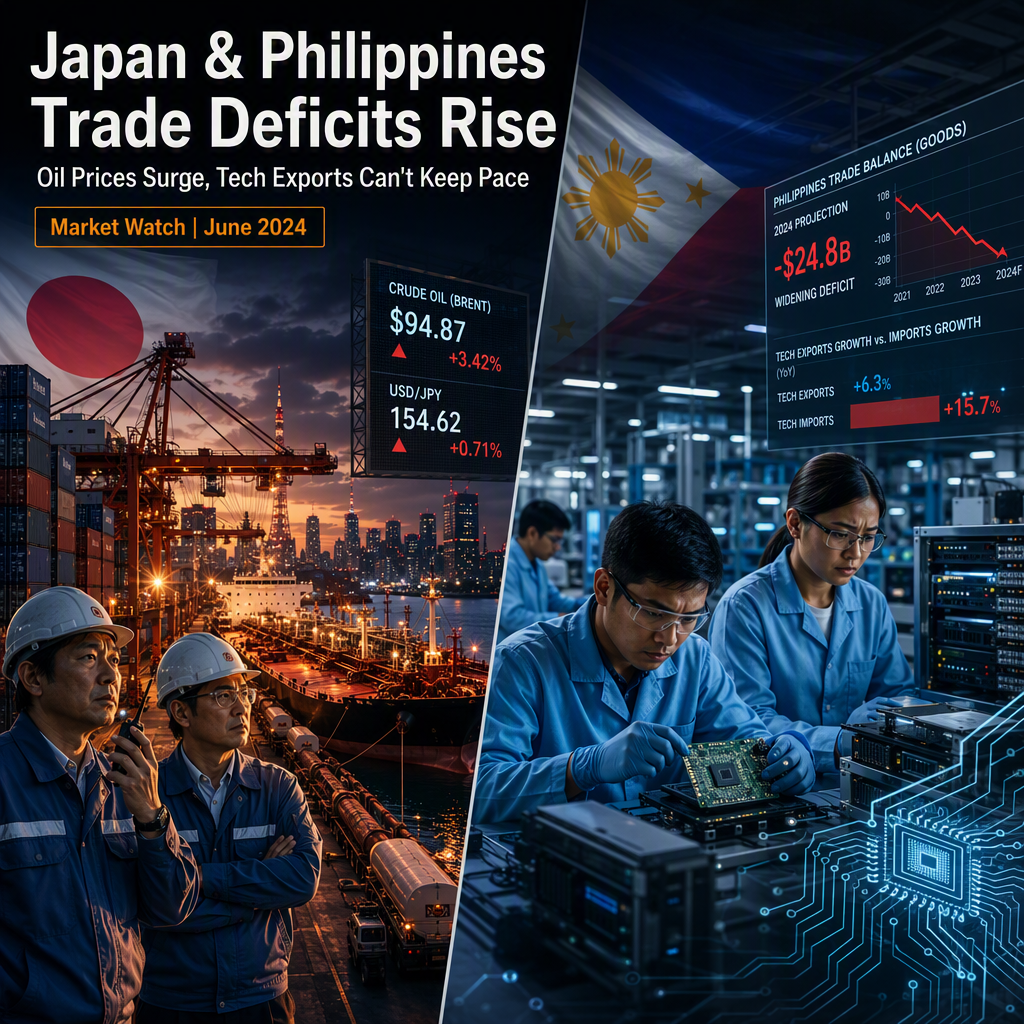
Japan and the Philippines both reported widening trade deficits for June, marking the second consecutive month of negative trade balance for Japan and an expanded monthly deficit for the Philippines, according to government statistics released by both countries on Thursday [1]. The deficits are attributed to rising oil prices, driven by the ongoing war in Iran and increased global demand amid the AI boom, which are putting pressure on trade balances and local currencies across Asia [1].
While some Asian economies, such as South Korea, are benefiting from surging tech exports—particularly semiconductors and chips, with South Korea's exports in June surpassing $100 billion for the first time—Japan and the Philippines have not been able to fully offset the negative impact of elevated oil prices despite some growth in tech exports [1]. As a result, energy imports continue to outpace gains from tech exports in these countries, exacerbating their trade deficits [1].
Market analysts warn that if high oil prices persist, Japan and the Philippines could experience sustained currency weakness and further deterioration in their trade balances [1]. They suggest that unless these economies can significantly increase tech exports or find alternative energy sources, financial pressures are likely to continue [1]. A Tokyo-based market analyst noted, "The AI boom has driven demand for chips, but rising oil prices related to the Iran war are offsetting these gains" [1]. A regional financial strategist added, "Economies that cannot fully ride the tech export wave will continue to face currency and trade balance pressures" [1].
Market sentiment remains cautious, with traders closely monitoring energy price trends and tech export data [1]. Technical analysis indicates that stronger tech export growth is needed to improve trade balances, but resistance remains high due to persistent energy costs [1]. Investors and traders are advised to keep a close watch on these factors, as local currencies are expected to remain under pressure unless there is a significant shift in export growth or energy prices [1].
CONCLUSION
Japan and the Philippines are facing mounting trade and currency pressures due to rising oil prices and insufficient tech export growth to offset these costs. Unless there is a significant change in energy prices or a surge in tech exports, both countries are likely to continue experiencing financial strain. Market participants are advised to monitor energy and tech export trends closely for signs of recovery.