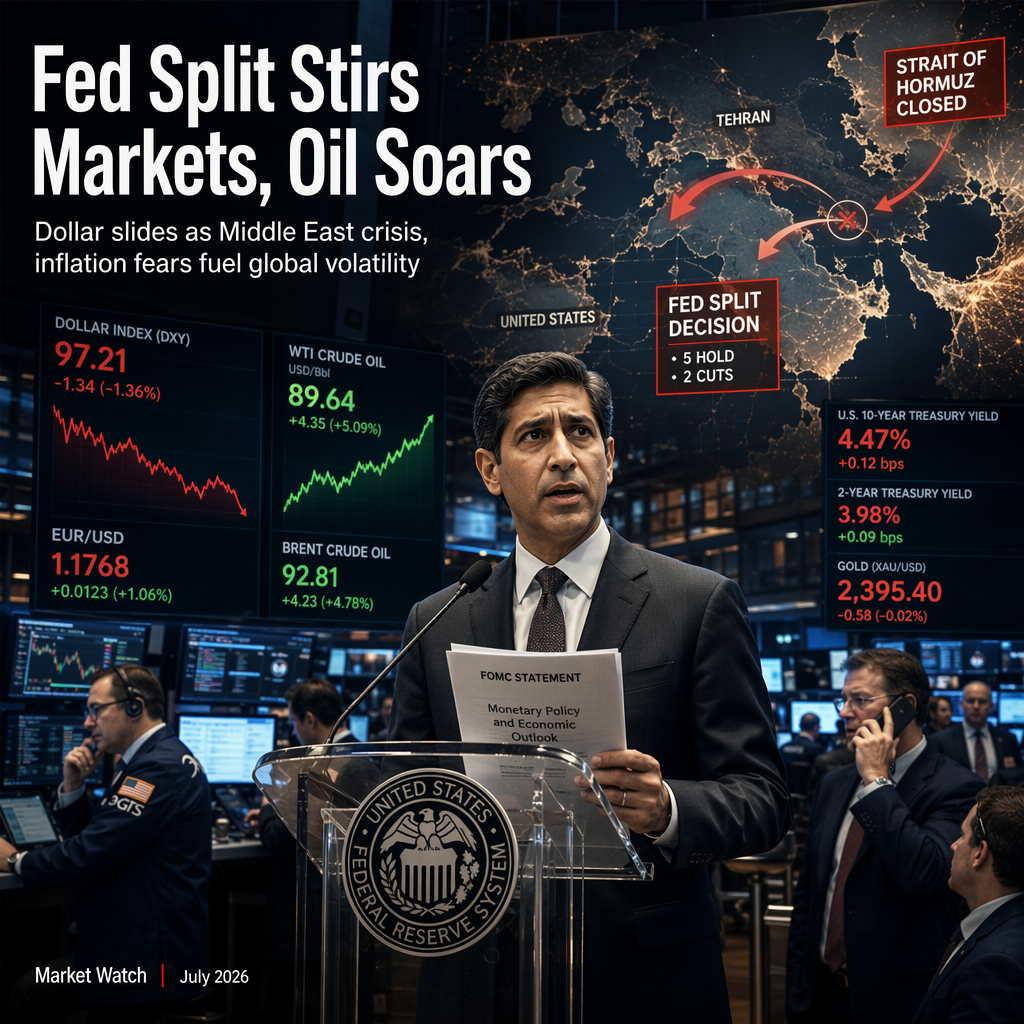
The Federal Reserve opted to keep its policy rate unchanged at 3.5%-3.75% during its July meeting, marking the fifth consecutive hold, but the decision was notably split with three officials dissenting in favor of a 25-basis-point hike, highlighting internal concerns about persistent inflation [1][3][4][5][6]. Fed Chairman Kevin Warsh emphasized the committee's readiness to act swiftly if inflation pressures accelerate, stating, 'I asked for a good family fight, and I got one. That's the purpose. That's the design feature' [1][5][6]. Despite the hawkish undertones, the immediate market reaction saw the US Dollar weaken, with the Dollar Index falling 0.5% to 100.89 and EUR/USD gaining 80 pips to 1.1470 [3][4]. However, longer-dated US Treasury yields rose sharply, with the 30-year yield reaching its highest level since 2007, while the 2-year yield fell [2][6]. The probability of the Fed leaving rates unchanged at its next meeting increased by 20 percentage points to 45%, according to CME FedWatch [6]. ING strategists and Commerzbank analysts noted that the Fed's messaging was less hawkish than expected, with ING highlighting that real yields fell 7bp after the press conference and warning that upcoming US GDP and PCE data could drive further Dollar correction, potentially pushing DXY toward 100.50 ahead of the September FOMC [2][4]. The market consensus for Q2 US GDP is at 2% QoQ annualized, with the Atlanta Fed GDPNow forecast at 1.6% as of July 27, 2026 [2][4]. Meanwhile, the New Zealand Dollar (NZD) strengthened against the US Dollar, trading near 0.5810, supported by bets on further RBNZ rate hikes following hotter domestic inflation, with New Zealand's annual CPI inflation rising to 4.10% in Q2 2026 from 3.1% in Q1 [1]. Financial markets are pricing in at least two more OCR hikes to 3.0% this year [1]. The British Pound (GBP) declined against the Dollar, with GBP/USD near 1.3345, as hawkish Fed signals and escalating Middle East tensions weighed on the currency [5]. Societe Generale analysts flagged downside risks for GBP/USD, warning that a hawkish Fed could hasten a return to below 1.32 [5]. Geopolitical tensions surged as US forces launched strikes against Iran late Wednesday, following President Donald Trump's threat to retaliate for Iranian missile attacks on American forces in the region [5][6]. Oil prices responded sharply, with Brent climbing 2.09% to $92.64 a barrel and US West Texas Intermediate up 1.46% to $85.66 [6]. The closure of the Strait of Hormuz for five months due to the US-Iran conflict has intensified inflation pressures, impacting central bank policy decisions globally [5].
CONCLUSION
The Fed's split decision and hawkish rhetoric, combined with escalating Middle East tensions and surging oil prices, have triggered significant volatility across currency and bond markets. The US Dollar weakened initially but stabilized, while longer-term yields rose and commodity prices surged. Forward-looking analyst commentary suggests further Dollar correction risk, with upcoming US economic data and geopolitical developments likely to drive market direction in the near term.