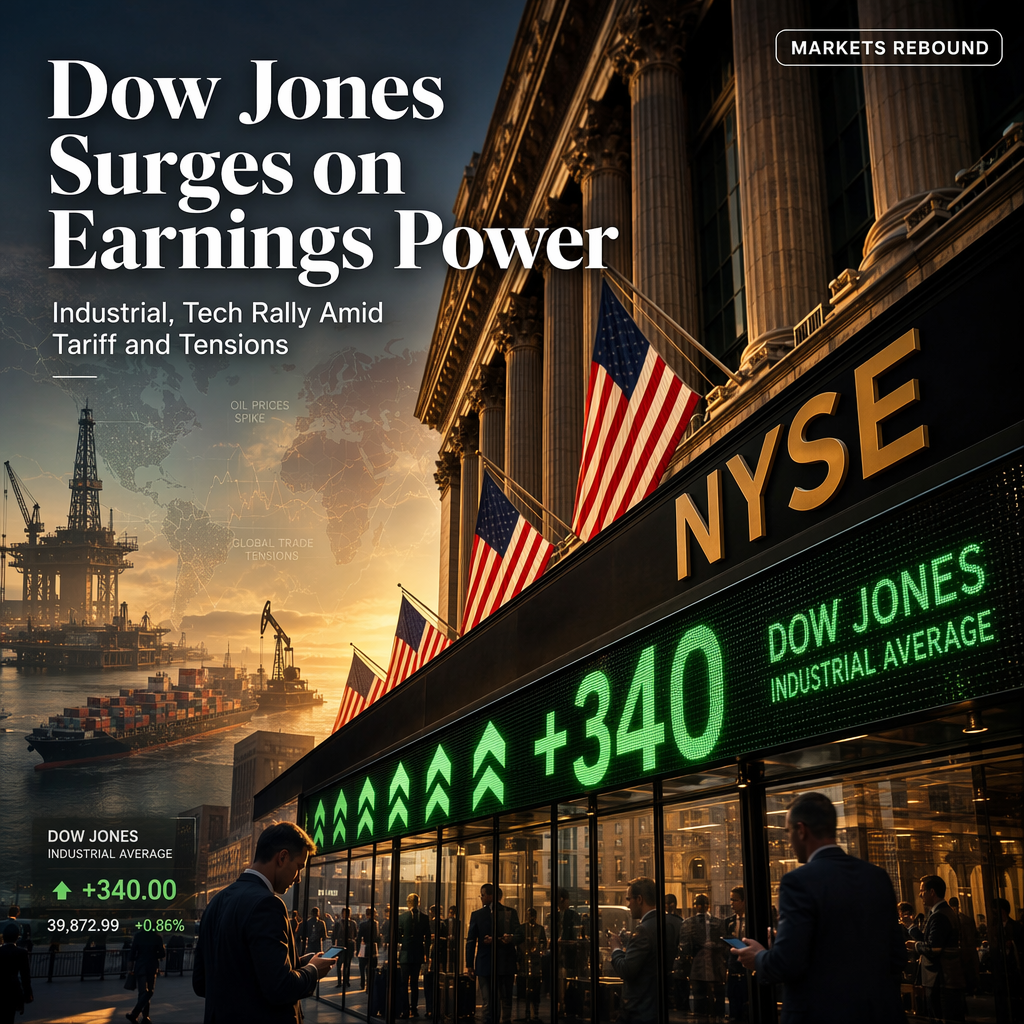
The Dow Jones Industrial Average (DJIA) climbed approximately 340 points, or 0.7%, on Tuesday, breaking a three-day losing streak that had pulled the index away from its early July record just above 53,300. At midday in New York, the DJIA was trading just below the 52,200 level, about 2% short of its recent high-water mark [1]. The rebound was fueled by strong corporate earnings, with 3M (MMM) surging more than 9% after a second-quarter beat and General Motors (GM) gaining 3% after exceeding both revenue and profit estimates. According to FactSet, nearly 88% of the roughly 66 S&P 500 companies reporting so far have topped profit estimates, highlighting a robust earnings season. Semiconductors also contributed significantly, with the iShares Semiconductor ETF (SOXX) up 5%, Micron (MU) rising 7%, Intel (INTC) up more than 5%, and Marvell Technology (MRVL) gaining around 6% [1].
Despite the positive earnings momentum, geopolitical and trade tensions provided a counterweight. The ongoing CENTCOM air campaign against Iran entered its tenth consecutive night, with crude oil prices responding: West Texas Intermediate (WTI) climbed back above $85 and Brent rose above $91, while crude oil added 2% on the day. However, equity investors appeared to treat the conflict as background noise, with reports of a mediator-drafted, 10-day ceasefire proposal offering a faint hope for peace [1].
On the trade front, the U.S. implemented a 50% tariff on most Canadian goods on Monday, citing discrimination against American products. U.S. Trade Representative Jamieson Greer indicated that further action against dozens of countries is imminent, referencing a Financial Times report about a new tariff wave before the current 10% global levy expires. This shift in focus from geopolitical to trade tensions was seen as a strategic move by the administration, especially in light of June's Consumer Price Index (CPI) data, which fell 0.4% month-over-month and cooled to 3.5% year-over-year. However, the CPI decline was largely attributed to a sharp drop in gasoline prices, which fell 9.7% in a month, and the underlying ceasefire that contributed to lower energy prices had already collapsed [1].
Additionally, the U.S. import bill showed all-import prices rising 7.1% year-over-year in June, the fastest pace since August 2022, with nonfuel imports also increasing. Sell-side analysts cautioned that, after the market's run to record highs, strong results may no longer be sufficient to sustain momentum, as expectations have become elevated and companies missing estimates are facing swift market penalties [1].
CONCLUSION
The Dow Jones rebounded on the back of strong earnings reports, particularly in the industrial and semiconductor sectors, but faces headwinds from escalating trade tensions and persistent geopolitical risks. While the market responded positively to corporate performance, analysts warn that elevated expectations could lead to increased volatility if companies fail to deliver. The combination of robust earnings and external uncertainties suggests a high-impact environment for investors.