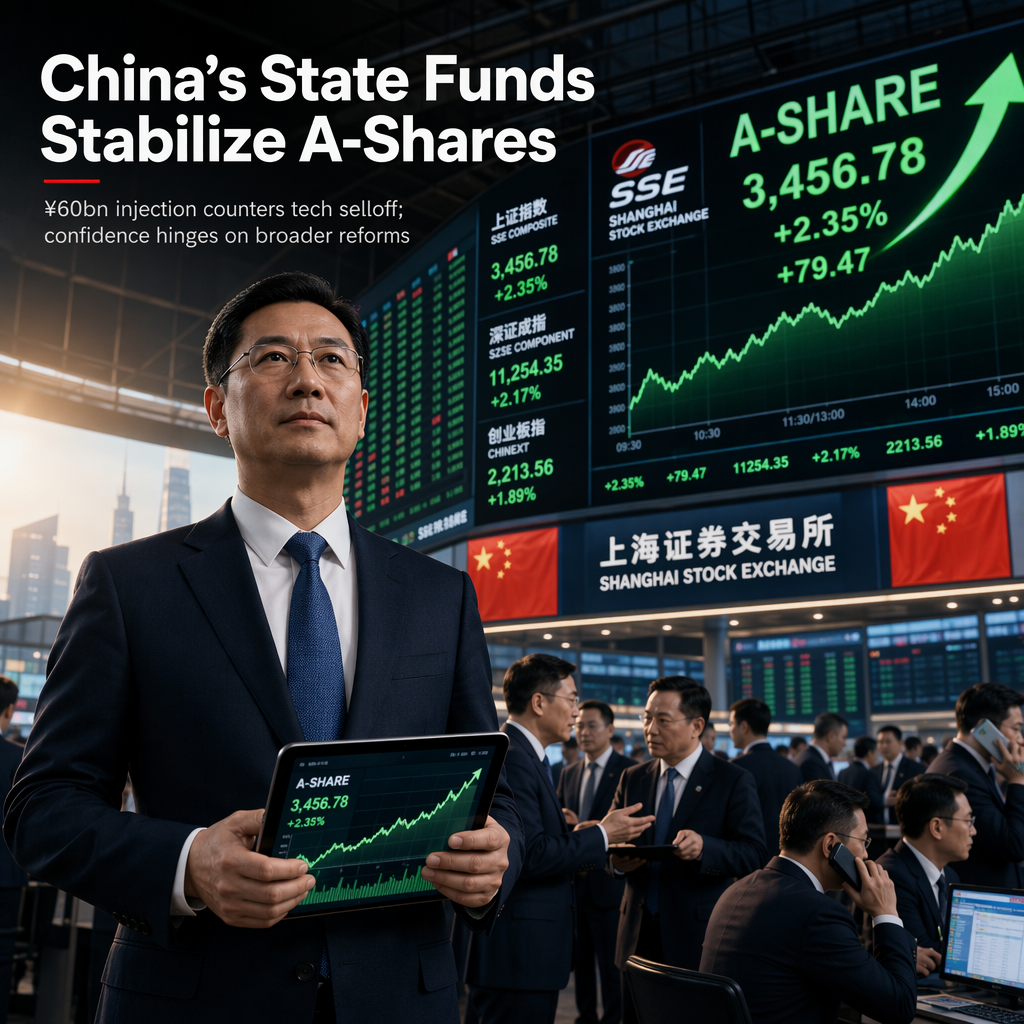
China's regulators and state-backed funds, collectively referred to as the 'national team,' intervened to stabilize A-share markets following volatility triggered by global tech deleveraging and profit-taking that affected domestic equities [1]. On Monday, the China Securities Regulatory Commission convened an investor symposium, emphasizing enhanced supervision, investor protection, and a commitment to stable market operations [1]. In a concrete move, the national team injected approximately ¥60 billion through stock buyback re-lending facilities, with centrally administered state firms purchasing shares in state-owned enterprises (SOEs), technology companies, and exchange-traded funds (ETFs) [1].
According to BNY’s Geoff Yu, institutional flows into Chinese equities rebounded significantly last week after substantial sales throughout much of June, indicating that the intervention was anticipated by market participants [1]. The report notes that while retail investors shifted from selling in early April to strong buying in mid-June, recent momentum has turned, and it remains uncertain whether retail participation will continue to increase [1].
The official backing of institutional flows is seen as an upside risk to Asia-Pacific (APAC) market sentiment as the month-end approaches, especially with the upcoming end-July politburo meeting expected to set China's growth agenda for the remainder of the year [1]. However, BNY’s analysis stresses that these state-backed equity purchases are aimed at market protection rather than addressing broader macroeconomic issues such as weak domestic demand or challenges in the property sector [1]. While Beijing’s actions can stabilize market benchmarks and reduce downside pressure, restoring investor confidence will require a stronger growth impulse [1].
CONCLUSION
China's state-backed intervention has provided short-term stability to A-shares, boosting institutional flows and supporting market sentiment in the region. However, analysts caution that these measures address market volatility rather than underlying economic challenges, and sustained confidence will depend on broader growth initiatives.