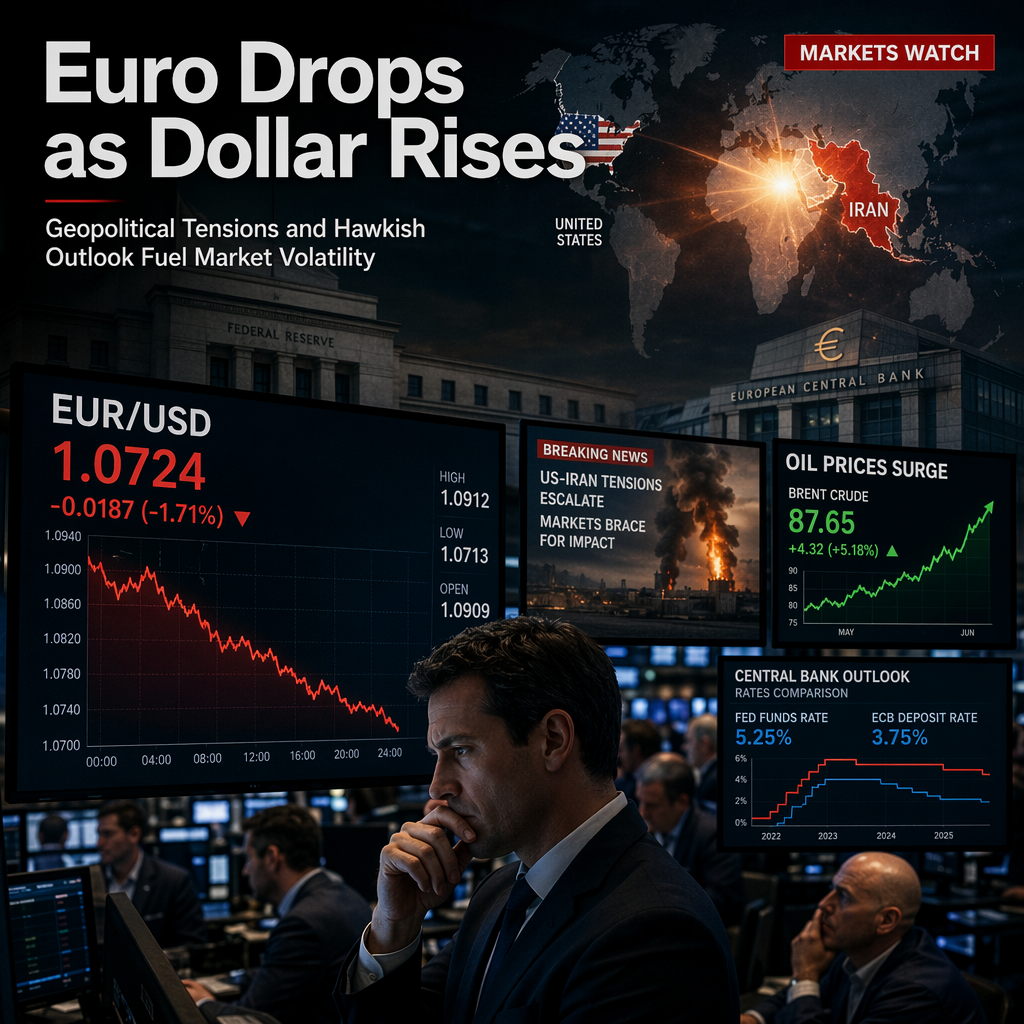
The Euro (EUR) declined to near 1.1425 against the US Dollar (USD) during Thursday's European trading session, as the US Dollar recovered most of its early losses. This rebound in the Greenback was attributed to increased demand for safe-haven assets following renewed geopolitical risks, specifically the exchange of attacks between the United States and Iran. President Donald Trump confirmed that the Memorandum of Understanding (MoU) with Iran is over, and US military forces have attacked Iranian infrastructure, suggesting that tensions could persist [1].
The US Dollar Index (DXY), which measures the USD against six major currencies, traded marginally lower around 101.00 after rebounding from a session low of 100.80 [1]. The heightened geopolitical tensions have also led to higher oil prices, particularly due to diminished traffic near the Strait of Hormuz. This has de-anchored inflation expectations, a development that could discourage the Federal Reserve from reducing interest rates this year. The FOMC Minutes from the June policy meeting, released on Wednesday, indicated that policymakers continue to view inflation as the dominant risk, with several officials believing that further tightening could become necessary [1].
On the European side, traders have increased their expectations for a more hawkish European Central Bank (ECB) stance, as oil prices have surged following the escalation in US-Iran tensions. According to a Reuters report cited in the article, traders have priced in an additional 30 basis points increase in ECB policy rates this year. In June, the ECB had already raised its key rates by 25 basis points [1].
Overall, the combination of geopolitical uncertainty, rising oil prices, and hawkish signals from both the Fed and the ECB has contributed to heightened volatility in the EUR/USD pair and broader currency markets [1].
CONCLUSION
The Euro's decline against the US Dollar reflects heightened geopolitical risks and shifting central bank expectations. Rising oil prices and persistent inflation concerns are prompting traders to anticipate tighter monetary policy from both the Federal Reserve and the ECB. Market volatility is likely to remain elevated as these factors continue to unfold.