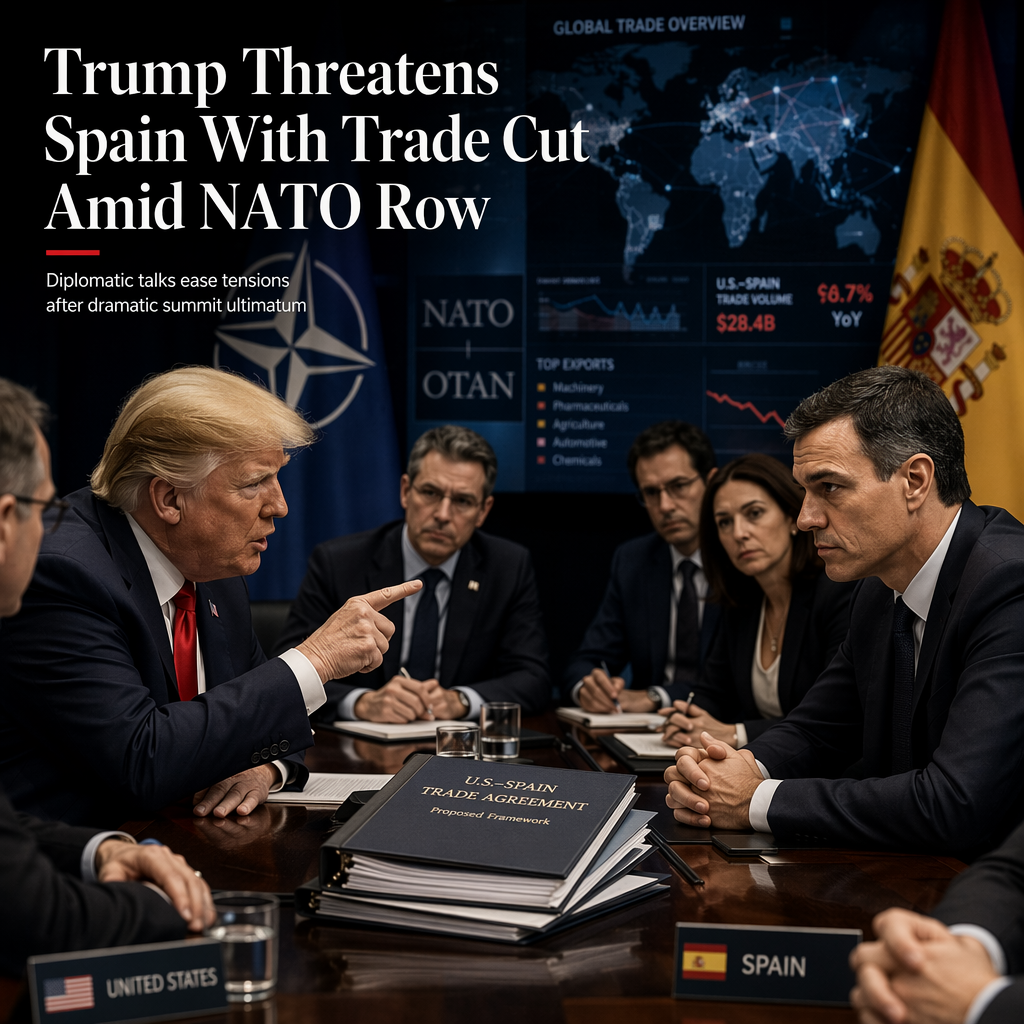
President Donald Trump threatened to completely cut off trade with Spain, citing the International Emergency Economic Powers Act (IEEPA) as a legal mechanism that would allow him to do so, according to U.S. Trade Representative Jamieson Greer [1]. Greer explained that, despite Spain's membership in the European Union, the IEEPA gives the president authority to prohibit trade in response to a declared national emergency, and has previously been used to limit trade with countries like North Korea [1]. However, the Supreme Court struck down Trump's use of IEEPA for imposing individualized tariffs earlier in the year, but clarified that the law does allow for prohibiting trade under certain circumstances [1].
The threat came after Trump expressed frustration with Spain's refusal to increase its defense spending to 5% of GDP as part of NATO commitments, a demand he has made of all alliance members [1]. During a NATO summit in Ankara, Turkey, Trump called Spain a "terrible partner in NATO" and stated, "Cut off all trade with Spain, please, including visits," while seated next to NATO Secretary-General Mark Rutte [1]. Spain has rejected the proposed spending target as "unreasonable," while most other NATO members have agreed to raise their targets [1].
Despite the harsh rhetoric, Greer indicated that recent talks between Trump and Spanish Prime Minister Pedro Sánchez may have eased tensions. He described a "good meeting" where "core issues about payment" were discussed, and noted "positive developments on that front on Spain" [1]. Trump himself softened his tone after leaving Turkey, telling reporters that Spain "came back all the way today" and was "very generous," though he did not specify what actions Spain took [1].
Key exports from Spain to the U.S. include refined petroleum, pharmaceuticals, and electrical transformers, highlighting the potential economic impact of any trade disruption between the two countries [1].
CONCLUSION
President Trump's threat to sever trade with Spain over NATO defense spending marks a significant escalation in U.S.-Spain relations, but recent diplomatic engagement appears to have reduced immediate risks. While the legal authority to cut off trade exists under IEEPA, both U.S. and Spanish officials have signaled a willingness to resolve differences through negotiation. Markets will likely remain sensitive to further developments in U.S.-EU trade relations.