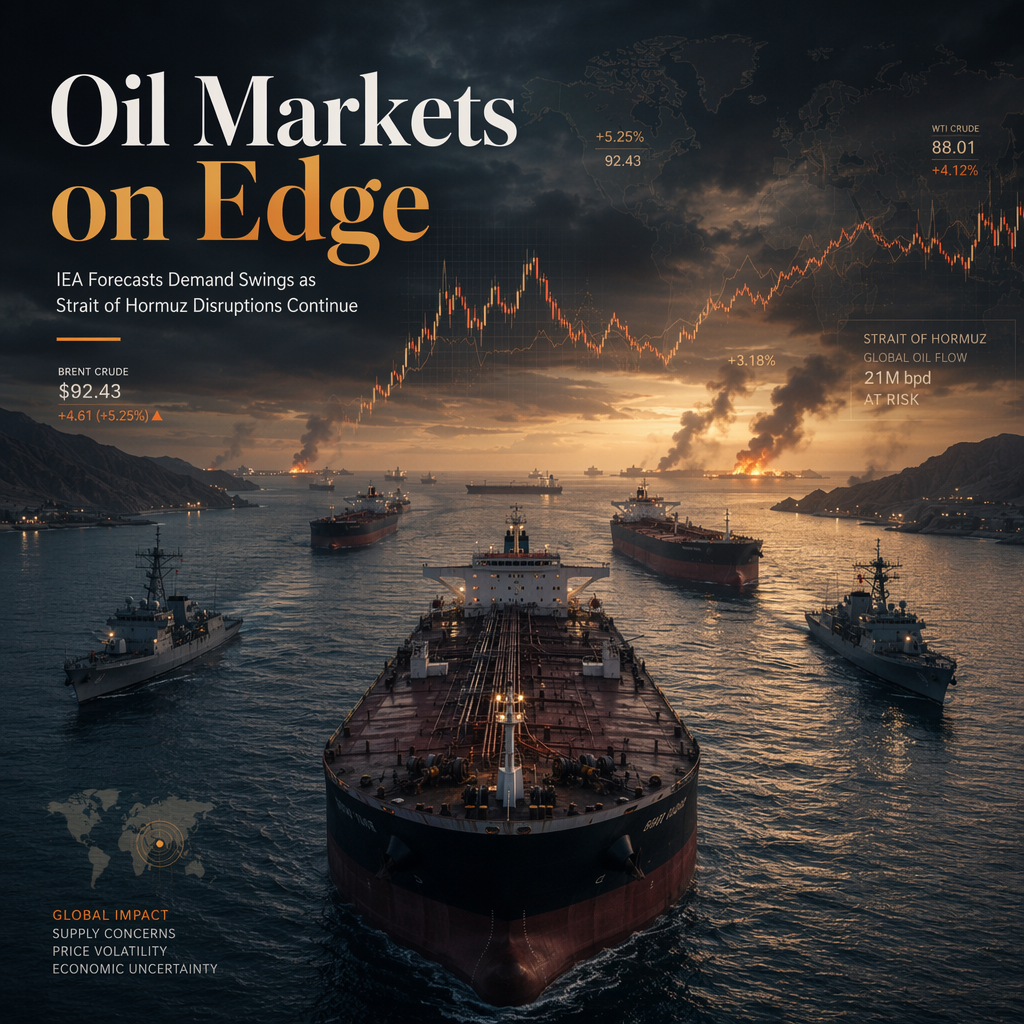
The International Energy Agency (IEA) has released updated forecasts indicating significant shifts in global oil demand and supply, largely influenced by geopolitical tensions and disruptions in the Middle East. According to the IEA, global oil demand is expected to rise by 1.2 million barrels per day (bpd) year-on-year in the fourth quarter of this year, following a decrease to 1.7 million bpd in the third quarter from 4.8 million bpd in the April-June period [1]. However, the agency projects that world oil demand will decline by 1 million bpd year-on-year in 2026, marking the first annual decrease since 2020, primarily due to the closure of the Strait of Hormuz and disrupted exports through the Persian Gulf [3].
The IEA also downgraded its projections for Russian oil production, expecting output to reach 8.9 million bpd this year and 8.8 million bpd in 2027, down from 9.2 million bpd in 2025 [1]. The agency's supply forecast suggests oil supply could expand by 7.5 million bpd this year if transit routes improve [1]. The forecast for a recovery in oil markets is contingent on a ceasefire and the gradual reopening of the Strait of Hormuz, but renewed exchanges of fire between the US and Iran this week have slowed tanker traffic and increased uncertainty [3].
Market reactions have been muted, with WTI oil prices trading slightly lower near $71.45-$71.50 and Brent crude futures easing to $76.25 per barrel [1][2][3]. The recent rally in WTI oil took a pause amid signs of de-escalation in the US-Iran conflict, although ongoing hostilities and attacks on commercial vessels continue to pose risks to energy supply [2][3]. The downside in oil prices is expected to remain limited due to persistent fears of supply disruption, while the CME FedWatch tool indicates that the odds of the Federal Reserve delivering at least one interest rate hike this year are marginally over 80% [2].
IEA officials, including Toril Bosoni, emphasized that recovery in the region will not be swift or linear, citing a "very uncertain and unstable situation" [3]. Nonetheless, significant growth from other producers and lower-than-expected demand could return the market to surplus towards the end of the year and into next year, allowing countries to rebuild inventories [3]. The US has stated its commitment to technical talks with Iran despite ongoing airstrikes, but President Donald Trump has declared the ceasefire "over" and characterized Iran's attacks as "acts of terrorism" [2][3].
According to [1], there was no immediate impact on oil prices from the IEA's demand forecasts, while [3] notes that oil prices edged lower following the latest developments. However, [2] reports that the downside in oil prices may be limited due to ongoing US-Iran aggression.
CONCLUSION
The IEA's forecasts highlight a volatile outlook for global oil demand and supply, with geopolitical tensions and disruptions in the Strait of Hormuz weighing heavily on market sentiment. While oil prices have edged lower, persistent risks of supply disruption and uncertain recovery scenarios suggest continued high market impact. The potential for surplus later in the year depends on improved transit and a lasting peace agreement, but ongoing US-Iran hostilities keep the outlook unstable.