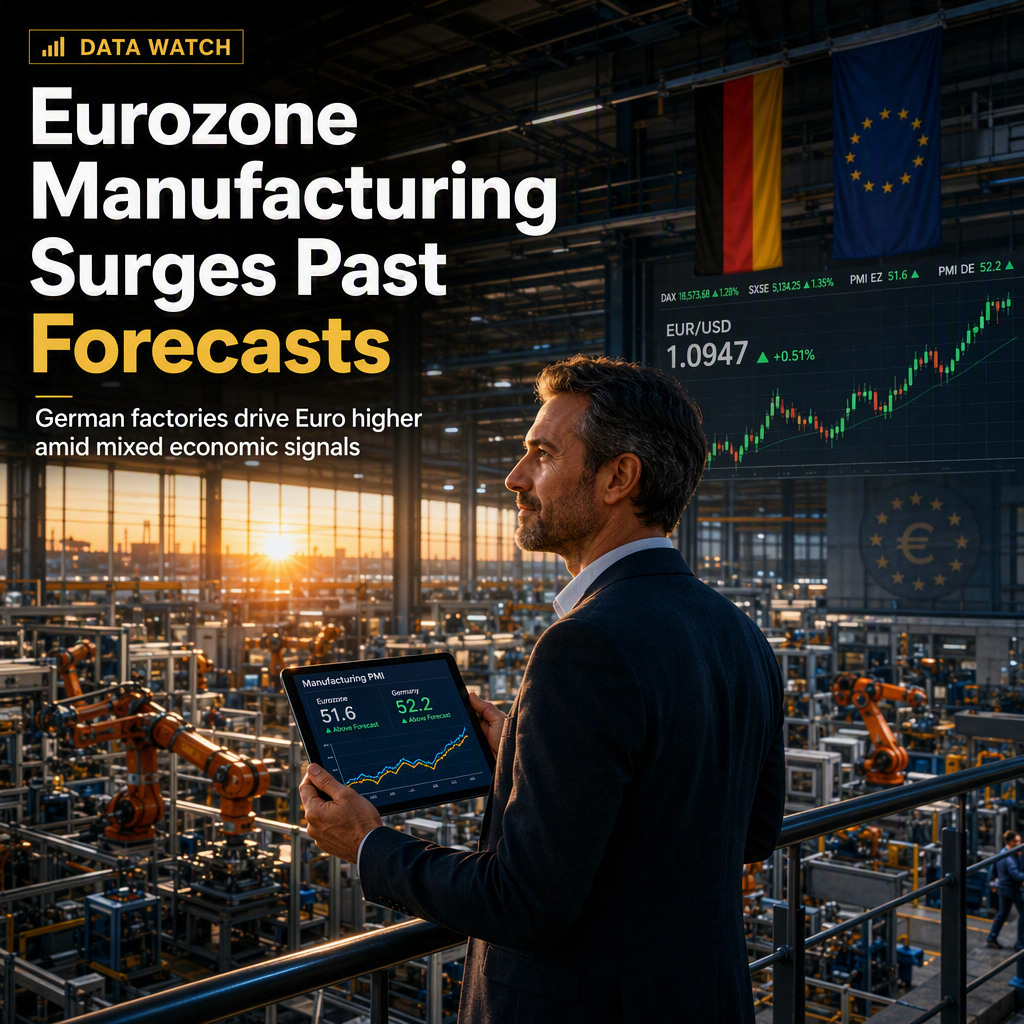
The Eurozone's manufacturing sector showed stronger-than-expected growth in August, as the preliminary HCOB Manufacturing Purchasing Managers’ Index (PMI) rose to 52.8, up from 51.9 in July and surpassing the consensus estimate of 51.8. This reading signals a robust expansion in manufacturing activity across the Eurozone, as any figure above 50 indicates growth in the sector [1].
Germany, the region's largest economy and manufacturing hub, also reported a significant uptick in its flash Manufacturing PMI, which climbed to 54.1 in August from 52.2 in July, beating expectations of a more modest rise to 52.0. This robust performance in German manufacturing contributed to a mild positive response in the Euro, with EUR/USD trading 0.15% higher near 1.1695 following the data release [2].
However, the broader German economy showed mixed signals. While the manufacturing sector remained strong, the German flash HCOB Composite PMI rose only moderately to 51.0, below the expected 51.3. Notably, the German Services PMI fell to 48.5 from 49.8 in July, missing expectations for a return to expansion at 50.1 and indicating continued contraction in the services sector [2].
Both articles highlight that the PMI data, compiled by S&P Global and Hamburg Commercial Bank (HCOB), serve as leading indicators for business activity and can anticipate trends in GDP, industrial production, employment, and inflation. The stronger-than-expected manufacturing readings are generally seen as bullish for the Euro [1][2].
CONCLUSION
Stronger-than-expected manufacturing PMI data from both the Eurozone and Germany point to robust expansion in the region's industrial sector, providing a boost to the Euro. However, ongoing weakness in Germany's services sector tempers the overall economic outlook. The market response was positive, with the Euro appreciating modestly against the US dollar following the data releases.