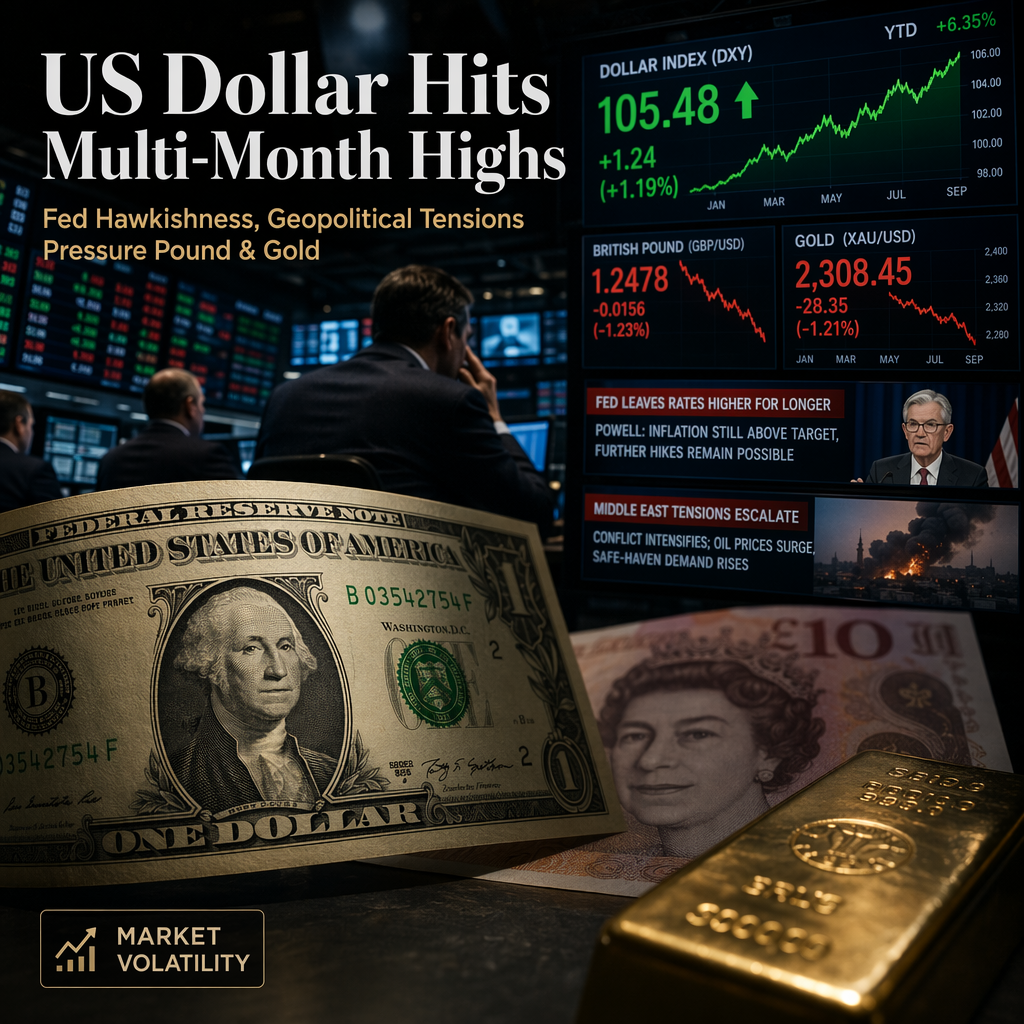
The US Dollar (USD) strengthened to its highest level since late March against the British Pound (GBP) and since May 2025 against gold (XAU/USD), driven by a combination of hawkish signals from the US Federal Reserve (Fed) and ongoing geopolitical uncertainty surrounding US-Iran relations [1][2]. The GBP/USD pair fell below the 1.3200 mark, reaching its lowest point since April and marking its third consecutive day of losses during the Asian session on Friday. This decline was attributed to persistent domestic political risks in the UK, including Greater Manchester Mayor Andy Burnham's victory in a parliamentary seat and his remarks about a 'turning point' for British politics, as well as reduced expectations for aggressive Bank of England (BoE) rate hikes following softer inflation data earlier in the week [1].
Simultaneously, gold prices weakened further below the $4,200 mark, also registering a third straight day of losses and hitting a fresh weekly low. The Fed kept its benchmark interest rate unchanged at 3.5% to 3.75% but signaled the possibility of at least one rate hike by year-end, with nine out of nineteen Fed members supporting further tightening if inflation persists. Fed Chair Kevin Warsh emphasized a strong commitment to price stability, suggesting no imminent rate cuts even if growth slows. According to the CME Group's FedWatch Tool, traders are now pricing in a 70% chance of a rate hike in September, keeping US Treasury yields elevated and supporting the USD [2].
Geopolitical developments further fueled demand for the safe-haven USD. The optimism from an interim US-Iran peace deal faded as unresolved issues persisted, and US Vice President JD Vance canceled a planned trip for talks with Iran in Switzerland, stating the meeting was not finalized. Additionally, Israeli air strikes in Lebanon threatened to unravel the US-Iran deal, adding to market uncertainty [1][2].
The British Pound was the weakest major currency this week, falling 1.70% against the USD and registering declines against most other major currencies, except for a marginal loss against the New Zealand Dollar [1]. Gold also appeared poised to register its third consecutive weekly loss, with technical indicators such as the Relative Strength Index (RSI) near 36 and the MACD in negative territory, signaling ongoing downside pressure [2]. Market participants are now watching upcoming UK Retail Sales data and further geopolitical developments for fresh impetus [1][2].
CONCLUSION
The US Dollar's strength, underpinned by hawkish Fed signals and geopolitical tensions, has led to significant declines in both the British Pound and gold. Market sentiment remains risk-averse, with traders closely monitoring central bank actions and Middle East developments for further direction. Both GBP/USD and XAU/USD are expected to remain under pressure in the near term.