
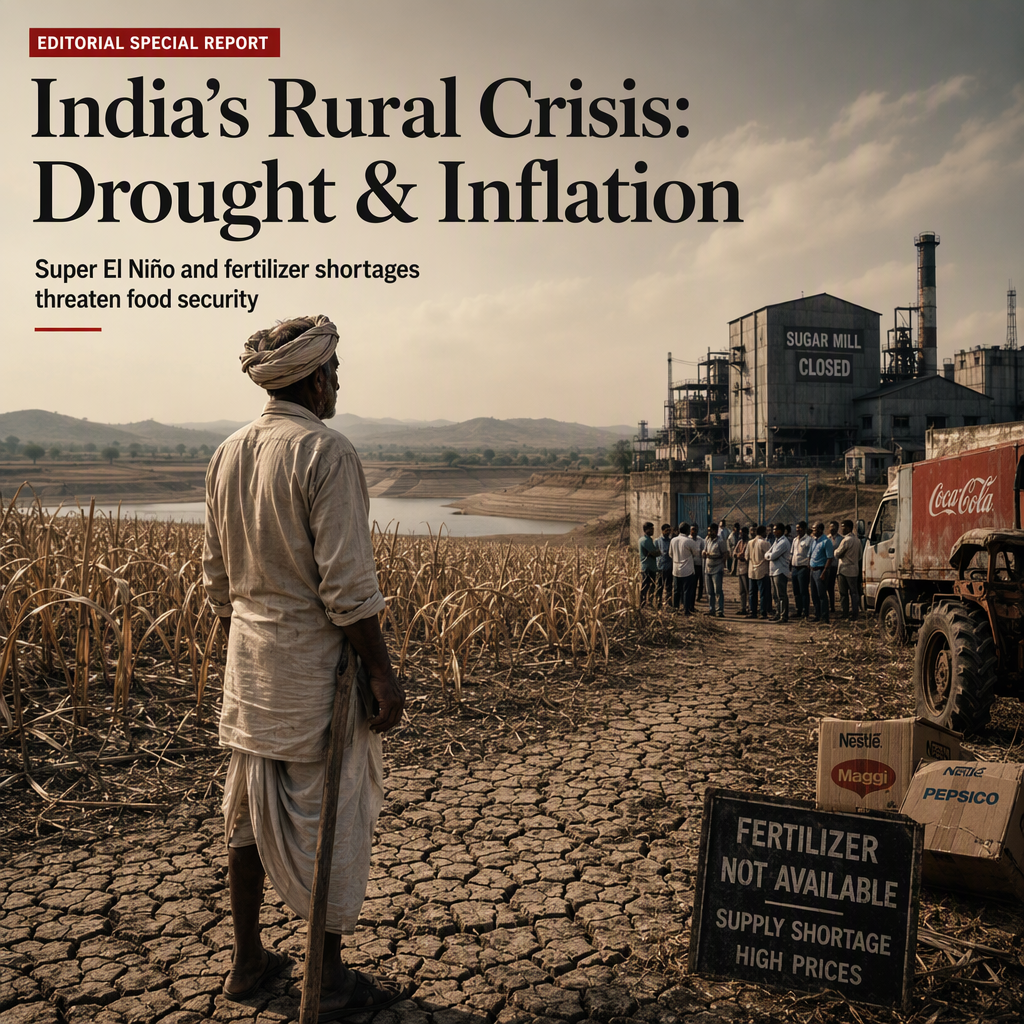
India is bracing for a major food crisis and economic shock as the country experiences its lowest rainfall in more than a decade between June and September, attributed to the super El Niño phenomenon [1]. The foreign minister has warned that the combination of El Niño and fertilizer shortages, driven by wars affecting key producers in the Middle East and Russia, will lead to a significant food crisis in the coming months [1]. This situation is expected to materially slow down India's rural economy and trigger a sharp rise in inflation [1].
India's rural sector is crucial, feeding almost 1.5 billion people, supporting 46.1% of the workforce, and driving consumer spending. Major multinational companies such as HUL, Colgate-Palmolive, Nestle, and Maruti Suzuki are highly dependent on rural demand [1]. The agriculture sector, particularly the sugar industry, is under severe stress, with nearly 5 crore farmers and 5 lakh factory workers affected by weak monsoons and dry weather, which have reduced yields and sucrose recovery [1].
According to the India Meteorological Department, the June-September rainfall was the fourth lowest since 2001 and the 13th driest since 1901 [1]. Reservoirs were 28% short of full capacity at the end of September, posing risks to winter crops, and several key farm states are facing extreme drought conditions, as reported by Nomura [1].
Inflation in India has been rising for 10 consecutive months, surpassing the central bank's medium-term target of 4% in August [1]. The super El Niño is emerging as a significant headwind for India's growth, which is already challenged by global energy shocks, trade uncertainty with the U.S., and record exits of foreign investors from its equity markets [1]. Following the foreign minister's warnings, political opponents criticized the government for not acting in time to prevent the crisis [1].
CONCLUSION
India's rural economy and food security are under severe threat due to the super El Niño and fertilizer shortages, resulting in rising inflation and risks to key agricultural sectors. The situation has significant implications for multinational companies reliant on rural demand and could further strain India's economic outlook. Policymakers face mounting pressure to address these challenges amid growing political criticism.