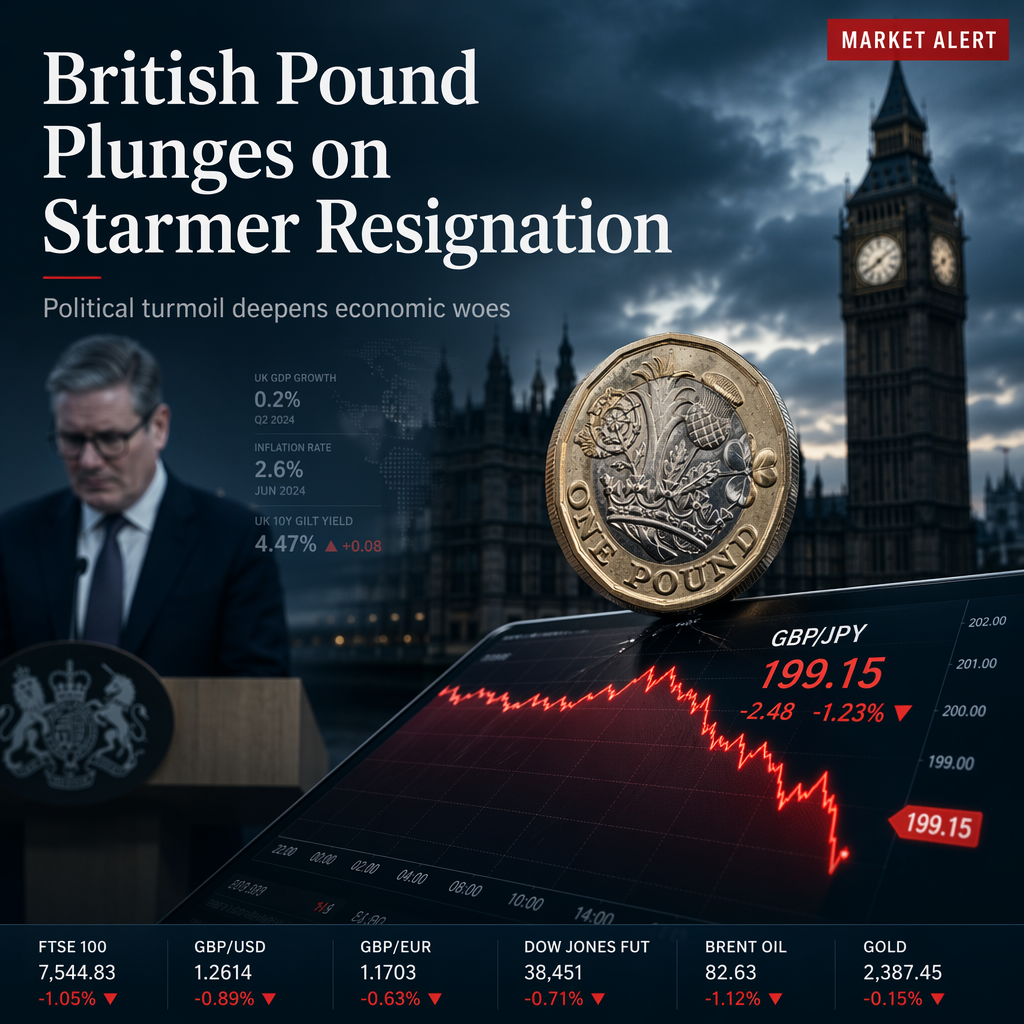
The British Pound weakened sharply against the Japanese Yen, with the GBP/JPY cross coming under pressure near the 213.00 level on Wednesday, following the announcement that United Kingdom Prime Minister Keir Starmer will resign as Labour Party leader and Prime Minister. This unexpected political development has injected fresh uncertainty into the UK outlook, as investors assess the risks associated with a leadership transition at a time when the UK economy is already showing signs of weakness. Nominations for Labour’s leadership are expected to begin on July 9, and markets are likely to closely monitor whether the next Labour leader signals any major shift in fiscal policy, borrowing plans, or economic priorities, as ongoing political uncertainty could keep the Pound vulnerable in the near term [1].
Economic data released alongside the political news showed further signs of strain in the UK economy. The S&P Global UK Composite Purchasing Managers Index (PMI) slipped to 49.4 in June from 49.7 in May, remaining below the 50.0 threshold for a second consecutive month, indicating contraction. The Services PMI fell to 48.7 from 49.3, marking the weakest reading in 41 months, while the Flash UK Manufacturing Output Index improved to 53.6 from 52.2, offering a rare positive note [1].
From a technical perspective, GBP/JPY trades at 213.02, maintaining a bearish near-term tone as the price remains below both the 20-period Simple Moving Average (SMA) at 213.45 and the 100-period SMA at 214.31. The Relative Strength Index (RSI) is around 41, suggesting subdued bullish momentum. Immediate resistance is noted at 213.25 and 213.45, with stronger resistance at 214.31. On the downside, support is seen at 212.77 and 212.54, where a break could reinforce the broader bearish bias and expose deeper declines [1].
CONCLUSION
The resignation of Prime Minister Keir Starmer has heightened political uncertainty in the UK, pressuring the British Pound and raising concerns about the country's economic outlook. With key economic indicators signaling contraction and markets awaiting clarity on future fiscal policy, Sterling is likely to remain vulnerable in the near term.