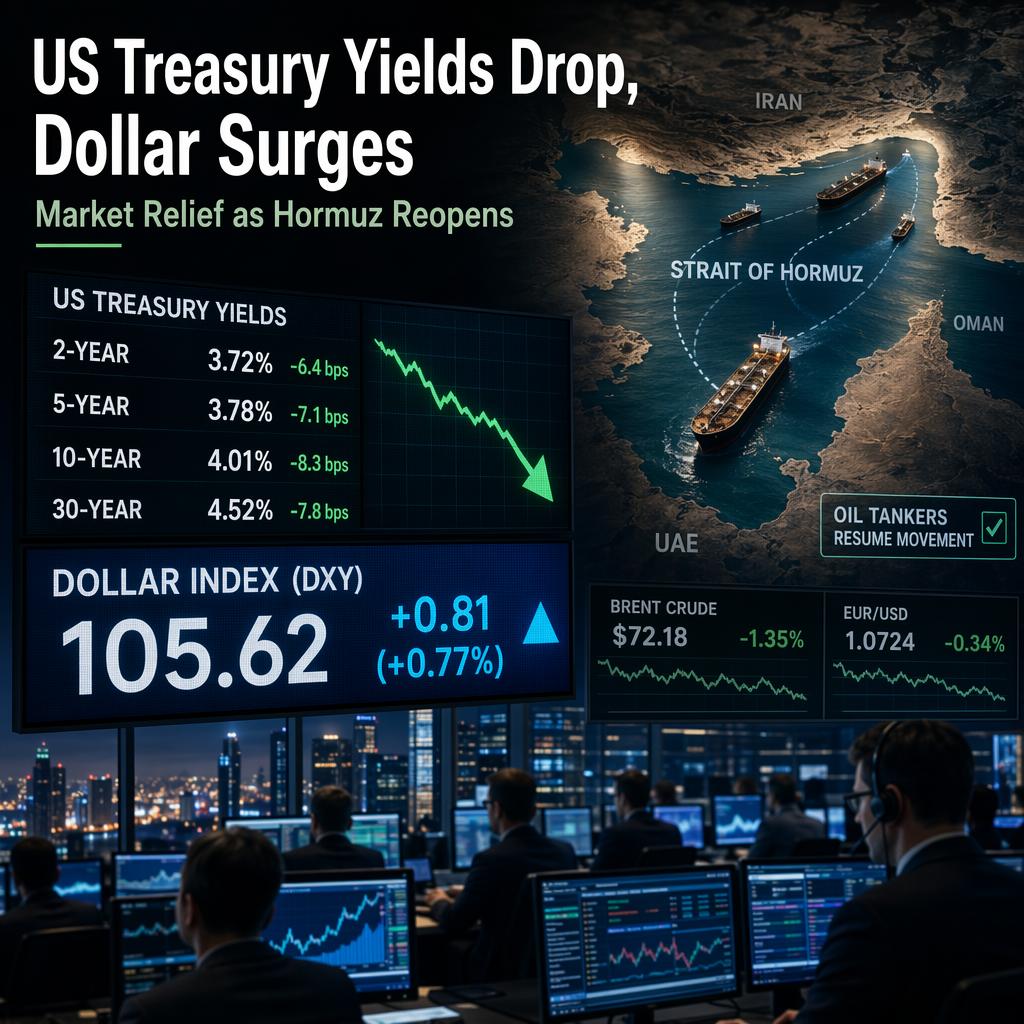
On Wednesday, US Treasury yields fell sharply across the curve following the reopening of the Strait of Hormuz, which eased inflationary pressures and led to a decline in Oil prices. The US 10-year Treasury note yield dropped nearly 10 basis points, down 2% to 4.40% at the time of writing, while West Texas Intermediate (WTI) crude lost 4% to trade around $70.00 per barrel [1]. The 5- and 10-year breakeven rates, which measure market-based inflation expectations, stood at 2.24% and 2.21%, respectively, after peaking in mid-April at 2.72% and 2.5% [1].
The US Dollar Index (DXY) rose by over 0.22% to 101.62, reaching a one-year high as traders awaited Thursday’s release of the US Personal Consumption Expenditures Price Index (PCE), the Federal Reserve’s preferred inflation gauge [1][2]. According to Source 2, the US Dollar was the strongest against the New Zealand Dollar, gaining 0.52%, and also posted gains against other major currencies, including the Euro (+0.24%), British Pound (+0.34%), and Japanese Yen (+0.16%) [2].
Market participants are closely watching the upcoming PCE data for May, which is expected to provide further insight into whether recent Oil price movements, influenced by the US and Israel's war with Iran, have impacted core inflation. US Treasury yields are anticipated to be volatile following the release [2]. The Federal Reserve is expected to keep rates unchanged at its July 29 meeting, with odds at 60%, though there remains a 40% chance of a rate hike depending on incoming data [1].
The US economic calendar is busy, with traders focusing on the Core PCE Price Index, Q1 2026 GDP figures, Durable Goods Orders, and jobless claims [1]. Meanwhile, the Euro and British Pound both weakened against the Dollar, with EUR/USD falling toward a one-year low near 1.1360 and GBP/USD close to a one-year low of 1.3160, amid political uncertainty in the UK and softer activity data [2].
CONCLUSION
The reopening of the Strait of Hormuz has eased inflation fears, leading to lower US Treasury yields and a surge in the US Dollar Index. Markets are now awaiting key US inflation data, with expectations of continued volatility in yields and currency movements. The Federal Reserve is likely to keep rates unchanged, but incoming data could shift policy expectations.