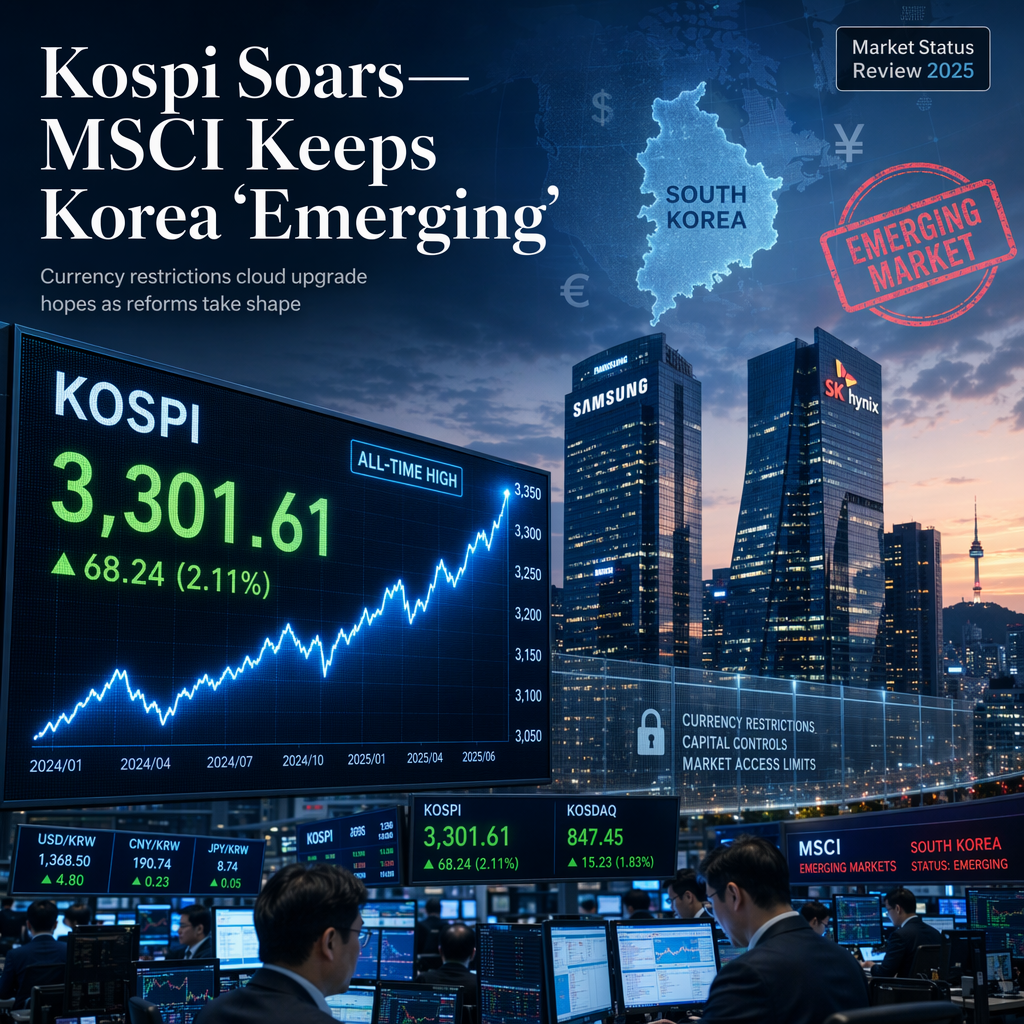
MSCI, the global equity index provider, has decided to keep South Korea classified as an emerging market in its latest review, despite the country's strong economic and technological development and the Kospi index's exceptional performance in 2025. According to Henry Fernandez, CEO of MSCI, South Korea is 'one of the most developed markets on the planet' in many respects, but its equity market still exhibits several attributes typical of emerging markets, particularly regarding the functioning of its currency market [1].
The Kospi index, which includes major technology companies such as Samsung and SK Hynix, was the world's best-performing equity index in 2025 and has surged 112% so far this year [1]. However, Fernandez highlighted that a key issue preventing South Korea's upgrade to developed-market status is the trading restriction on the Korean won. Unlike developed markets where investors can trade the local currency at their convenience in major financial centers, the Korean won can only be bought or sold during office hours in Seoul. This limitation complicates portfolio rebalancing for index fund managers and raises concerns about liquidity and bid-ask spreads in the currency market [1].
Fernandez acknowledged that reforms to the Korean system are 'clearly underway' and that 'enormous progress' has been made, but he expressed doubts about whether the planned night shift for won trading would provide sufficient liquidity and tight spreads comparable to other developed markets [1]. In addition to currency trading restrictions, MSCI cited rigid investor identification systems, restrictions on in-kind transfers and off-exchange transactions, and limits on investment products due to exchange data rules as further reasons for maintaining South Korea's emerging market classification [1].
Earlier in the week, MSCI published its review and did not place South Korea on its Developed Markets watchlist, disappointing hopes for an imminent upgrade [1].
CONCLUSION
MSCI’s decision to keep South Korea in the emerging market category, despite the Kospi’s record gains, highlights ongoing concerns about currency trading restrictions and market accessibility. While reforms are in progress, MSCI sees further improvements as necessary before considering an upgrade. The outcome signals that investors may need to wait longer for South Korea’s inclusion in developed market indexes.