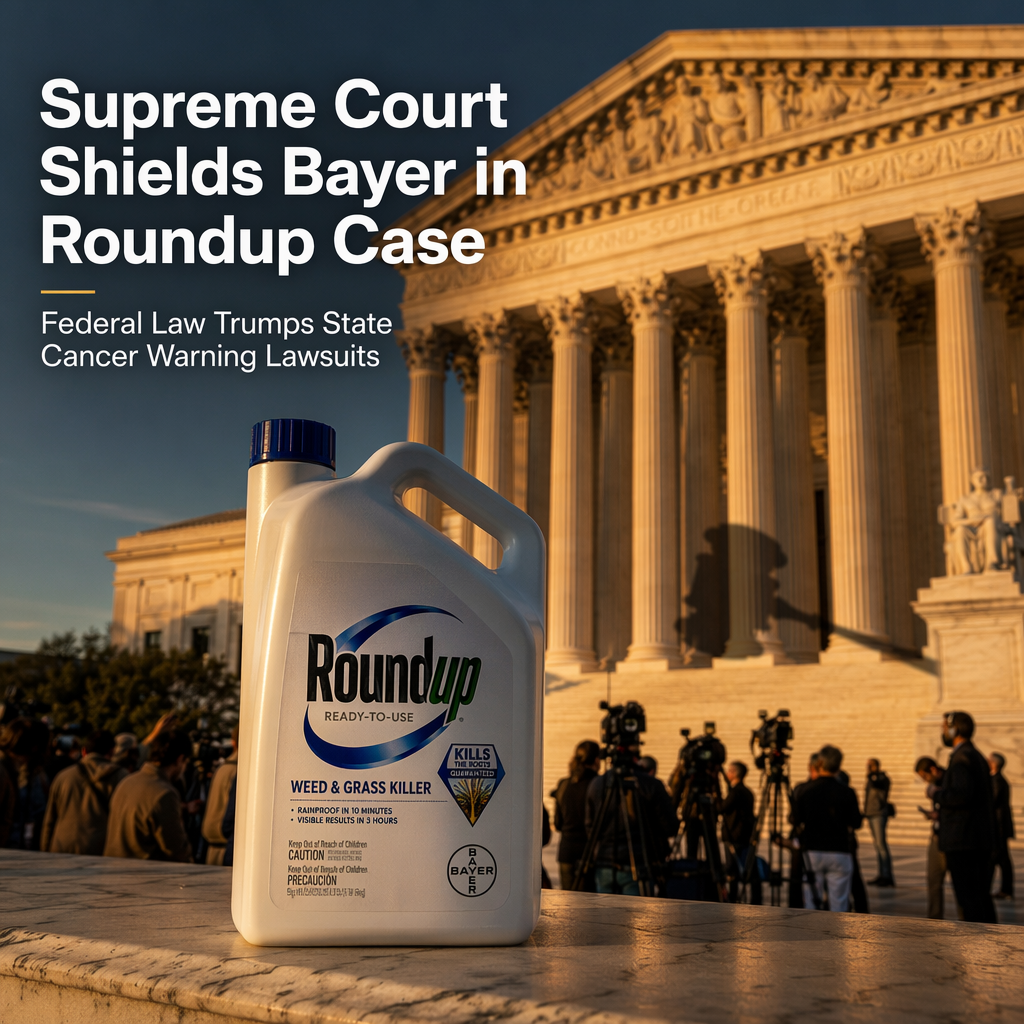
The U.S. Supreme Court delivered a significant victory to Bayer on June 25, 2026, ruling in a 7-2 decision that the company cannot be sued over state-level claims alleging failure to warn about cancer risks associated with its weedkiller Roundup and its active ingredient, glyphosate [1]. The Court determined that the Federal Insecticide, Fungicide and Rodenticide Act (FIFRA) preempts state tort law claims, as the Environmental Protection Agency (EPA) has found glyphosate safe when used as directed and has not mandated a cancer warning label [1]. Justice Brett Kavanaugh, writing for the majority, emphasized that the EPA's regulatory framework is comprehensive and that state law cannot impose labeling requirements beyond those set by federal law [1].
Bayer, which acquired Roundup maker Monsanto in 2018, welcomed the decision, stating it is 'good for science, farmers, and industries that depend on regulatory clarity for innovation' [1]. The company further noted that the ruling should help 'significantly contain the Roundup litigation after nearly a decade of legal battles,' potentially resulting in the dismissal of current warning-based claims and barring future failure-to-warn lawsuits [1].
The decision is also seen as a setback for the Make America Healthy Again movement, which had supported stricter warnings and felt let down by the Trump administration's position on glyphosate [1]. The administration had argued in favor of Bayer, asserting that federal law supersedes state-level warning requirements [1].
Market implications are substantial, as the ruling is expected to reduce Bayer's legal exposure related to Roundup, providing greater regulatory certainty for the company and the broader agricultural sector [1].
CONCLUSION
The Supreme Court's decision marks a pivotal legal win for Bayer, likely curtailing ongoing and future state-level litigation over Roundup's cancer risks. This outcome is expected to ease legal pressures on Bayer and provide clarity for the agricultural industry regarding federal versus state regulatory authority.