
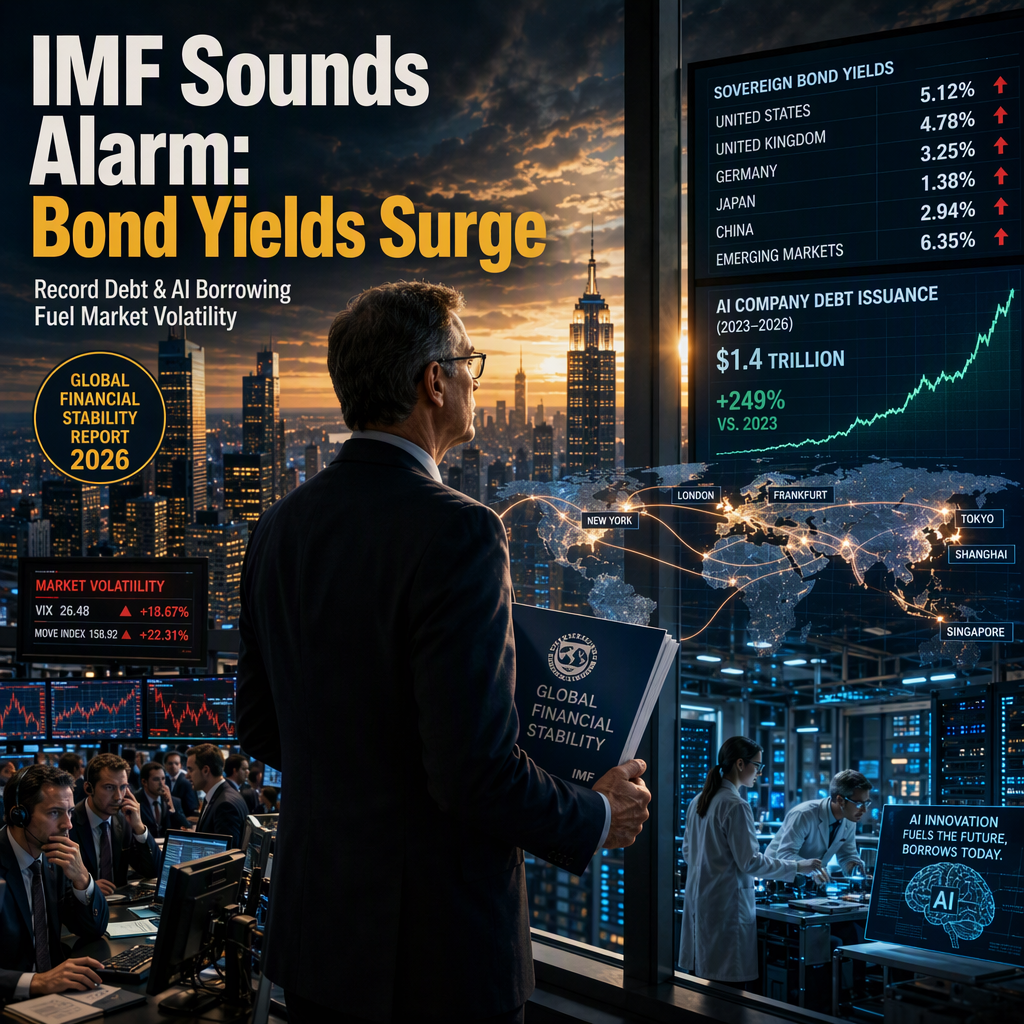
The International Monetary Fund (IMF) issued a warning on October 13, 2026, that government bond yields could rise in a disorderly manner due to mounting inflation, record-high global debt, and rapidly increasing AI-related borrowing, which are straining sovereign bond markets [1]. According to the IMF's latest Global Financial Stability Report, government bond yields in several advanced economies have reached multidecade highs, driven by higher energy costs stemming from the Middle East conflict and expectations of tighter monetary policy as central banks attempt to curb resurgent inflation [1].
The IMF highlighted that the high debt load and rollover risks make the bond market vulnerable to more frequent fiscal and inflation shocks. Global public debt is near its highest level since World War II and is projected to soon exceed 100% of GDP [1]. The IMF cautioned that a sharp rise in sovereign bond yields could severely impact asset values through higher discount rates, including for AI-related assets, and erode the value of government bonds used as collateral [1].
A notable development is the exponential rise in borrowing by AI firms, which are now competing with sovereign bonds for investor demand. The share of hyperscalers in global investment-grade bond issuance has surged to 10% from less than 1% since 2024. Tech giants such as Alphabet Inc's Google and Meta Platforms, along with hyperscalers and AI labs, have raised hundreds of billions of dollars in debt this year [1]. Marc Seidner, CIO of non-traditional strategies at Pacific Investment Management, noted that AI-linked issuance, much of it longer-dated, has grown large enough to compete with government bonds for investor capital, though it is not yet the dominant driver of yields [1].
Despite these risks, the IMF reported that liquidity measures remain stable in the U.S., Europe, and the U.K., and market functioning has been orderly. Hedge funds' leveraged Treasury basis trades have partly unwound without notable pressure in repurchase markets, but the remaining leverage leaves the market susceptible to a disorderly unwind. Hedge funds' share of U.S. Treasuries increased to about 9% in 2025 from about 4% in 2022, primarily through highly arbitraged strategies [1]. Japan stands out as an exception, with liquidity in its government bond market continuing to deteriorate and yield volatility rising since the end of yield curve control [1].
CONCLUSION
The IMF's warning underscores significant risks to sovereign bond markets from record debt levels, inflation, and surging AI-related borrowing. While liquidity remains stable in most major markets, vulnerabilities persist, especially in Japan and among leveraged hedge fund strategies. Investors should remain cautious as the potential for a disorderly spike in yields could have severe market-wide implications.