
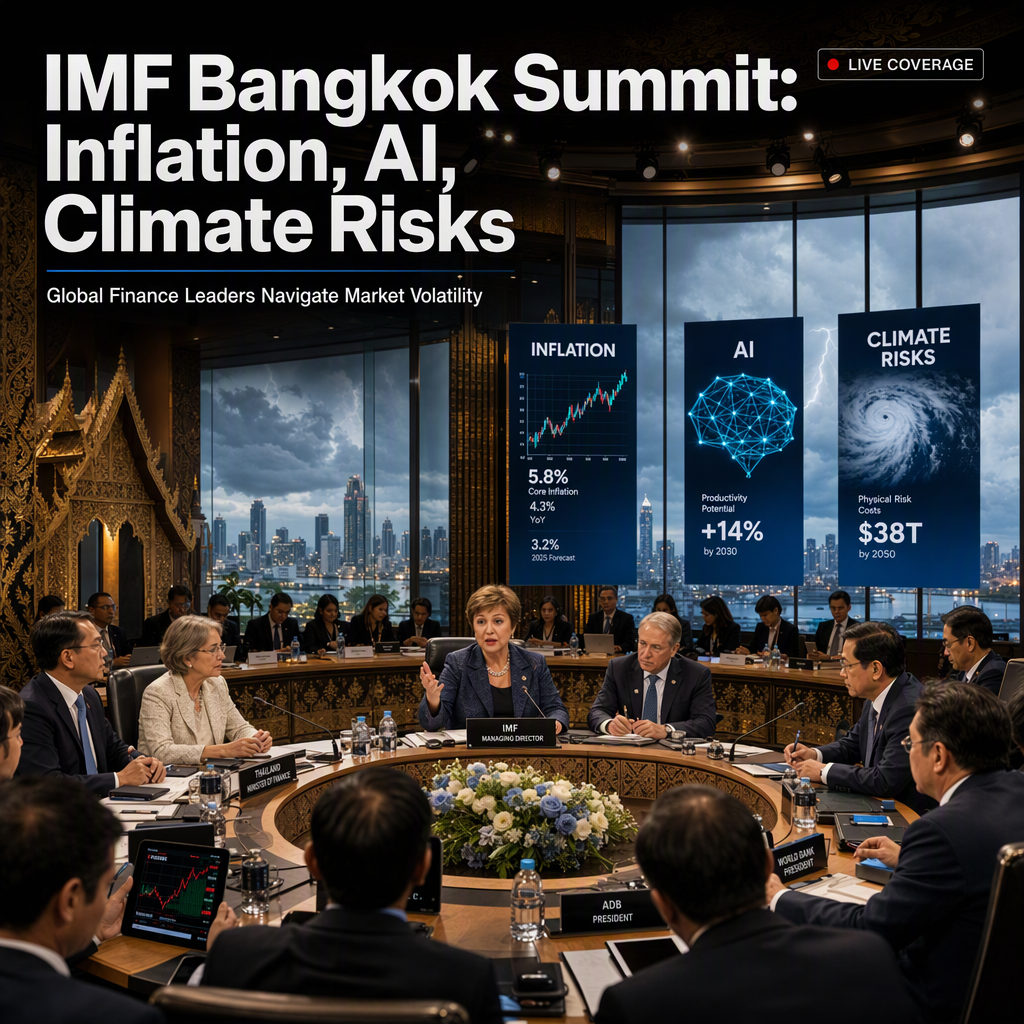
Finance officials and central bankers from around the world are convening in Bangkok this week for the International Monetary Fund's annual meeting, which begins on Monday. The agenda is set to focus on three major issues: persistent global inflation, the rapid advancement of artificial intelligence, and the financial risks associated with climate change [1]. Energy prices and bond yields are highlighted as urgent concerns, with disruptions in supply chains and volatile markets influencing both inflation and growth outlooks [1]. Policymakers are expected to share strategies for managing inflationary pressures and discuss implications for monetary policy, while also considering regulatory frameworks for AI and opportunities for economic growth driven by technological innovation [1].
Climate change will be a prominent topic, with finance ministers and central bankers examining risks posed by the transition to sustainable energy sources and discussing strategies for funding green initiatives [1]. Rising energy prices threaten to increase costs for consumers and businesses, and higher bond yields could tighten financial conditions and impact debt sustainability [1]. Technical market analysis will be presented during the sessions, focusing on price levels and support/resistance for key commodities and currencies, as well as the impact of recent rate hikes on market sentiment and asset valuations [1].
Quotes from officials underscore the complexity of the current environment: "We're facing a convergence of challenges: inflation remains stubborn, AI is reshaping industries, and climate risks are intensifying," said one central bank governor ahead of the meeting [1]. Analysts attending the event advise caution amid heightened volatility, recommending close monitoring of energy and bond markets for signs of emerging trends [1].
The IMF meeting in Bangkok is positioned as a critical forum for sharing insights on global financial stability, economic policy coordination, and navigating the interconnected risks of inflation, technology, and climate change [1].
CONCLUSION
The IMF annual meeting in Bangkok is set to address pressing global challenges, including inflation, AI, and climate change, with energy prices and bond yields adding urgency to the discussions. Market participants are advised to remain cautious amid heightened volatility, as policymakers seek coordinated strategies to ensure financial stability. The event is expected to have a significant impact on market sentiment and policy direction.