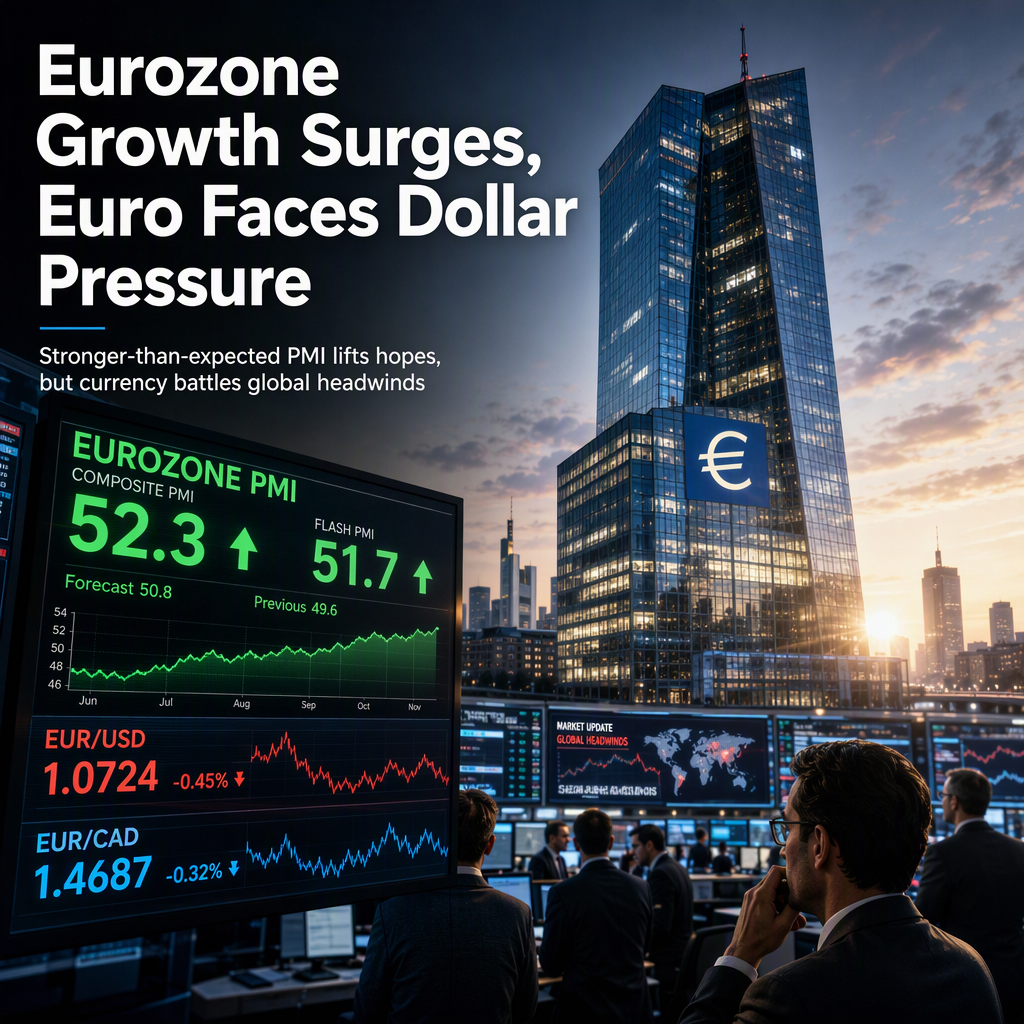
The Eurozone's September Purchasing Managers' Index (PMI) data exceeded expectations, providing support for the Euro and reinforcing the case for further European Central Bank (ECB) rate hikes. The composite PMI rose to a 41-month high of 53.1, surpassing the consensus of 51.7 and up from 52.0 in August, with services growth reaching a 10-month high and manufacturing holding steady at a multi-year high of 52.7. Both Germany and France contributed to the expansion in private sector growth, and the swaps curve now more than fully prices in 75 basis points of ECB tightening to 3.25%, above the ECB’s estimated neutral range of 1.75% to 3.00% [1].
However, the Euro faced downward pressure against both the US Dollar and the Canadian Dollar. Against the US Dollar, EUR/USD weakened due to broad Dollar strength, which was underpinned by hawkish Federal Reserve communication and resilient US labor market data. Richmond Fed President Thomas Barkin emphasized that a single rate hike may not be sufficient to control inflation, and strong high-frequency jobs indicators have led to consensus expectations for a robust September payroll print of around 80-100k. ING strategists see DXY at 101.0 as a realistic near-term target, with the Dollar expected to remain supported in the coming weeks as markets anticipate an October Fed hike [2].
In the EUR/CAD cross, the Euro halted a four-day winning streak, trading around 1.6090 after the release of the latest HCOB PMI data. While the Eurozone's services sector showed moderate expansion (services PMI expected at 51.7 vs. 51.6 in August), German manufacturing output slowed unexpectedly, with the Manufacturing PMI dropping to 53.8 (below the consensus of 54.5 and the previous 54.3). This was offset by a strong rebound in Germany's services PMI, which jumped to 52.9 from 49.7, pushing the German Composite PMI up to 53.8 from 51.8. Despite the Euro's weakness, losses against the Canadian Dollar were limited by subdued crude oil prices, as WTI remained below $90 per barrel amid efforts to resolve Middle Eastern supply disruptions [4].
Elsewhere in Central Europe, the Hungarian Forint initially rose after the Hungarian Central Bank (MNB) left its key rate unchanged at 5.50% and lowered its medium-term inflation target to 2.5% from 2028. The MNB adopted a cautious, data-driven approach to future policy decisions, which was seen as generally supportive for the Forint, provided there are no renewed rate cuts. However, the HUF later gave up its gains as the Euro weakened against the USD [3].
CONCLUSION
Despite stronger-than-expected Eurozone PMI data and expectations for further ECB tightening, the Euro remains under pressure due to a resilient US Dollar and mixed German economic signals. Market sentiment is cautious, with the Dollar expected to stay strong in the near term and the Euro's downside limited but present. Central bank policy and upcoming data releases will be key drivers for currency moves in the coming weeks.