The Pound Sterling has shown resilience in recent trading, rebounding from a late-June low near 1.3150 against the US Dollar to approach the 1.3300 area, though it faces significant resistance at the 50-day and 200-day Exponential Moving Averages, which are stacked between 1.3350 and 1.3400. Despite this recovery, analysts caution that the move appears more corrective than a true reversal, with the market remaining biased to the downside unless GBP/USD can close decisively above 1.3400 [1]. The Bank of England's recent decision to hold rates, accompanied by a hawkish split and firm messaging, has provided a yield-based floor for Sterling. However, political uncertainty following the resignation of the UK Prime Minister has dampened enthusiasm for the currency, creating a scenario where rallies are met with selling pressure [1].
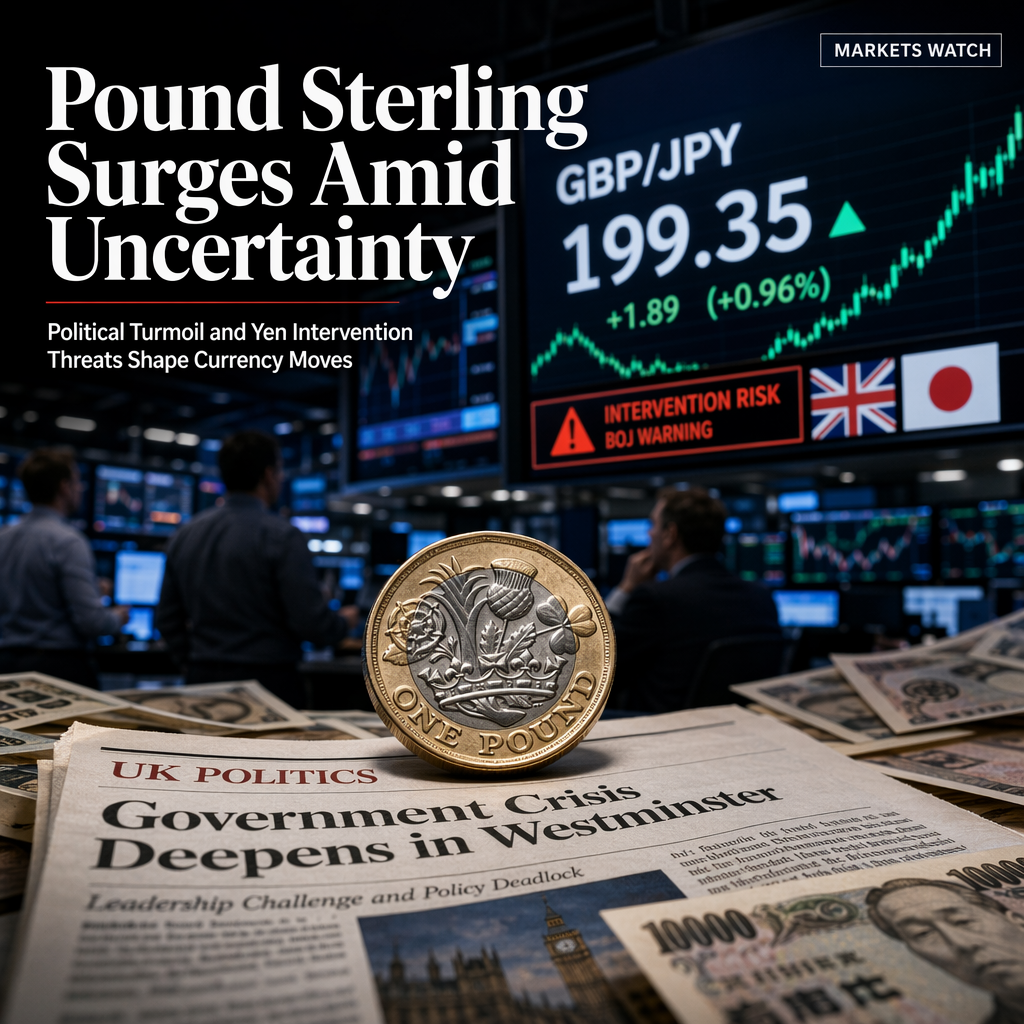
In the GBP/JPY cross, the Pound Sterling has broken out of its previous 212.00-215.00 range, trading as high as 215.93 and up 0.16% on Wednesday. Technical indicators, such as a bullish Relative Strength Index (RSI), suggest momentum remains positive, with bulls eyeing the 216.00 psychological level and the year-to-date high of 216.60. Should these levels be cleared, further gains toward 217.00 and potentially 220.00 are possible. However, the threat of intervention by Japanese authorities could cap further advances, as officials have been vocal about their willingness to act to support the Yen [3].
The Japanese Yen, meanwhile, continues to weaken despite the Bank of Japan's recent rate hike to 1%, its first significant tightening in a generation. The USD/JPY pair has reached multi-decade highs above 162.00, driven by a persistent rate differential of approximately 275 basis points in favor of the US Dollar. Japanese officials have issued increasingly stern warnings but have not specified a precise level for intervention, with the 160.00 area seen as a psychological support zone. Market participants are closely watching for potential intervention, especially as the pair approaches resistance at 163.00 and 164.00 [2].
Upcoming events that could influence these currency pairs include speeches by the Bank of England Governor and a key US Nonfarm Payrolls (NFP) report, scheduled for Thursday at 12:30 GMT with consensus expectations at 110K versus a prior 172K. A weaker-than-expected NFP could weaken the Dollar and provide a lift to both the Pound and the Yen, while a strong print could further widen the rate gap and pressure the Yen, potentially prompting Japanese authorities to act [1][2].
CONCLUSION
The Pound Sterling is caught between supportive central bank policy and political uncertainty, limiting its upside against both the Dollar and the Yen. The Japanese Yen remains under pressure from a wide rate differential, with intervention threats looming but not yet realized. Upcoming central bank communications and US labor data are likely to be key catalysts for further moves in GBP/USD, USD/JPY, and GBP/JPY.