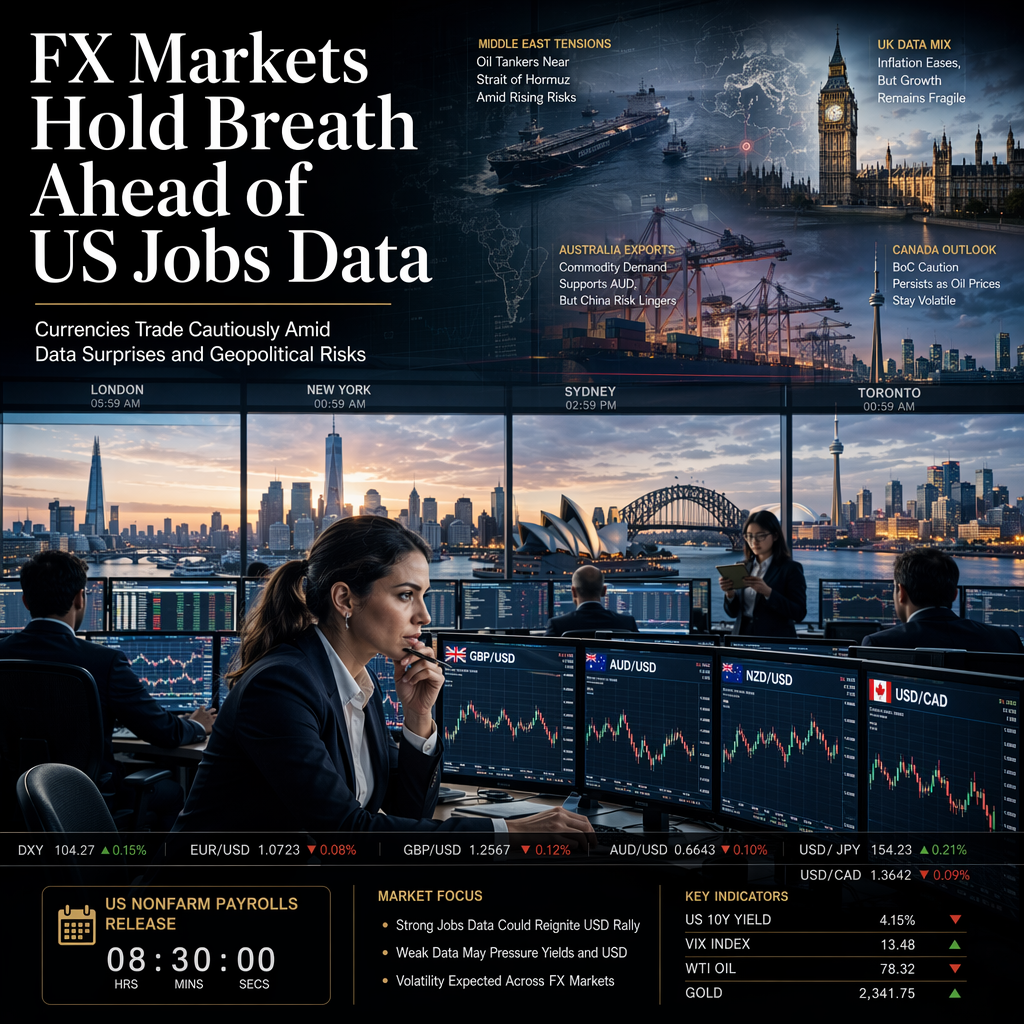
Currency markets are trading cautiously ahead of the highly anticipated US Nonfarm Payrolls (NFP) report for June, with major pairs such as GBP/USD, NZD/USD, AUD/USD, and USD/CAD all showing sensitivity to both domestic data and global developments [1][2][3][4][5]. The US NFP is expected to show 110,000 job additions in June, with the Unemployment Rate projected to remain at 4.3% [1]. Market participants are assigning a 64% probability of a Federal Reserve rate hike in September and an 85% chance of a move by year-end, driven by persistent inflation and recent hawkish commentary from Fed officials [2].
The British Pound has strengthened to near 1.3290 against the US Dollar, buoyed by Andy Burnham's commitment to fiscal discipline as the UK's likely next Prime Minister, which has eased market concerns about public finances [1]. Analysts at Natixis emphasize that maintaining investor confidence in the UK's fiscal outlook is critical, and future budgets will be closely watched for any deviation from fiscal rules [1].
The Australian Dollar steadied around 0.6900 after the Australian Bureau of Statistics reported a trade deficit of A$3,018 million in May, a sharp reversal from the previous month's surplus of A$1,383 million (revised from A$1,791 million) and well below the market consensus of a A$2,200 million surplus [3][4]. Exports fell by 6.9% month-on-month, while imports rose by 2.6% [3][4]. The AUD/USD pair edged slightly lower to 0.6890, down 0.02% on the day, and the Australian Dollar was the weakest against the British Pound among major currencies [4]. Analysts note that a trade deficit may signal weakening export demand and could prompt expectations of a more dovish Reserve Bank of Australia, though improved risk sentiment could limit downside for the AUD [4].
The New Zealand Dollar remains near a one-week high against the USD, trading around 0.5685, as traders await the US NFP for direction [2]. The Reserve Bank of New Zealand's hawkish shift is providing some support for the NZD, but geopolitical risks and strong US inflation data continue to favor the USD [2].
The Canadian Dollar is trading near year-to-date lows, with USD/CAD consolidating above 1.4200, as falling oil prices and a dovish Bank of Canada weigh on the currency [5]. The BoC is prioritizing economic growth over inflation, and the resumption of shipping through the Strait of Hormuz has eased oil supply concerns, further undermining the CAD [5]. Geopolitical tensions, including ongoing US-Iran talks and Russian attacks on Kyiv, are supporting safe-haven demand for the USD [2][3][5].
Across all markets, traders are largely sidelined ahead of the US NFP release, which is expected to be a key driver for the next move in the US Dollar and related currency pairs [1][2][3][5].
CONCLUSION
Major currency pairs are trading in tight ranges as markets await the US Nonfarm Payrolls report, which is expected to set the tone for Federal Reserve policy expectations and global FX moves. Domestic data, such as Australia's trade deficit and the UK's political transition, are influencing sentiment, but the US labor market report remains the primary focus. Geopolitical risks and central bank policy divergence continue to shape market dynamics.