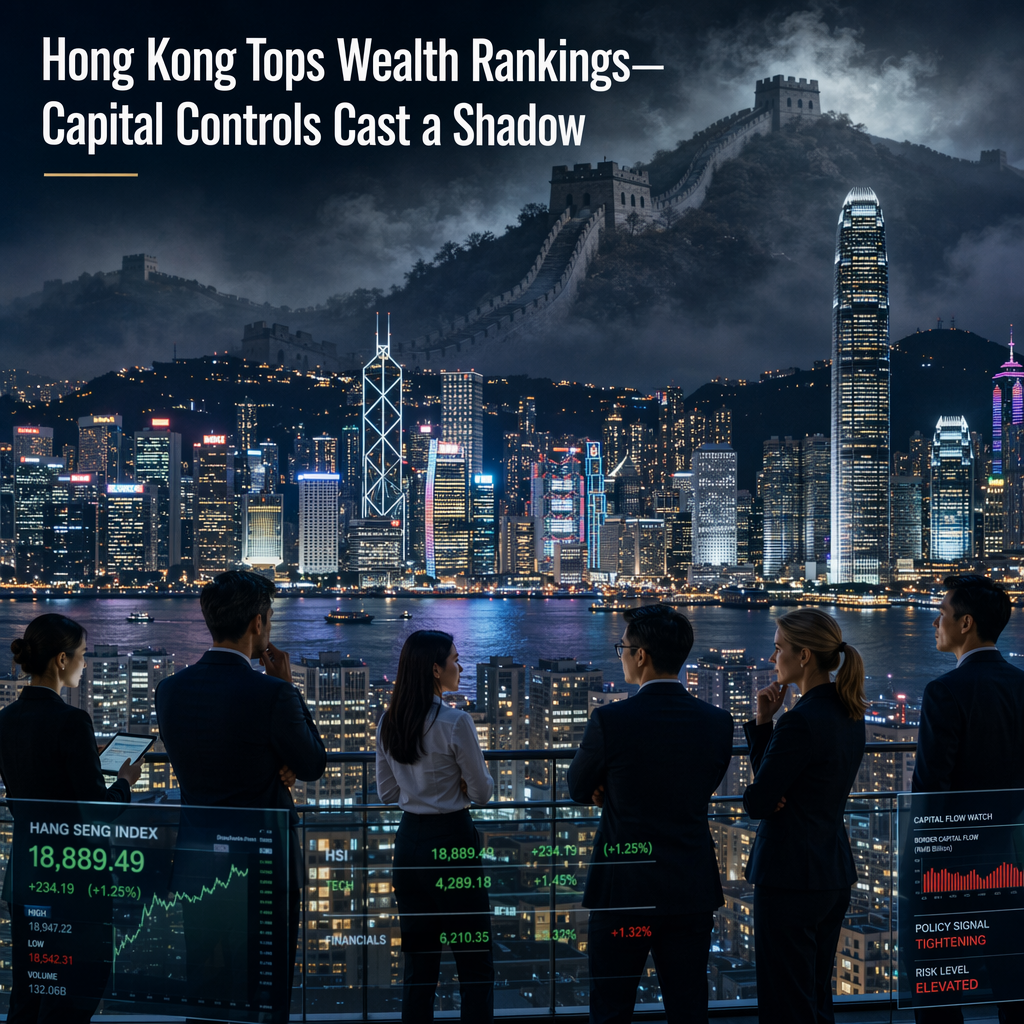
Hong Kong has once again been ranked as the world's wealthiest city in recent global rankings, surpassing other major financial centers in terms of household wealth [1]. This achievement comes despite ongoing crackdowns on the city's autonomy and the presence of stringent capital controls imposed by Beijing, which restrict the free flow of money across China's borders [1]. These controls are intended to prevent capital flight and maintain financial stability, but they also hinder the integration of China's domestic markets with global financial systems [1].
Hong Kong continues to serve as a critical gateway for international capital entering and exiting mainland China, a role that both strengthens and threatens its position as a global financial hub due to Beijing's policies [1]. Matteo Giovannini, a senior finance manager at the Industrial and Commercial Bank of China, highlights the contradiction in China's approach: the desire to attract international capital and investment while maintaining strict oversight and control over financial flows [1].
The Hang Seng stock index remains a key barometer of Hong Kong's financial health and continues to attract international investors, though it experiences volatility as regulatory pressures from Beijing introduce uncertainty [1]. Analysts note that while capital controls help shield China from external shocks, they also limit opportunities for domestic investors and restrict financial sector innovation in Hong Kong [1]. Market sentiment is described as mixed, with Hong Kong's wealth status reinforcing its appeal to high-net-worth individuals and global institutions, but concerns over potential further crackdowns or tighter controls could undermine confidence and trigger capital outflows [1].
Technical analysis indicates the Hang Seng index is trading near key resistance levels, with support at previous lows established during past periods of regulatory uncertainty [1]. Traders are advised to closely monitor policy announcements from Beijing, as these can have immediate impacts on market direction and investor sentiment [1]. The future of Hong Kong as a financial hub will depend on how China balances its need for capital inflows with its desire for control, highlighting the ongoing challenges for global investors navigating China's complex financial landscape [1].
CONCLUSION
Hong Kong's reaffirmed status as the world's wealthiest city underscores its continued importance as a financial gateway for China, but also highlights the risks posed by Beijing's capital controls. Market sentiment remains mixed, with both opportunities and uncertainties ahead as investors await further policy signals from China.