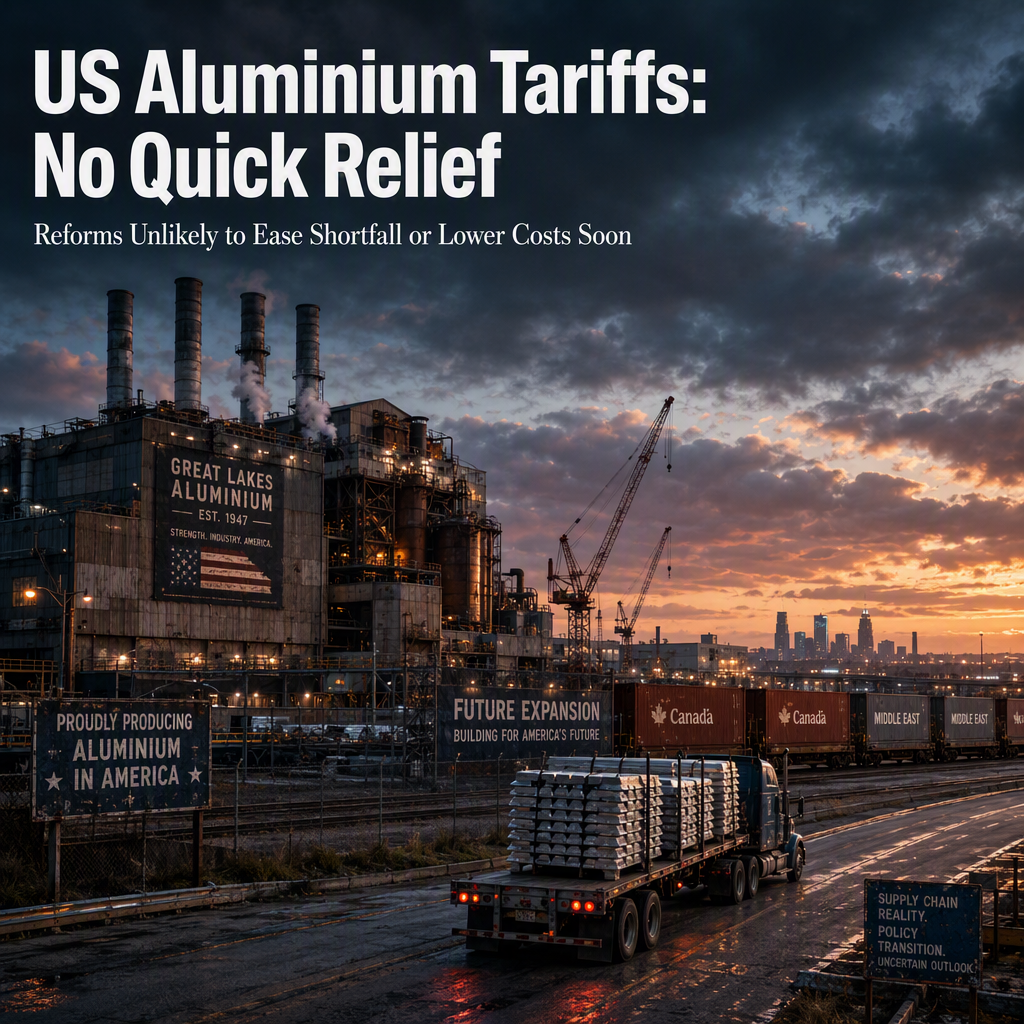
The US government has amended Section 232 aluminium tariffs in an effort to incentivize investment in domestic smelting capacity, according to ING Commodities Strategist Ewa Manthey [1]. Under the revised policy, companies that build, expand, or refurbish US smelting operations can apply to import qualifying aluminium volumes at a reduced 25% tariff, compared to the standard 50% rate, provided they meet approved investment milestones [1]. This policy shift comes after years of tariff protection failed to revive US primary aluminium output, which has steadily declined to just four operating smelters from more than 20 at the start of the century [1]. The US remains heavily reliant on imported aluminium, with Canada as the dominant supplier and Middle Eastern producers playing an increasingly important role [1].
Despite the new tariff structure, ING notes that rebuilding US smelting capacity will not happen quickly due to the need for abundant, competitively priced electricity, significant capital investment, long-term power contracts, environmental approvals, and years of construction before new production comes online [1]. As a result, the US is expected to remain dependent on imports, and the Midwest premium—a key measure of US aluminium delivery costs—is likely to stay elevated in the near to medium term [1].
ING analysts emphasize that while the amended tariffs may improve the longer-term outlook for domestic aluminium production, they are unlikely to materially reduce import dependence or procurement costs over the next several years [1]. The programme should be viewed as a long-term industrial policy rather than a near-term solution to the US aluminium supply shortfall [1]. If successful, it could gradually support a revival of US primary aluminium production [1].
CONCLUSION
The amended Section 232 tariffs are designed to encourage US aluminium smelting investment but are not expected to quickly resolve the country's supply shortfall or lower the Midwest premium. Market participants should anticipate continued import reliance and elevated delivery costs in the coming years, with any significant domestic production gains likely to materialize only in the long term.