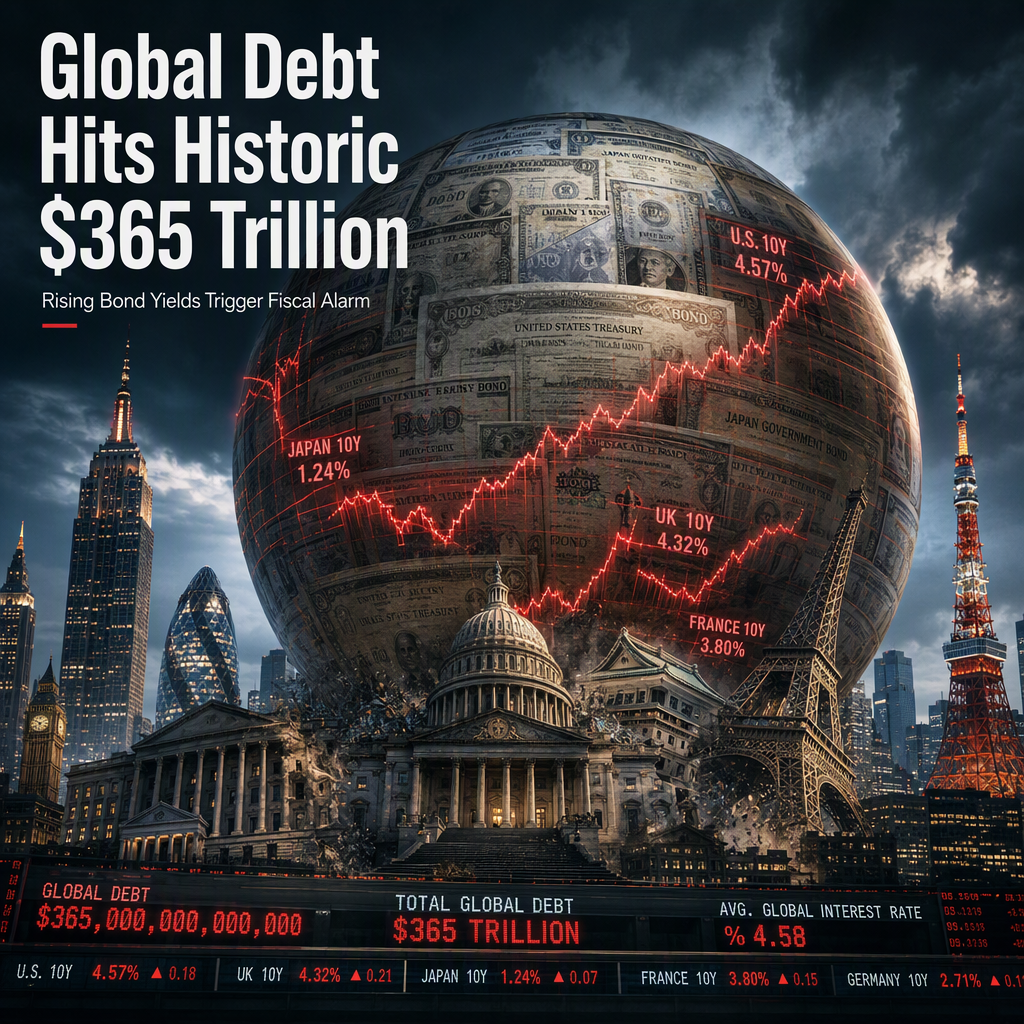
Global debt has reached a record $365 trillion, increasing by $10 trillion in the first half of the year, according to research published by the Institute of International Finance (IIF) on September 24, 2026 [1]. Economists warn that governments are caught in a 'vicious cycle' as large deficits coincide with rising interest expenses, and there is insufficient political will to address the situation [1]. The U.S., Japan, France, and the U.K. are highlighted as facing challenges typically associated with debt-distressed emerging markets, with interest payments by advanced economies surpassing global spending on AI ($2.6 trillion), defense ($3.1 trillion), or clean technology ($2.3 trillion) [1].
The IIF reported that advanced economies paid over $3.3 trillion in interest on internationally traded government bonds last year, reflecting the impact of persistently large deficits and rising interest expenses [1]. State debts are rising as yields on medium- and long-term government bonds issued by major economies hit their highest levels in more than a decade, driven by investor discomfort with rising interest rates, persistent energy cost pressures, tepid economic growth, and high fiscal spending [1].
Debt has become a political issue, creating a cycle of elections and short-term fixes that increase long-term vulnerability, as the marginal utility of higher debt diminishes [1]. The IIF warns that as benchmark rates rise, interest expenses are set to surge, while structural pressures from healthcare and public pension spending remain largely unaddressed [1].
The Organisation for Economic Co-operation and Development (OECD) emphasized the need for greater efforts to contain and reallocate government spending, improve public sector efficiency, and strengthen revenues to ensure longer-term debt sustainability and enable governments to respond to future shocks [1]. IMF chief Kristalina Georgieva stated that it is 'impossible to stress strongly enough how critical it is' to bring down debt and prioritize fiscal consolidation, warning that shocks to the global economy are 'pushing debt levels up like a staircase not to heaven' and criticizing the lack of government action [1].
CONCLUSION
Global debt has reached unprecedented levels, fueled by rising bond yields and persistent fiscal deficits in major economies. Economists and international organizations are sounding alarms about the risks and urging governments to prioritize fiscal consolidation and structural reforms. The market impact is high, with mounting debt posing significant risks to economic stability and future government responses.