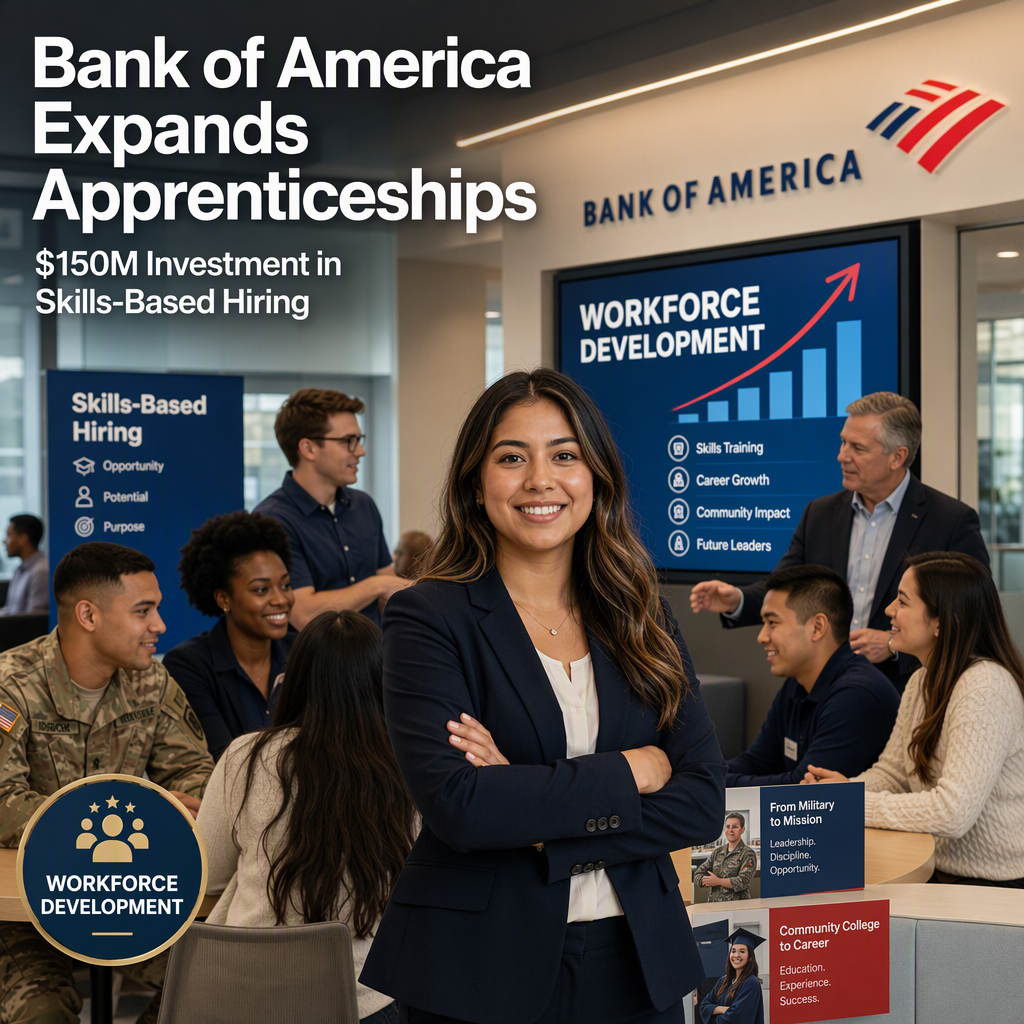
Bank of America announced an expansion of its skills-based hiring initiatives, revealing plans to hire 1,000 additional apprentices over the next two years and invest $150 million in workforce development programs [1]. The new apprenticeship positions will cover areas such as consumer banking, technology, operations, and other business sectors, supplementing the more than 800 apprentices the bank already hires annually through paid work-based learning programs [1].
Chair and CEO Brian Moynihan emphasized the company's commitment to building a skilled American workforce, stating, 'This is one more way for us to do what we can to help create a skilled American workforce for tomorrow' [1]. He also expressed appreciation for the Department of Labor's support, suggesting that such reforms could enable the private sector to expand these efforts further [1].
Bank of America highlighted that about 40% of its current hires do not possess a bachelor's degree, reflecting a broader industry trend toward skills-based hiring practices that de-emphasize college degrees [1]. In addition to the apprenticeship expansion, the bank has pledged to hire 10,000 workers with military backgrounds over five years and 8,000 individuals from community colleges [1].
The $150 million investment will be distributed over five years to workforce development organizations that provide in-demand skills and connect individuals to career opportunities. This follows nearly $40 million invested last year through partnerships with over 100 colleges and universities and more than 600 nonprofits [1]. Acting Secretary of Labor Keith Sonderling praised the initiative, stating that such programs prepare Americans for high-skilled, high-paying jobs while supporting local communities [1].
This announcement comes on the heels of Bank of America's $250 billion initiative to finance infrastructure projects and its recent plans to hire nearly 4,000 summer interns and full-time campus recruits earlier this year [1].
CONCLUSION
Bank of America's expanded apprenticeship and workforce development investments underscore its commitment to skills-based hiring and supporting the U.S. labor market. The initiatives are expected to provide more opportunities for individuals without traditional four-year degrees and strengthen the bank's talent pipeline. Market sentiment is positive, reflecting confidence in the bank's long-term workforce strategy.